Received: July 2026
DOI 10.17677/fn20714807.2026.04.01
Fluorine Notes, 2026, 167, 1-2
METHODS OF SUBSTITUTION OF HYDROGEN ATOMS IN FLUORINATED BENZENES ON CHLORINE, BROMINE AND IODINE ATOMS
P. V. Nikulshin a,b*, A. V. Sysoev b
a A. N. Nesmeyanov Institute of Organoelement Compounds, Russian Academy of Sciences, Russia, 119334 Moscow, Vavilov St., 28
e-mail: npvru@mail.ru
b N. N. Vorozhtsov Novosibirsk Institute of Organic Chemistry, Siberian Branch of the RussianAcademy of Sciences, Russia, 630090 Novosibirsk, Academician Lavrentiev av. 9
Abstract: Methods of substitution hydrogen in fluorinated benzenes with chlorine, bromine, and iodine atoms are considered.
Keywords: fluorinated benzenes, chlorination, bromination, iodination.
Nowadays the chemistry of fluorinated benzenes is important area in the chemistry of arenes. It allows to find various solutions for a number of fundamental and applied problems for the different purposes in this field. The intensive development the chemistry of fluorinated aromatic compounds in the last 65 years has made it possible to search for areas of practical using of fluorinated benzenes, for example, in medicine [1-16], agriculture [8, 9, 17, 18], liquid crystals [19-23], semiconductor materials [24-34]. Highly important "building blocks" in the chemistry of fluorinated aromatic compounds are chloro-, bromo-, and iodofluorinated benzenes.
The aim of this work is considering various methods of introducing chlorine, bromine, and iodine atoms into fluorinated benzenes by substitution of hydrogen atom.
1. Chlorination, bromination and iodination of fluorobenzene.
The most well-known method for synthesis of chloro- and bromofluorobenzenes is the interaction of fluorobenzene with chlorine and bromine or other chlorinating and brominating reagents in the presence of Lewis acids. The fluorine atom, like other halogens, has a deactivating effect in electrophilic reactions, but it is also an ortho- and para-orientant [35]. The introduction of chlorine and bromine atoms in the para- and ortho-positions of fluorobenzene (1) in the reactions under consideration can also be explained by the stabilizing effect on the carbocation center of the resonance effect of the fluorine atom (σI= 0.52, σR = -0.44 [36]). A comparison of the bromination reactions of benzene (2) and fluorobenzene 1 confirms these ideas. Thus, it is known that arene 1 reacts with bromine at room temperature [37]; with high yield (83%). Bromobenzene is obtained by reacting compound 2 with an aqueous HOBr solution at room temperature [38]. At the same time, bromination of fluorobenzene 1 with bromine was carried out in the presence of a catalyst (FeBr3) under heating. A mixture of para-bromofluorobenzene (3) (98.2%) and ortho-bromofluorobenzene (4) (1.8%) with a total yield of ~77% was obtained [39]. Chlorination of arene 1 in the presence of FeCl3 occurred at 0°C and resulted in the formation of a mixture of chloro- (5) (84%) and ortho-chlorofluorobenzene (6) (16%) with a total yield of 64% [39]. In these reactions, meta-substitution occurs by no more than 1% [39]. Optimization of the bromination reaction conditions using Fe, FeCl3, and zeolites as catalysts made it possible to obtain arene 3 with a yield of up to 98% and a purity of >99.8% [40-46]. Heating arene 2 with FeCl3 in the nickel autoclave at 119-124 °C, a mixture of compounds 5 (95%) and 6 (5%) was formed with a total yield of 74%. Increasing the temperature to 145-153°C gave an almost pure compound 5 with a yield of 80% [47]. [
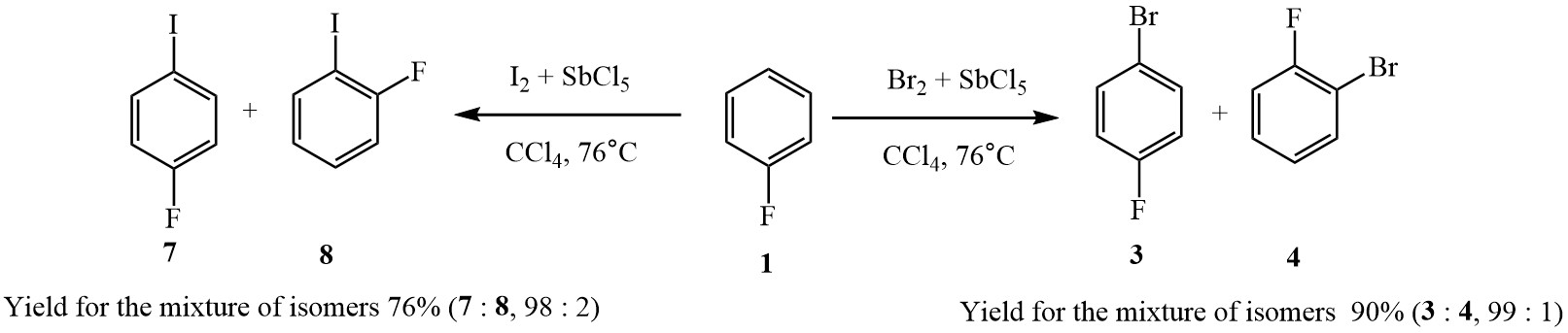
SbCl5 can be used as a catalyst for the selective bromination and iodination reaction [48], while the formation of arene 4 and 1-fluoro-2-iodobenzene (8) was observed in small amounts (Scheme 1).
Scheme 1.
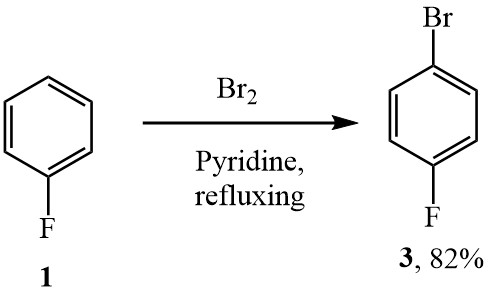
It is worth noting that the selective bromination reaction can be carried out by refluxing arene 1 with Br2 in pyridine [49] (Scheme 2).
Scheme 2.
Another approach to introducing a halogen into arene 1 is to use N-halosuccinimides in the presence of BF3 complex and water taken in ratio of ~1:1 [50] (Scheme 3).
Scheme 3.

The authors of [50] proposed a mechanism for replacing hydrogen with an atom of chlorine, bromine, and iodine. This mechanism involves the generation of halogen cations from N-halosuccinimides and a complex of BF3 and water, and the subsequent interaction of halogen cations with arene 1 (Scheme 4).
Scheme 4.

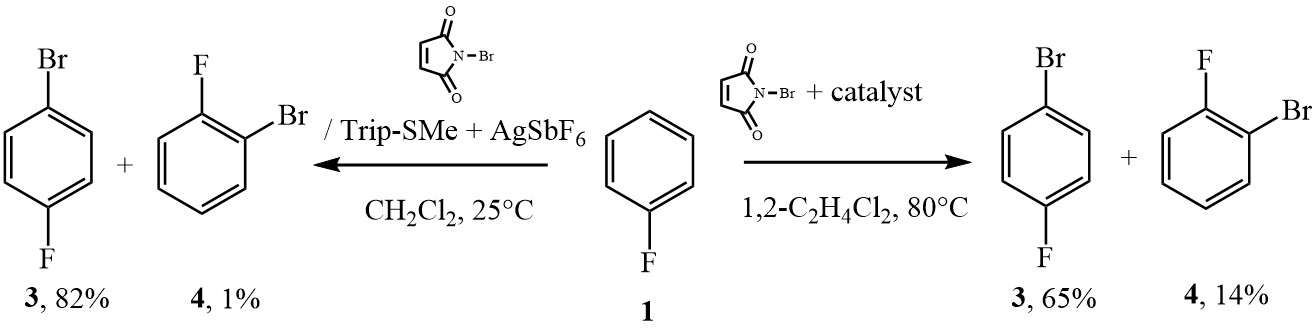
In the case of bromination with N-bromosuccinimide, the possibility of using a gold complex [51], a mixture of 9,10-dihydro-9-(methylthio)-9,10[1',2']-benzoanthracene (Trip-SMe) and AgSbF6 [52] as a catalysts was shown (Scheme 5).
Scheme 5.
During the bromination reaction in CHF2CF2SO3H, the yield of compound 3 was 92% (the ratio of compounds 3 and 4 is not given in this work) [53]. For a similar iodination reaction, a mixture of compounds 7 and 8 was obtained with a total yield of 65% [53] (Scheme 6).
Scheme 6.

Tribromo- and triiodoisocyanuric acids can be used as a source of bromine and iodine [54, 55] (Scheme 7).
Scheme 7.

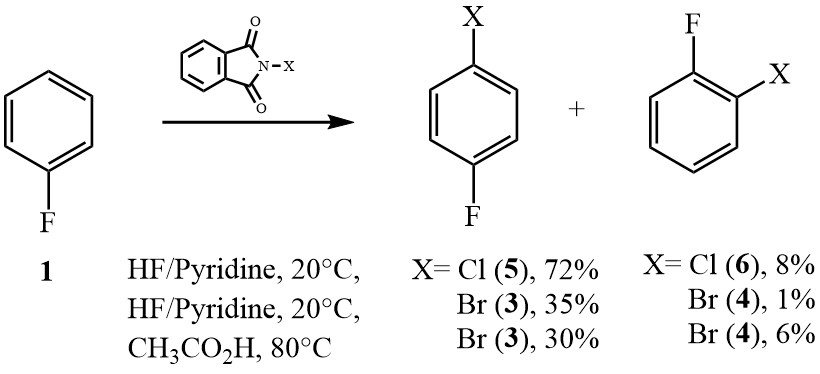
The use of N-halophthalimide as a chlorinating and brominating reagent is complicated by the significant formation of isomers [56] (Scheme 8).
Scheme 8.
Compound 5 can be obtained by heating benzene 1 with NaCl and K2S2O8 in MeCN [57] (Scheme 9).
Scheme9.

Similarly, heating fluorobenzene 1 with I2 in an acidic medium and oxidizing agents such as K2S2O8 [58], MnO2 [59, 60], NaIO4 [61, 62], HIO4 [63, 64], CH3CO3H [65] can produce arene 7 (Scheme 10).
Scheme 10.

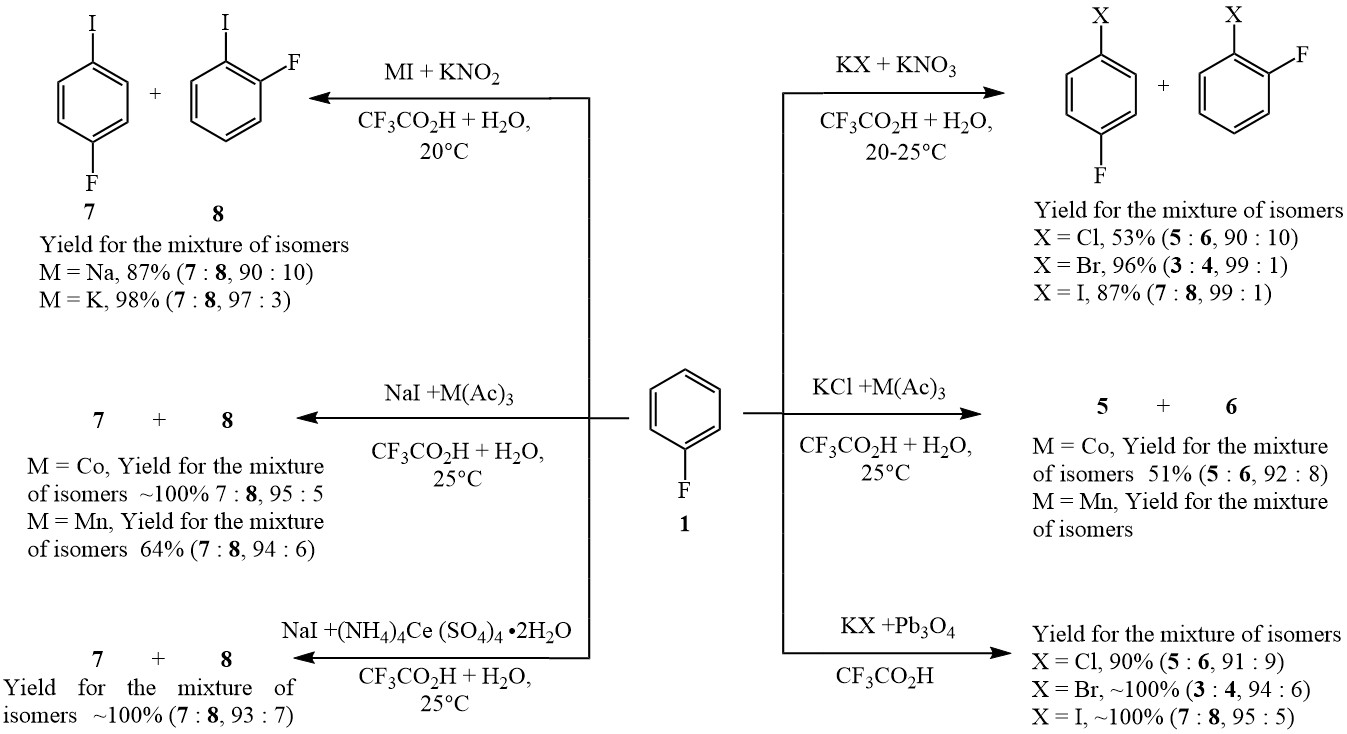
The possibility of chlorination [66], bromination [67] and iodination [68, 69] by the interaction with KCl, KBr, KI or NaI on compound 1 in the presence of NaNO3 or NaNO2 in CF3CO2H has been shown (Scheme 11). Co(III), Mn(III) acetates, and ammonium cerium (IV) sulfate can be used as oxidizing agents for the chlorination [70] and iodination [71] reactions of compound 1 (Scheme 11). Pb3O4 can also be used as an oxidizer [72] (Scheme 11).
Scheme 11.
When using H2O2 as an oxidizer, arene 3 can be obtained in high yield and purity [73] (Scheme 12).
Scheme 12.

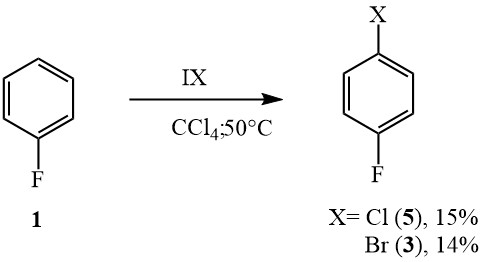
The chlorination and bromination reactions under the action of ICl and IBr has been described, however, the yields of compounds 3 (96.1% isomer content in the mixture) and 5 (91.2% isomer content in the mixture) were not high [39] (Scheme 13).
Scheme 13.
Using BrCl [74] and FI [75], was allowed to carry out the reaction of bromination and iodination of fluorobenzene 1 with good yields (Scheme 14).
Scheme 14.

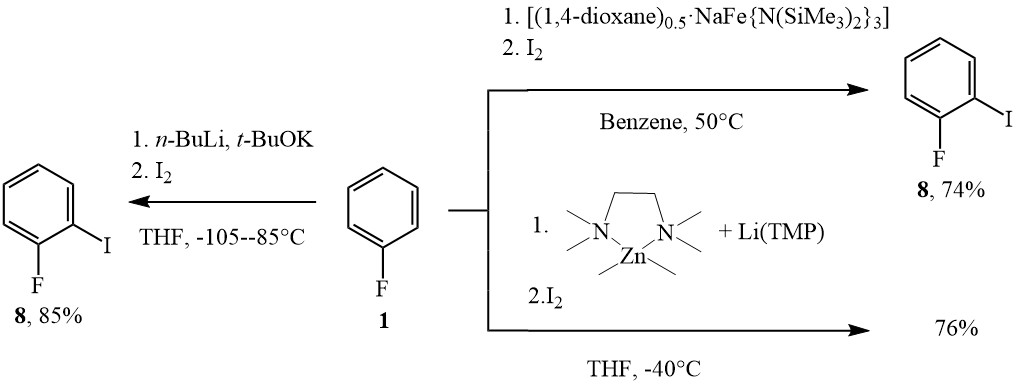
Benzene 8 can be obtained via organometallic compounds with good yields [76-78] (Scheme 15).
Scheme 15.
2. Introduction of chlorine, bromine and iodine atoms into difluorobenzenes.
The interaction 1,2-Difluorobenzene (9) with chlorine [79] in the presence of FeCl3 [80, 81] lead to yields 1-chloro-3,4-difluorobenzene (10) (Scheme 16).
Scheme 16.

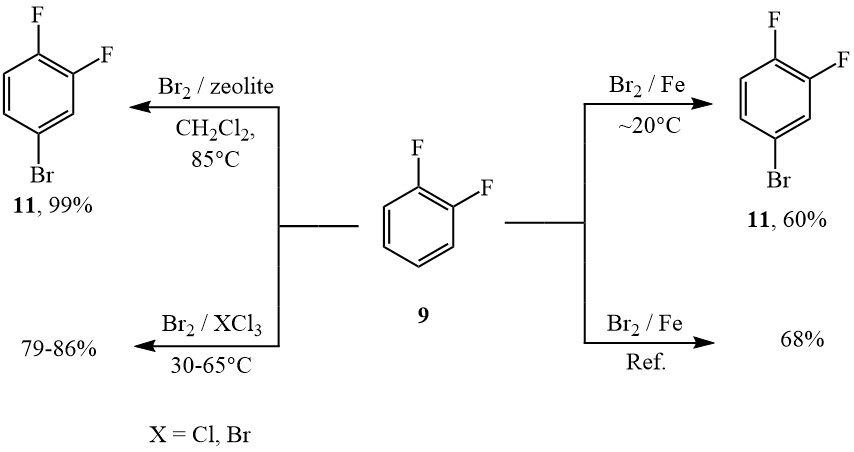
When benzene 9 reacts with bromine in the presence of iron [82, 83], zeolite [46] or XCl3 (X = Al, Fe) [81, 84], 1-bromo-3,4-difluorobenzene (11) is formed (Scheme 17).
Scheme 17.
Similarly, dichloro- and dibromo derivatives 12 and 13 can be obtained from benzene 9 for a long heating [85] (Scheme 18).
Scheme 18.

The possibility of obtaining 1,2,3,4-tetrabromo- and 1,2,3,4-tetraiododifluorobenzenes (14 and 15) from benzene 9, was shown [86, 87] (Scheme 19).
Scheme 19.

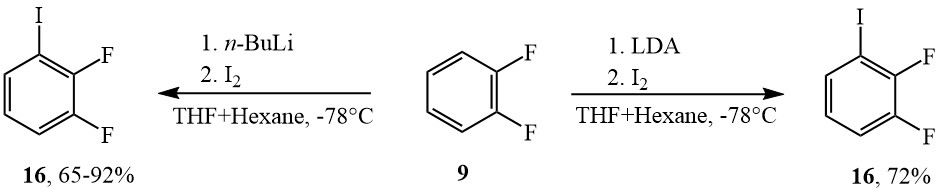
The possibility of selective iodination of benzene 9 to 1,2-difluoro-3-iodobenzene (16) [88-90] is also interesting (Scheme 20).
Scheme 20.
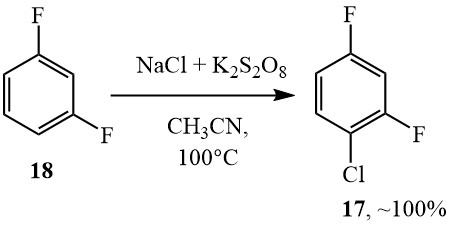
1-Chloro-2,4-difluorobenzene (17) can be obtained by heating 1,3-difluorobenzene (18) with NaCl and K2S2O8 in MeCN [57] (Scheme 21).
Scheme 21.

Arene 18 can be easily brominated to 1-bromo-2,4-difluorobenzene (19) with good yield [46, 91] (Scheme 22).
Scheme 22.
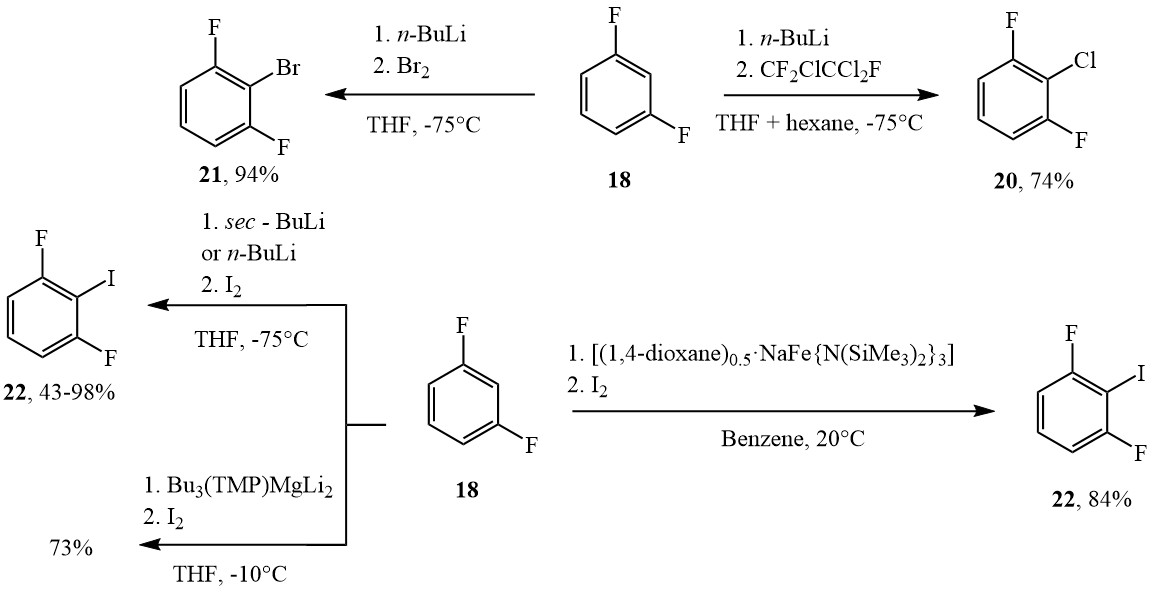
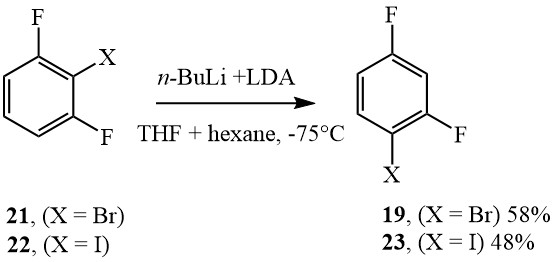
1-Chloro-2,6-difluorobenzene (20), 1-bromo-2,6-difluorobenzene (21), and 1,3-difluoro-2-iodobenzene (22) can be obtained from compound 18 and n-BuLi (sec-BuLi) with subsequent treatment with 1,1,2-trifluoro-1,2,2-trichloroethylene [92], bromine [93] or iodine [94-99] (Scheme 36). Benzene 22 can also be obtained using other organometallic compounds [77, 100] (Scheme 23).
Scheme 23.
The possibility of isomerization of benzenes 21 into 19 [23], 22 and 1,3-difluoro-4-iodobenzene (23) [94] is also interesting (Scheme 24).
Scheme 24.
It is worth noting that the interaction of compound 17 with N-chlorosuccinimide leads to 1,3-dichloro-2,4-difluorobenzene (24) [101, 102], and benzene 19 with bromine to 1,3-dibromo-2,4-difluorobenzene (25) [101, 103] Scheme 25).
Scheme 25.

The possibility of exhaustive bromination of 1,2,3,5-tetrabromo-4,6-difluorobenzene (26) also has been shown for benzene 19 [104] (Scheme 26).
Scheme 26.

Exhaustive chlorination and iodination of arene 18 was carried out using trichloroisocyanuric acid [105] or K2S2O8 +I2 [91] (Scheme 27).
Scheme 27.

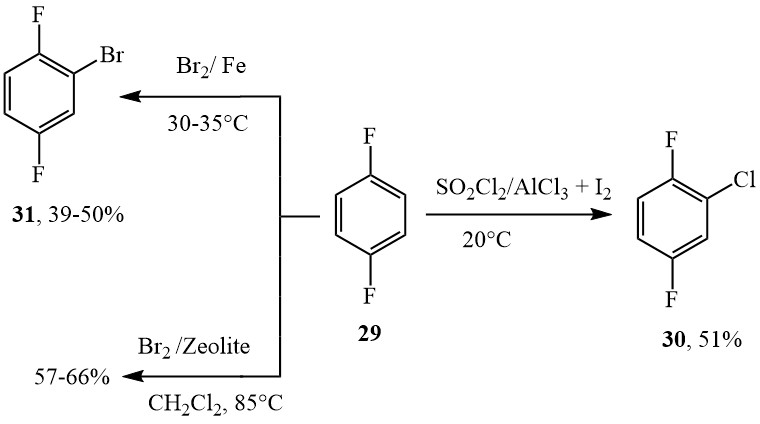
Reaction of 1,4-difluorobenzene (29) with SO2Cl2 [106]in the presence of AlCl3 and I2 yields 1,4-difluoro-5-chlorobenzene (30), and with Br2 and Fe [107, 108] or Br2 with the addition of zeolites [44, 46] yields 1-bromo 2,4-difluorobenzene (31) (Scheme 28).
Scheme 28.
Chlorination [54], bromination [54, 109] and iodination [54, 110, 111] of compound 29 can also be performed using N-halosuccinimides (Scheme 29).
Scheme 29.

For arene 29, chlorination [105], bromination [112] (yield not given), and iodination [87] to tetrachloro-, tetrabromo- and tetraiododifluorobenzenes are possible (Scheme 30).
Scheme 30.

3. Chlorination, bromination and iodination of trifluorobenzenes.
1-Bromo-3,4,5-tetrafluorobenzene (36) can be obtained by reacting 1,2,3-trifluorobenzene (37) with NaBr in the presence of NaClO and NaH2PO4 with high yield [113] (Scheme 31).
Scheme 31.

Bromination [114] and iodination [115-116] in the position 4 of benzene 37 can proceed selectively through an organolithium derivative with good yields (Scheme 32).
Scheme32.

For benzene 37, the possibility of exhaustive bromination to 1,2,3-tribromo-4,5,6-trifluorobenzene (40) was shown [21] (Scheme 33).
Scheme 33.

The bromination of 1,2,4-trifluorobenzene (41) Br2 to 1-bromo-2,4,5-trifluorobenzene (42) with the addition of [117-122], SnCl4 [123], AlCl3 + SnCl4 [124] ascatalysts was described (Scheme 34).
Scheme 34.

The exhaustive bromination of benzene 41 by the action of Br2 in the presence of Al [125] was shown (Scheme 65). Arene 43 also can be obtained by the interaction benzene 41 with N-bromosuccinimide [21] (Scheme 35).
Scheme 35.

The possibility of selective iodination at the third [77] or fifth position [111] of the aromatic ring has been shown for benzene 41 (Scheme 36).
Scheme 36.

It was shown when 1,3,5-trifluorobenzene (46) Cl2 is chlorinated in the presence of Fe at the room temperature, 1,3,5-trifluoro-4-chlorobenzene (47) is formed as the main product [126]. When the mixture of SO2Cl2 and ClSO3H acts on compound 46 in the presence of AlCl3, mainly 1,3,5-trifluoro-2,4-dichlorobenzene (48) and a small amount of 1,3,5-trifluoro-2,4,6-trichlorobenzene (49) are formed (Scheme 37).
Scheme 37.

The ratio of compounds 48 and 49 is not given [126].
Arene 49 can be obtained by chlorination of benzene 46 with trichloroisocyanuric acid [105] (Scheme 38).
Scheme 38.

Bromination of arene 46 to 1-bromo-2,4,6-trifluorobenzene (50) can be carried out using Br2 in the presence of FeCl3 [127-130], or N-bromosuccinimide [131] (Scheme 39).
Scheme 39.

1,3,5-Tribromo-2,4,6-trifluorobenzene (51) can be obtained by heating benzene 46 with 1,3-dibromo-5,5-dimethylhydantoin [132] or N-bromosuccinimide [21] (Scheme 40).
Scheme 40.

Iodination of benzene 46 using organometallic compounds leads to 1,3,5-trifluoro-2-iodobenzene (52) [77, 115, 133, 134] (Scheme 41).
Scheme 41.
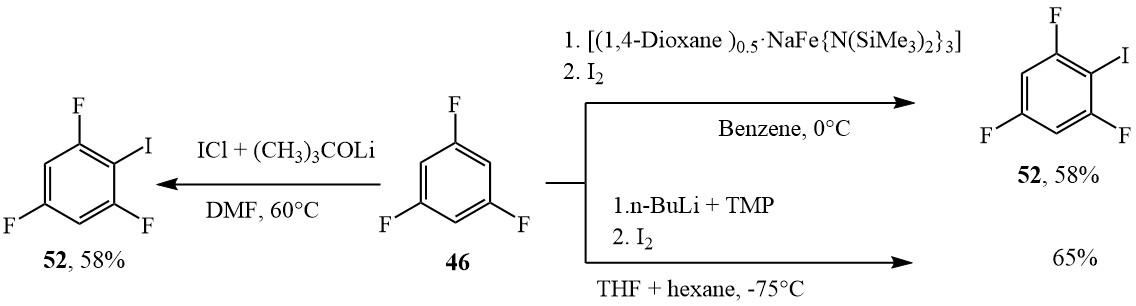
1,3-Diiodo-2,4,6-trifluorobenzene (53) was synthesized from compounds 46 [134] and 52 [77] (Scheme 42).
Scheme 42.

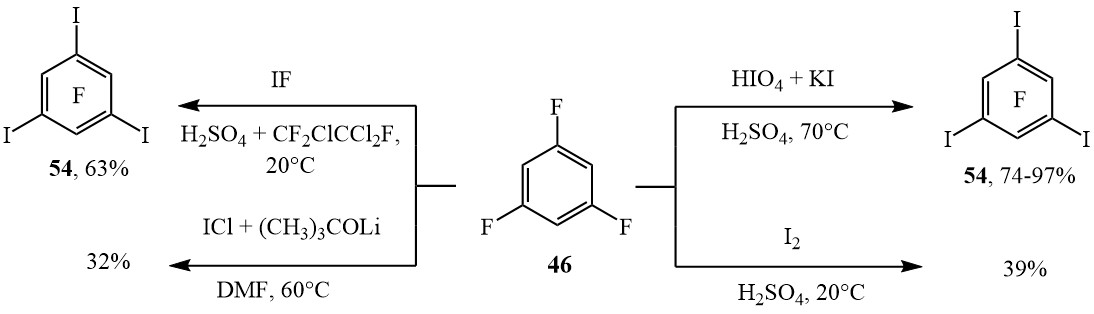
1,3,5-Triiodo-2,4,6-trifluorobenzene (54) was obtained by heating arene 46 in concentrated H2SO4 with HIO4 and KI [135-141, by reaction benzene 46 with I2 or IF in concentrated H2SO4 [142], or by heating with ICl and (CH3)3COLi in DMF [115, 133] (Scheme 43).
Scheme 43.
4. Chlorination, bromination and iodination of tetrafluorobenzenes.
Increasing the number of fluorine atoms in the benzene ring to four leads to the fact that reactions of replacing a hydrogen atom with a halogen usally occur under rather harsh conditions.
Chlorination of 1,2,3,4-tetrafluorobenzene (55) with Cl2 in the presence of AlCl3 leads to a monochlorine derivative [143] (Scheme 44).
Scheme 44.

1-Bromo-2,3,4,5-tetrafluorobenzene (57) was synthesized from benzene 55 and Br2 in 20% oleum in the presence of AlBr3 at 0°C [144, 145], and 1,2 dibromotetrafluorobenzene (58) was synthesized upon heating [146] (Scheme 45).
Scheme 45.

1,2,3,4-Tetrafluoro-5-iodobenzene (59) can be obtained from benzene 55 and I2 in 20% oleum [144] (Scheme 46).
Scheme 46.

can be carried out by the interaction of the latter with IF [142], HIO4 [147] and KIO4 + KI [148] (Scheme 47).
Scheme47.

1-Bromo-2,3,4,6-tetrafluorobenzene (61) and 1,3,5,6-tetrafluoro-2-iodobenzene (62) can be synthesized via organolithium derivative of 1,2,3,5-tetrafluorobenzene (63) [149, 150] (Scheme 48).
Scheme 48.
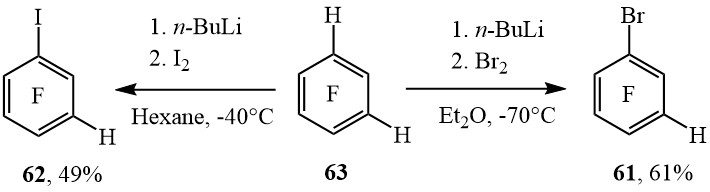
Benzene 63 under the action of bromine in 20% oleum in the presence of AlBr3 at 0°C gives 1,3-dibromotetrafluorobenzene (64) [144] (Scheme 49).
Scheme 49.

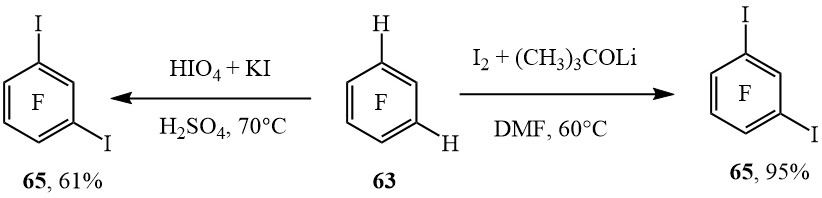
The iodination of compound 63 to 1,3-diiodo-2,4,5,6-tetrafluorobenzene (65) can be carried out by heating with iodine in the presence of (CH3)3COLi in DMF [133], or by heating with mixture of HIO4 and KI in H2SO4 [151, 152] (Scheme 50).
Scheme 50.
In studying the reactions of chlorination, bromination, and iodination of 1,2,4,5-tetrafluorobenzene (66), it was found that only bromination and iodination of this compound could be achieved. Thus, in work [153], an unsuccessful attempt was made to chlorinate benzene 66 using SO2Cl2 in 65% oleum upon heating (Scheme 51).
Scheme 51.

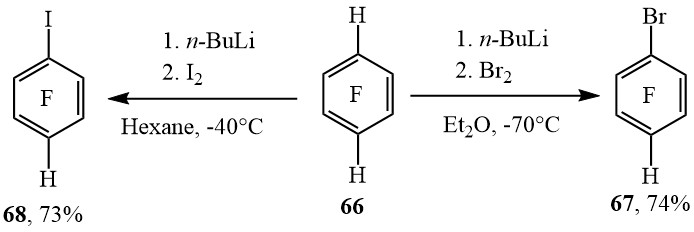
1-Bromo-2,3,5,6-tetrafluorobenzene (67) and 1-iodio-2,3,5,6-tetrafluorobenzene (68) can be obtained via organolithium derivative from benzene 66 [149, 150] (Scheme 52).
Scheme 52.
When bromine acts on tetrafluorobenzene 66 in 60% oleum in the presence of AlBr3, 1,4 dibromotetrafluorobenzene (69) is formed upon heating [154] (Scheme 53).
Scheme 53.

1,4-Diiodotetrafluorobenzene (70) can be obtained from arene 66 via organometallic compounds [77, 115] (Scheme 54).
Scheme 54.
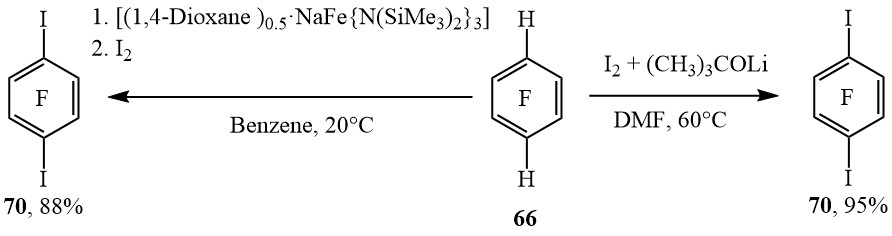
Another approach to the synthesis of arene 70 may involve the interaction of benzene 66 with I2, fuming H2SO4 [155] or oleum [153], in concentrated H2SO4 with HIO4 and KI [140], or with IF in concentrated H2SO4 [142] (Scheme 55).
Scheme 55.

5. Synthesis of chloropentafluorobenzene, bromopentafluorobenzene and iodopentafluorobenzene from pentafluorobenzene.
The substitution of a hydrogen atom for chlorine in pentafluorobenzene (71) by the action of Cl2 in the presence of SbF5 in ClSO2F [156] has been demonstrated (Scheme 55). HCl or NaCl [157], as well as ClOSO2F [158] can be used as chlorine sources (Scheme 55). The hydrogen atom was also replaced by chlorine in compound 71 by the action of difluorochloronium cation salts in the presence of SbF5 or BF3 in ClSO2F, resulting in the production of pentafluorochlorobenzene (72) [159] (Scheme 56). However, these reactions are complicated by the formation of polyfluorinated cyclohexadiene derivatives [159]. The chlorination reaction of arene 71 can be catalyzed by FeCl3 [160] (Scheme 56).
Scheme 56.

Chlorination of arene 71 can also be carried out using N-chlorosuccinimide [50], CCl4 [161], trichloroisocyanuric acid [105], hexachloromelamine [105],1,3-dichloro-5,5-dimethylhydantoin [105] (Scheme 57).
Scheme 57.

Similarly to the chlorination reaction in the presence of SbF5 or BF3 in ClSO2F, shown in Scheme 57, the hydrogen atom was replaced by bromine in compound 71 [159] (Scheme 58). Brompentafluorobenzene (72) can be obtained by the action of bromine in 20% oleum in the presence of AlBr3 [162] or bromine in the presence of AlCl3 [163, 164] (Scheme 58). BrCl [165], N,N,N′,N′-tetrabromobenzene-1,3-disulfonamide [166], tribromisocyanuric acid [167], or N-bromosuccinimide [50] can be used as bromine sources (Scheme 58).
Scheme 58.

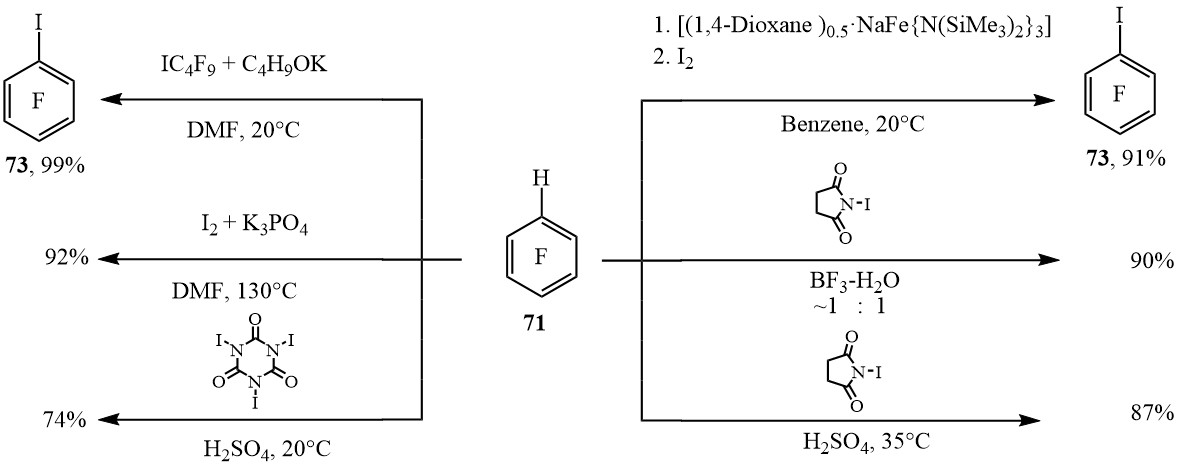
The iodination of arene 71 can be carried out using IC4F9 [168], complex of [(1,4 dioxane)0.5NaFe{N(SiMe3)2}3] and I2 [77], N-iodosuccinimide [50, 169], I2 and K3PO4 [115, 133], 1,3,5-triiodo-1,3,5-triazine-2,4,6-trione [167](Scheme 59).
Scheme 59.
Acknowledgements
This work was supported by the Ministry of Science and Higher Education of the Russian Federation (Contract No. 075-03-2026-024 and 075-00365-26-00).
References
1. M. Salwiczek, E. K. Nyakatura, U. I. M. Gerling, S. Ye, B. Koksch. Fluorinated amino acids: compatibility with native protein structures and effects on protein−protein interactions, Chem. Soc. Rev., 2012, 41, 2135−2171. DOI: 10.1039/c1cs15241f.
2. Zhou, J. Wang, Z. Gu, S. Wang, W. Zhu, J.L. Acena, V. A. Soloshonok, K. Izawa, H. Liu. Next generation of fluorine-containing pharmaceuticals, compounds currently in phase II−III clinical trials of major pharmaceutical companies: new structural trends and therapeutic areas, Chem. Rev., 2016, 116, 422–518. DOI: 10.1021/acs.chemrev.5b00392.
3. D. E. Yerien, S. Bonesi, A. Postigo. Fluorination methods in drug discovery, Org. Biomol. Chem., 2016, 14, 8398–8427. DOI: 10.1039/c6ob00764c.
4. J. Wang, M. Sanchez-Rosello, J. L. Acena, C. del Pozo, A. E. Sorochinsky, S. Fustero, V. A. Soloshonok, H. Liu. Chem. Rev., 2014, 114, 2432–2506. DOI: 10.1021/cr4002879
5. B. M. Johnson, Y.-Z. Shu, X. Zhuo, N. Meanwell. Metabolic and pharmaceutical aspects of fluorinated compounds, J. Med. Chem., 2020, 63, 6315−6386. DOI: 10.1021/acs.jmedchem.9b01877.
6. T. V. Bright, F. Dalton, V. L. Elder, C. D. Murphy, N. K. O’Connora, G. Sandford. A convenient chemical-microbial method for developing fluorinated pharmaceuticals, Org. Biomol. Chem., 2013, 11, 1135−1142. DOI: 10.1039/c2ob27140k.
7. M. Morgenthaler, J. D. Aebi, F. Gruninger, D. Mona, B. Wagner, M. Kansy, F. Diederich. A fluorine scan of non-peptidic inhibitors of neprilysin: fluorophobic and fluorophilic regions in an enzyme active site, J. Fluor. Chem., 2008, 129, 852−865. DOI: 10.1016/j.jfluchem.2008.02.004.
8. A. Harsanyi, G. Sandford.Organofluorine chemistry: applications, sources and sustainability, Green Chem., 2015, 17, 2081−2086.DOI: 10.1039/c4gc02166e.
9. Jeschke. The unique role of fluorine in the design of active ingredients for modern crop protection, ChemBioChem., 2004, (5), 570–589. DOI: 10.1002/cbic.200300833.
10. S. Purser, P. R. Moore, S. Swallow, V. Gouverneur,Fluorine in medicinal chemistry, Chem. Soc. Rev.,2008, 37(2), P. 320–330. DOI: 10.1039/b610213c.
11. A. F. Brooks, J. J. Topczewski, N. Ichiishi, M. S. Sanford, P. J. H. Scott.Late-stage [18F] fluorination: new solutions to old problems, Chem. Sci., 2014, 5, 4545−4553. DOI: 10.1039/c4sc02099e.
12. E. P. Gillis, K. J. Eastman, M. D. Hill, D. J. Donnelly, N. A. Meanwell.Applications of fluorine in medicinal chemistry, J. Med. Chem. 2015, 58, 8315−8359.DOI: 10.1021/acs.jmedchem.5b00258.
13. W. K. Hagmann. The many roles for fluorine in medicinal chemistry, J. Med. Chem., 2008, 51, 4359−4369. DOI: 10.1021/jm800219f.
14. N. A. Meanwell. Fluorine and fluorinated motifs in the design and application of bioisosteres for drug design, J. Med. Chem., 2018, 61, 5822−5880. DOI: 10.1021/acs.jmedchem.7b01788.
15. Ed. R. Filler, Y. Kobayashi., L. M. Yagupolskii, Organofluorine Compounds in Medicinal Chemistry and Biomedical Applications, Elsevier, Amsterdam-London-New York-Tokyo, 1993, 386 pp.
16. J.-P. Bégué, D. Bonnet-Delpon, Bioorganic and Medicinal Chemistry of Fluorine. Hoboken, John Wiley & Sons, Inc., New Jersey, 2008, 384 pp.
17. N. N. Melnikov, K. V. Novozhilov, S. R. Belan, Pesticides and plant growth regulators: Handbook, Chemistry, Moscow, 1995, 352 pp. (In Russian).
18. Ed. M. Hudlický, A. E. Pavlath, Chemistry of Organic Fluorine Compounds II: a Critical Review, American Chemical Society, Washington, DC, 1995, 1296 pp.
19. P. Kirsch, W. Binder, A. Hahn, K. Jährling, M. Lenges, L. Lietzau, R. Fröhlich.Super-fluorinated liquid crystals: towards the limits of polarity, Eur. J. Org. Chem., 2008, P. 3479−3487. DOI: 10.1002/ejoc.200800149.
20. B. Jin, K. Sano, S. Aya, Y. Ishida, N. Gianneschi, Y. Luo, X. Li. One-pot universal initiation-growth methods from a liquid crystalline block copolymer, Nat. Commun., 2019, 10, 1-8. DOI: 10.1038/s41467-019-10341-7.
21. A. M. Kenwright, G. Sandford, A. J. Tadeusiak, D. S. Yufit, J. A. K. Howard, P. Kilickiran, G. Nelles.Strategies for the synthesis of fluorinated liquid crystal derivatives from perbromofluoroaromatic systems,Tetrahedron, 2010, 66(52), 9819 – 9827. DOI: 10.1016/j.tet.2010.10.069.
22. D. Demus, J. Goodby, G. W. Gray, H. W. Spiess, Handbook of Liquid Crystals. Wiley-VCH: Weinheim, 1998, 556 pp.
23. J. H. Clark, D. Wails, T. W. Bastock, Aromatic Fluorination. London: Boca Raton, CRC Press, 1996, 196 pp.
24. D. Matsuo, X. Yang, A. Hamada, K. Morimoto, T. Kato, M. Yahiro, J. Otera. Fluoro-substituted Phenyleneethynylenes: Acetylenic n-Type Organic Semiconductors,Chem. Lett. 2010, 39(12), 1300–1302. DOI: 10.1246/cl.2010.1300.
25. B. Hu, Y. Wang, X. Chen, Z. Zhao, Z. Jiang, P. Lu, Y. Wang. Synthesis and photophysical properties of tetrafluorophenyl-modified carbazole oligomers. Tetrahedron, 2010, 66(38), P. 7583–7589. DOI: 10.1016/j.tet.2010.07.040.
26. F. Babudri, G. M. Farinola, F. Naso, R. Ragni.Fluorinated organic materials for electronic and optoelectronic applications: the role of the fluorine atom, Chem. Commun. – 2007, 1003−1022. DOI: 10.1039/b611336b.
27. D. J. Crouch, P. J. Skabara, J. E. Lohr, J. J. W. McDouall, M. Heeney, I. McCulloch, M. B. Hursthouse.Thiophene and selenophene copolymers incorporating fluorinated phenylene units in the main chain: synthesis, characterization, and application in organic field-effect transistors, Chem. Mater., 2005, 17, 6567−6578.DOI: 10.1021/cm051563i.
28. C. R. Swartz, S. R. Parkin, J. E. Bullock, J. E. Anthony, A. C. Mayer, G. G. Malliaras.Synthesis and characterization of electron-deficient pentacenes, Org. Lett., 2005, 7, 3163−3166. DOI: 10.1021/ol050872b.
29. Y. Sakamoto, T. Suzuki, A. Miura, H. Fujikawa, S. Tokito, Y. Taga. Synthesis, Characterization, and Electron-Transport Property of Perfluorinated Phenylene Dendrimers,J. Am. Chem. Soc., 2000, 122(8), 1832–1833. DOI: 10.1021/ja994083z.
30. S. B. Heidenhain, Y. Sakamoto, T. Suzuki, A. Miura, H. Fujikawa, T. Mori, Y. Taga. Perfluorinated Oligo(p-Phenylene)s: Efficient n-Type Semiconductors for Organic Light-Emitting Diodes.J. Am. Chem. Soc., 2000, 122(41), 10240–10241.DOI: 10.1021/ja002309o.
31. A. Facchetti, M.-H. Yoon, C. L. Stern, H. E. Katz, T. J. Marks. Building Blocks for n-Type Organic Electronics: Regiochemically Modulated Inversion of Majority Carrier Sign in Perfluoroarene-Modified Polythiophene Semiconductors,Angew. Chem. Int. Ed., 2003, 42(33), P. 3900–3903. DOI: 10.1002/anie.200351253.
32. D. Sainova, S. Janietz, U. Asawapirom, L. Romaner, E. Zojer, N. Koch, A. Vollmer. Improving the Stability of Polymer FETs by Introducing Fixed Acceptor Units into the Main Chain: Application to Poly(alkylthiophenes),Chem. Mater., 2007, 19(6), 1472–1481.DOI: 10.1021/cm061571e.
33. K. Geramita, J. McBee, T. D. Tilley. 2,7-Substituted hexafluoroheterofluorenes as potential building blocks for electron transporting materials, J. Org. Chem., 2009, 74, 820–829. DOI: 10.1021/jo802171t.
34. Y. Wang, S. R. Parkin, J. Gierschner, M. D. Watson, Highly fluorinated benzobisbenzothiophenes, Org. Lett., 2008, 10, 3307–3310. DOI: 10.1021/ol8003468.
35. O. A. Reutov, A. L. Kurts, K. P. Butin, Organic Chemistry: in 4 parts, BINOM, Moscow, 2007, part 2, 418 (in Russian)
36. W. A. Sheppard, C.M. Sharts, Organic fluorine chemistry, W. A. Benjamin, INC., New York, 1969.
37. J. Schramm. Ueber den Einfluss des Lihtes auf den Varlauf chemischer Reaktionen bei der Einwirkung der Halogene auf aromatische Verbindungen, Ber., 1885, 18, 606-609.
38. I. Guben Methods of Organic Chemistry, ONTI, 3(3), 1935, 407 (In Russian).
39. G. Olah, A. Parlath, G. Varsanyi.The Preparation and Examination of Organic Fluorine Compounds. Part XXIV. The Halogenation of Fluoobenzene, J. Chem. Soc., 1957, 1823-1829. DOI: 10.1039/JR9570001823.
40. Pat EP761627 (1997), Preparation of p-bromofluorobenzene.
41. Pat CN1810745 (2006), Process for preparation of 4-bromofluorobenzene
42. M. Del Pilar Crespo, T. D. Avery, E. Hanssen, E. Fox, T. V. Robinson, P. Valente, L. Tilley. Artemisinin and a Series of Novel Endoperoxide Antimalarials Exert Early Effects on Digestive Vacuole Morphology,Antimicrob. Agents Chemother, 2007, 52(1), 98–109. DOI: 10.1128/aac.00609-07.
43. Pat WO9950206 (1999), Selective bromination of aromatic compounds.
44. Pat. WO2013081034 (2013), Halogenation catalyst and method for producing same.
45. K. Smith, G. A. El-Hiti, M. E. W. Hammond, D. Bahzad, Z. Li, C. Siquet. Highly efficient and selective electrophilic and free radical catalytic bromination reactions of simple aromatic compounds in the presence of reusable zeolites,J.C.S. Perkin Trans. I., 2000, 16, 2745–2752. DOI: 10.1039/b002157l.
46. Y. Nishina, K. Takami. Bromination of aromatic compounds using an Fe2O3/zeolite catalyst., Green Chem., 2012, 14(9), P. 2380-2383. DOI: 10.1039/c2gc35821b.
47. P. Kovacic, N. O. Brace. Chlorination of Aromatic Compounds with Metal Chlorides.,J. Am. Chem. Soc., 1954, 76(21), 5491–5494. DOI: 10.1021/ja01650a069.
48. S. Uemura, A. Onoe, M. Okano, Aromatic Bromination and Iodination with Mixtures of Antimony (V) Chloride and Halogens, Bull. Chem. Soc. Jpn., 1974, 47(1), 147–150. DOI: 10.1246/bcsj.47.147.
49. Pat. CN103012026 (2013), Bromination reaction method.
50. S. G. K. Prakash., T. Mathew, D. Hoole, P. M. Esteves, Q. Wang, G. Rasul, G. A. Olah, N-Halosuccinimide/BF3-H2O Efficient Electrophilic Halogenating System for Aromatics, J. Am. Chem. Soc. 2004, 126(48), 15770-15776. DOI: 10.1021/ja0465247.
51. A. Pourjavadi, N. Keshavarzi, S. H. Hosseini, F. M. Moghaddam, Gold-Decorated 3D 2,6-Diaminopyridine Network: A Robust Catalyst for the Bromination of Aromatic Compound,Ind. Eng. Chem. Res., 2018, 57(37.), 12314-12322. DOI: 10.1021/acs.iecr.8b01179.
52. Y. Nishii, M. Ikeda, Y. Hayashi, S. Kawauchi, M. Miura, Triptycenyl Sulfide: A Practical and Active Catalyst for Electrophilic Aromatic Halogenation using N-Halosuccinimides, J. Am. Chem. Soc., 2019, 141(13), 5130–5134. DOI: 10.1021/jacs.9b12672.
53. G. K. S. Prakash, T. Mathew, C. Panja, A. Kulkarni, G. A. Olah, M. A. Harmer,Tetraflic Acid (1,1,2,2-Tetrafluoroethanesulfonic Acid, HC2F4SO3H) and Gallium Tetraflate as Effective Catalysts in Organic Synthesis, Adv. Synth. Catal.,2012,354(11-12), 2163–2171. DOI: 10.1002/adsc.201200111.
54. M. de Mattos, P. Esteves, L. de Almeida, Tribromoisocyanuric Acid in Trifluoroacetic Acid: An Efficient System for Smooth Brominating of Moderately Deactivated Arenes, Synlett. 2013, 24(5), 603–606. DOI: 10.1055/s-0032-1317795.
55. . Esteves, M. de Mattos, R. da Ribeiro,Superelectrophilic Iodination of Deactivated Arenes with Triiodoisocyanuric Acid, Synthesis, 2011, (5), 739–744. DOI: 10.1055/s-0030-1258429.
56. I. Možek, B. Šket. Chlorination and Bromination of Aromatic Molecules by an N-Halosaccharin / Pyridinium Poly(Hydrogen Fluoride) System, Synth. Commun., 1992, 22(17), 2513–2520. DOI: 10.1080/00397919208021647.
57. L. Gu, T. Lu, M. Zhang, L. Tou, Y. Zhang. Efficient Oxidative Chlorination of Aromatics on Saturated Sodium Chloride Solution, Adv. Synth. Catal., 2013, 355(6), 1077 – 1082.DOI: 10.1002/adsc.201300062
58. T. Kitamura, M. Hossain, J. Oyamada, Direct Synthesis of Iodoarenes from Aromatic Substrates Using Molecular –Iodine, Synthesis, 2008, (5), 690–692. DOI: 10.1055/s-2008-1032165.
59. P. Lulinski, B. Krassowska-Swiebocka, L. Skulski,Chemical Manganese Dioxide (CMD): lts Application to the Oxidative Iodination of Benzene, Halobenzenes and Some Deactivated Arenes, Molecules, 2004, 9(7) P. 595–601. DOI: 10.3390/90700595.
60. P. Lulinski, L. Skulski,Oxidative Iodination of Arenes with Manganese (IV) Oxide or Potassium Permanganate as the Oxidants, Bull. Chem. Soc. Jpn., 1999, 72(1), 115–120. DOI: 10.1246/bcsj.72.115.
61. Pat. CN104892528 (2015), Method for preparing 2-thiobarbituric acid derivative
62. P. Lulinski, L. Skulski, Iodination of Both Deactivated and Activated Arenes with Sodium Periodate or Sodium Iodate as the Oxidants, Bull. Chem. Soc. Jpn., 2000, 73(4), P. 951–956. DOI: 10.1246/bcsj.73.951.
63. Pat. WO2004069772 (2004), Process for preparation of iodine compounds and production of high-purity 5-iodo-2-methylbenzoic acid.
64. Pat. JP4332702 (2009), Process for preparation of iodo compounds.
65. Y., Ogata, I. Urasaki, Iodination of Acenaphthene and Fluorene with Iodine–Peracetic Acid, J. Chem. Soc. C., 1970, 12, 1689-1691. DOI: 10.1039/j39700001689.
66. D. I. Makhonkov, A.V. Cheprakov, M. A. Rodkin, I. P. Beletskaya, Oxidative chlorination of aromatic compounds in the presence of nitrogen-containing compounds,Zh. Org. Khim. (Russ. J. Org. Chem.),1988, 24(2), 241-248.
67. A.V. Cheprakov, D. I. Makhonkov, M. A. Rodkin, I. P. Beletskaya, Catalytic and stoichiometric bromination of aromatic compounds in aqueous trifluoroacetic acid in the presence of nitrogenous oxidants,Zh. Org. Khim. (Russ. J. Org. Chem.),1988, 24(2), 248-255.
68. G. Stavber, J. Iskra, M. Zupan, S. Stavber, Oxidative Iodination of Organic Compounds with Iodide Catalyzed by Sodium Nitrite,Adv. Synth. Catal., 2008, 350(18), 2921–2929. DOI: 10.1002/adsc.200800553.
69. A.V. Cheprakov, D. I. Makhonkov, I. P. Beletskaya, Stoichiometric and catalitic oxidative iodination in the presence of nitrogenous oxidants in aqueous trifluoroacetic acid,Zh. Org. Khim. (Russ. J. Org. Chem.), 1988, 24(11), 2251-2258.
70. D. I. Makhonkov, A.V. Cheprakov, I. P. Beletskaya, Oxidation by metal salts V*. Oxidative halogenation of benzene and halobenzenes with acetates of Co (III) and Mn (III) trifluoroacetic acid and its aqueous solutions,Zh. Org. Khim. (Russ. J. Org. Chem.),1986, 22(4), 681-688.
71. D. I. Makhonkov, A.V. Cheprakov, M. A. Rodkin, I. P. Beletskaya, Oxidation by salts of metals VI*. Oxidative iodination of aromatic substrates promoted by compounds Co (III), Mn (III) and Ce (IV) in aqueous trifluoroacetic acid,Zh. Org. Khim. (Russ. J. Org. Chem.),1986, 22(6), 2251-2258.
72. D. I. Makhonkov, A.V. Cheprakov, M. A. Rodkin, Yu. A. Serguchev, V. G. Davydov, I. P. Beletskaya, Oxidative halogenation of aromatic compounds in the Pb3O4 – Hlg- -CF3COOH system, Izv. USSR Acad. Sci. Ser. Chem. (Bull. Acad. Sci. USSR div. Chem. Sci.),1987, (11), 2609-2611.
73. Pat. CN1733665 (2006) Method for preparing p-bromofluorobenzene from fluorobenzene.
74. Pat. CN116063145 (2023), Preparation of 4-bromofluorobenzene using bromine chloride with high-purity and high-yield.
75. S. Rozen, D. Zamir, A novel aromatic iodination method using fluorine, J. Org. Chem., 1990, 55(11), 3552–3555. DOI: 10.1021/jo00298a032.
76. M. Fossatelli, H. D. Verkruijsse, L. Brandsma,Generation of Ortho-Potassiofluorobenzene and its Functionalization,Synthetic Commun., 1990, 20(11), 1701 – 1704. DOI:10.1080/00397919008053092
77. L. C. H. Maddock, T. Nixon, A. R. Kennedy, M. R. Probert, W. Clegg, E. Hevia, Hevia EAngew, Utilising sodium-mediated ferration for regioselective functionalisation of fluoroarenes via C−H and C−F bond activations, Chem. Int. Ed.,2018, 57(1), 187 – 191. DOI:10.1002/anie.201709750
78. Y. Feng, T. Yukioka, M. Matsuyama,A. Mori, K. Okano,Deprotonative Generation and Trapping of Haloaryllithium in a Batch Reactor, Org. Lett., 2023, 25(17), 3013-3017. DOI: 10.1021/acs.orglett.3c00800.
79. Pat.JP05125003 (1993), Preparation of 1-chloro-3,4-difluorobenzene.
80. Z. Li, N.Huang,Syntheses of 2-chloro-4,5-difluorobenzoic acid,Org.Prep. Proced. Int., 1996, 28(2), 245-248.
81. Volchkov N.V., Lipkind M.B, Nefedov O.M., Egorov M.P., Three-step regioselective synthesis of 2,3-difluorohalobenzenes using tetrafluoroethylene and buta-1,3-diene as starting building blocks Russ. Chem. Bull., 2021, 70(5), 925-932. DOI: 10.1007/s11172-021-3168-5].
82. A. Roe, J. A. Montgomery, W. A. Yarnall, V.A. Hoyle, The Preparation of Some Fluorophenothiazines, J. Org. Chem, 1956, 21(1), 28-31. DOI: 10.1021/jo01107a005.
83. I. Cervena, K. Sindelar, Z. Kopicova, J. Holubek, E. Svatek, J. Metysova, M. Hrubantova, M. Protiva, Fluorinated tricyclic neuroleptics: 6,7-difluoro derivative of chlorprotidxene and 2-fluoro-3-hydroxy derivative of octoclothepin,Collection Czechoslov. Chem. Commun., 1977,42(6), 2001 – 2017. DOI: 10.1135/cccc19772001.
84. Pat. CN116041137 (2023), Preparation of 1-bromo-3,4-difluorobenzene.
85. Pat.EP2940002 (2015),Halogenated aniline and method for producing same.
86. G. G. Yakobson, L. S. Kobrina, N. N. Vorozhtsov, Jr., Aromatic nucleophilic substitution IV. Interaction of benzene pentachlor derivatives with sodium methylate,Zh. Org. Khim. (Russ. J. Org. Chem.),1965, 35(1), 137-141.
87. M. Sharif, A. Maalik, S. Reimann, J. Iqbal, T. Patonay, A. Spannenberg, A. Villinger, P.Langer,Synthesis and photophysical properties of tetra- and pentaalkynylfluorobenzenes by Sonogashira reactions of novel iodofluorobenzenes, Tetrahedron, 2013, 69(1), 174 – 183. DOI:10.1016/j.tet.2012.10.049.
88. B. Maiti, K. Wang, S. Bhandari, S. D. Bunge, R. J. Twieg, B. D. Dunietz,Enhancing charge mobilities in selectively fluorinated oligophenyl organic semiconductors: a design approach based on experimental and computational perspectives,J. Mater. Chem. C., 2019, 7(13), 3881– 3888. DOI: 10.1039/C8TC06517A.
89. D. Czajkowska-Szczykowska, A. Aguilar-Granda, J. Maj, A. Z. Wilczewska, S. Witkowski, R. Santillan, B. Rodríguez-Molina, Solid State Characterization of Bridged Steroidal Molecular Rotors: Effect of the Rotator Fluorination on Their Crystallization, Cryst. Growth. Des., 2016, 16(3), 1599–1605. DOI: 10.1021/acs.cgd.5b01705.
90. S. Tsukada, M. Kondo, H. Sato, T. Gunji,Fine electronic state tuning of cobaltadithiolene complexes by substituent groups on the benzene ring,Polyhedron, 2016, 117(265), 272. DOI:10.1016/j.poly.2016.05.062
91. M. M. Nagy, T. V. Talalaeva, G. V. Kazennikova, K. A. Kocheshkov, Fluorinated styrenes. Message 1. 2,4-Difluorostyrene, Izv. USSR Acad. Sci. Ser. Chem. (Bull. Acad. Sci. USSR div. Chem. Sci.), 1959, (1), 65-70.
92. C. Heiss, T. Rausis, M. Schlosser,Promoting or Preventing Haloaryllithium Isomerizations: Differential Basicities and Solvent Effects as the Crucial Variables,Synthesis, 2005, (4), 617 – 621. DOI:10.1055/s-2005-861787
93. M. Schlosser, C. Heiss,The Regioflexible Substitution of 1,3-Difluorobenzen, Eur. J. Org. Chem., 2003, 23, 4618 – 4624. DOI: 10.1002/ejoc.200300354.
94. T. Rausis, M. Schlosser, The Basicity Gradient-Driven Migration of Iodine: Conferring Regioflexibility on the Substitution of Fluoroarenes, Eur. J. Org. Chem, 2002, 19, 3351 – 3358. DOI: 10.1002/1099-0690(200210)2002:19<3351:AID-EJOC3351>3.0.CO;2-I.
95. Pat WO2013071865 (2013), Kinase modulating compounds, compositions containing the same and use thereof.
96. Pat.CN103102349 (2017),Kinase modulating compounds, compositions containing the same and use thereof.
97. Pat. US6605610 (2003),Aryl fused azapolycyclic compounds.
98. A. M. Roe, R. A. Burton, G. L. Willey, M. W. Baines, A. C. Rasmussen,The synthesis and activity of some 2,6-difluorophenyl-substituted compounds,J. Med. Chem., 1968, 11(4), 814 –819. DOI:10.1021/jm00310a026
99. J. W. Coe, M. C. Wirtz, C. G. Bashore, J. Candler,Formation of 3-Halobenzyne: Solvent Effects and Cycloaddition Adducts,Org. Lett., 2004, 6(10), 1589 – 1592. DOI:10.1021/ol049655l
100. H. Awad, F. Mongin, F. Trécourt, G. Quéguiner, F. Marsais, F. Blanco, B. Abarca, Ballesteros R.Deprotonation of fluoro aromatics using lithium magnesates,Tetrahedron Lett., 2004,45(36), 6697 – 6701. DOI:10.1016/j.tetlet.2004.07.077.
101. J. T. Manka,V. C. McKenzie,P. Kaszynski,Azo Group-Assisted Nucleophilic Aromatic Substitutions in Haloarene Derivatives: Preparation of Substituted 1-Iodo-2,6-bispropylthiobenzenes, J. Org. Chem.,2004, 69(6), 1967–1971.DOI: 10.1021/jo0302399.
102. X. Weilong, H. Joon, K. Dongwook, C. Sukbok,Copper-Catalyzed Direct C–H Alkylation of Polyfluoroarenes by Using Hydrocarbons as an Alkylating Source,J. Am. Chem. Soc., 2020., 142(16), 7487–7496. DOI: 10.1021/jacs.0c00169
103. PatWO2012162334 (2012),Compounds for the reduction of beta-amyloid production.
104. N. N. Vorozhtsov Jr., G. G. Yakobson, N. I. Kruzhechkovskaya, Aromatic fluorine derivatives. VII. Production of fluorobenzenes, Zh. Org. Khim. (Russ. J. Org. Chem.),1961, 31(5), 1674-1678.
105. Pat. RU2577863 (2016), Method for producing fluorinated halogenated benzenes.
106. M. Achmatowicz,T. Scattolin, D. R. Snead,D. J. Paymode, S. Roshandel,C. Xie, G. Chen, C. Chen, Scalable Atroposelective Synthesis of MRTX1719: An Inhibitor of the PRMT5/MTA Complex, Org. Process Res. Dev., 2023, 27(5),954-971.DOI: 10.1021/acs.oprd.3c00072.
107. Pat. WO2013081034 (2013),Halogenation catalyst and method for producing same.
108. T. V. Talalaeva, G. V. Kazennikova, K. A. Kocheshkov, Fluorinated styrene. IV. 2, 5 Difluorostyrene and 2,5-difluoro-β-fluorostyrene, Zh. Org. Khim. (Russ. J. Org. Chem.), 1959, 29, (5), 1593-1595.
109. Pat.CN109369412 (2019),Preparation method of 2,5-difluoro-4-nitrobenzoic acid.
110. G. A.Olah; Q. Wang, G. Sandford, G. K. Surya Prakash, Synthetic methods and reactions. 181. Iodination of deactivated aromatics with N-iodosuccinimide in trifluoromethanesulfonic acid (NIS-CF3SO3H) via in situ generated superelectrophilic iodine(I) trifluoromethanesulfonate,J. Org. Chem., 1993,58(11), 3194 – 3195. DOI:10.1021/jo00063a052.
111. Z.-X. Wang, W. Duan, L.I. Wiebe, J. Balzarini, E. De Clercq, E.E. Knaus,Synthesis of 1-(2-deoxy-β-d- ribofuranosyl)-2,4-difluoro-5-substituted-benzene thymidine mimics, some relatedα-anomers, and their evaluation as antiviral and anticancer agents,Nucleosides, nucleotides and nucleic acids, 2001, 20(1-2), 11 – 40. DOI:10.1081/NCN-100001435.
112. C.Gao, J. Li, S. Yin, G. Lin, T. Ma, Y. Meng, J. Sun, C. Wang,Isostructural Three-Dimensional Covalent Organic FrameworksAngew. Chem. Int. Ed., 2019, 58(29), 9770 – 9775. DOI:10.1002/anie.201905591.
113. Pat. CN108947763 (2018), Preparation method of 3,4,5-trifluorobromobenzene.
114. C. Heiss, M. Schlosser,Organometallic Control over the Regiospecificity of Functionalization Reactions: 1,2,3-Trifluorobenzene and Bromo Derivatives thereof as Substrates,Eur. J. Org. Chem., 2003, (3), 447 – 451. DOI:10.1002/ejoc.200390078.
115. H. Do, O. Daugulis,A Simple Base-Mediated Halogenation of Acidic sp2 C−H Bonds under Noncryogenic Conditions,Org. Lett., 2009, 11(2), 421 – 423. DOI:10.1021/ol802411f.
116. H.Tecle, J. Shao, Y. Li, M. Kothe, S. Kazmirski, J. Penzotti, Y. Ding,J Ohren.,D.Moshinsky, R. Coli, N. Jhawar, E. Bora Beyond the MEK-pocket: Can current MEK kinase inhibitors be utilized to synthesize novel type III NCKIs? Does the MEK-pocket exist in kinases other than MEK?,Bioorg. Med. Chem. Lett., 2009, 19(1), 226 – 229. DOI:10.1016/j.bmcl.2008.10.108.
117. G. C. Finger, F. H. Reed, D. M. Burness, D. M. Fort, R. R. Blough, Aromatic Fluorine Compounds. II. 1,2,4,5-Tetrafluorobenzene and Related Compounds, J. Am. Chem. Soc., 1951, 73(1), 145-149. DOI: 10.1021/ja01145a052.
118. Pat. IN2015DE00092 (2016), Process for the preparation of 1-bromo-2,4,5-trifluorobenzene.
119. Pat. CN113004142 (2021), New preparation method of 2,4,5-trifluoro-benzeneacetic acid.
120. Pat. CN116283539 (2023), Green preparation of 2,4,5-trifluorophenylacetic acid.
121. Pat. CN101168495 (2008), Method for synthesizing 1-bromo-2,4,5-trifluorobenzene from 1,2,4-trifluorobenzene
122. Q. Deng, R. Shen, R., Ding, L. Zhang, Chem. Eng. Technol,Bromination of Aromatic Compounds using Bromine in a Microreactor,Chem. Eng. Technol.,2016, 39(8), 1445–1450.DOI: 10.1002/ceat.201400723.
123. Pat. CN107383418 (2017), New UV-resistant plastics additive and preparation method thereof.
124. CN107673951 (2018), Method for preparing 2,4,5-trifluorophenylacetic acid with high performance
125. G. G. Yakobson, V. E. Platonov, N. N. Vorozhtsov, Jr., Aromatic fluorine derivatives. XVI. Production of hexafluorobenzene and polifluorochloro derivatives of benzene,Zh. Org. Khim. (Russ. J. Org. Chem.), 1965, 35(7), 1158-1161.
126. C. Finger, F. H. Reed, L. L. Finerty, Aromatic Fluorine Compounds. V. 1,3,5-Trifluorobenzene, J. Am. Chem. Soc., 1951, 73(1). 153-155. DOI: 10.1021/ja01145a055.
127. C. Lamberth, E. Godineau, T. Smejkal, S. Trah, A new Knoevenagel-type synthesis of fully substitutedγ-hydroxybutenolides, Tetrahedron Lett., 2012, 53(32), 4117–4120. DOI: 10.1016/j.tetlet.2012.05.125.
128. Pat. WO2008090127 (2008), Preparation of 2-aryl malonic acid esters.
129. Pat. IN201711008025 (2018),Process for preparation of halo-substituted benzoic acid compound and intermediates thereof.
130. Pat. WO2018163210 (2018), Process for preparation of halo-substituted benzoic acid compound and intermediates thereof.
131. F. Mo,J. M. Yan,D Qiu,F. Li,Y. Zhang,J. Wang,Gold-Catalyzed Halogenation of Aromatics by N-Halosuccinimides,Angew. Chem. Int. Ed.,2010, 49(11), 2028–2032.DOI:10.1002/anie.200906699.
132. Pat. JP2008001650 (2008) 1,3,5-tris(2,3,5,6-tetrafluoro-4-trifluoromethylphenyl)benzenes as refractive index controllers for plastic optical fibers and their manufacture.
133. I. Popov, H. Do, In situ generation and trapping of aryllithium and arylpotassium species by halogen, sulfur, and carbon electrophiles, J. Org. Chem., 2009, 74(21), 8309 – 8313. DOI:10.1021/jo9015369.
134. F. Mongin, E. Marzi, M. Schlosser,Extensive Halogen Scrambling and Buttressing Effects Encountered upon Treatment of Oligobromoarenes with Bases, Europ. J. Org. Chem., 2001, (14), 2771 – 2777. DOI:10.1002/1099-0690(200107)2001:143.0.CO;2-Y.
135. M. Servalli, N. Trapp, A. D. Schlüter Single-Crystal-to-Single-Crystal (SCSC) Linear Polymerization of a Desymmetrized Anthraphane,Chem. Eur. J., 2018, 24(56) - P. 15003 – 15012. DOI:10.1002/chem.201802513.
136. H. H. Wenk, W. Sander,Generation of Fluorinated m-Benzyne Derivatives in Neon Matrices,Eur. J. Org. Chem., 2002, (23), 3927 – 3935. DOI:10.1002/1099-0690(200212)2002:23<3927::AID-EJOC3927>3.0.CO;2-R.
137. P. Metrangolo, F. Meyer, T. Pilati, G. Resnati, G. Terraneo,Mutual induced coordination in halogen-bonded anionic assemblies with (6,3) cation-templated topologies,Chem. Commun., 2008, (14), 1635 – 1637. DOI:10.1039/B716879A.
138. R. B. Ferreira, J. M. Figueroa, D. E. Fagnani, K. A. Abboud, R. K. Castellano,Benzotrifuran (BTFuran): a building block forπ-conjugated systems,Chem. Commun., 2017, 53(69), 9590 – 9593 DOI:10.1039/C7CC04505K.
139. F. Meyer, T. Pilati, K. F. Konidaris, P. Metrangolo, G. Resnati,Connectivity and Topology Invariance in Self-Assembled and Halogen-Bonded Anionic (6,3)-Networks,Molecules, 2017,22(12), art. no. 2060. DOI:10.3390/molecules22122060.
140. E. Nieland, D. Komisarek,S. Hohloch, K. Wurst, V. Vasylyeva, O. Weingart, B. M. Schmidt, Supramolecular networks by imine halogen bonding, Chem. Commun., 2022, 58, 5233-5236. DOI: 10.1039/d2cc00799a.
141. G. Hennrich, A. M. Echavarren,New persubstituted 1,3,5-trisethynyl benzenes via Sonogashira coupling,Tetrahedron Lett., 2004., 45(6), 1147 – 1149. DOI:10.1016/j.tetlet.2003.12.011.
142. Pat. US5734073 (1998),Halogenation reactions.
143. Pat. CN102531831 (2012), A method for preparing 1-chloro-2,3,4,5-tetrafluorobenzene.
144. J. Burdon, D. R. King, J. C. Tatlow, Aromatic polyfluoro compounds-XXXIV. Nucleophilic replacement reactions of tetrafluorohalogenobenzenes, Tetrahedron, 1966, 22(8), 2541-2549. DOI: 10.1016/S0040-4020(01)99045-3.
145. Pat. US6492569 (2002),Process for the preparation of tetrafluorohalogenbenzenes.
146. E. Nield, R. Stephens, J. C. Tatlow, Fluorocyclohexanes. Part VI. Some Hexa- and Pentafluorocyclohexenes and Their Dehydrofluorination, J. Chem. Soc., 1960, (10), 3800-3806. DOI: 10.1039/JR9600003800.
147. A. Schwartzen, J. Weddeling, J. Langosch, B. Neumann, H. Stammler, N. W. Mitzel,Chalice-Type Tridentate Silicon Lewis Acids of C3 Symmetry in a Single Step Starting from Hexadehydrotribenzo[12]annulene,Chem. Eur. J., 2021, 27(5), 1821 – 1828. DOI:10.1002/chem.202004088.
148. V.V. Bardin, Reactions of polyfluoroaromatic compounds with electrophilic agents in the presence of tris(dialkylamino)phosphine 6. *Reactions of halogenotetrafluorobenzenes RC6F4X (X = Cl, Br, or I) with chlorotrimethylsilane,Rus. Chem. Bull., 1997, 46(4), 780 – 785. DOI:10.1007/BF02495213.
149. D. Bulfield, S.M. Huber,Pushing the Boundaries of Suzuki–Miyaura Cross Coupling with Electron-Poor Substrates,J. Org. Chem., 2017, 82(24), 13188 – 13203. DOI:10.1021/acs.joc.7b02267.
150. R. Harrison, H. Heaney,Aryne chemistry. Part IX. Cycloaddition reactions of the isomeric trifluorobenzynes,J. Chem. Soc. C., 1968, 889 – 892. DOI:10.1039/J39680000889.
151. T. X. Neenan, G. M.Whitesides, Synthesis of high carbon materials from acetylenic precursors. Preparation of aromatic monomers bearing multiple ethynyl groups,J. Org. Chem., 1988, 53(11), 2489–2496. DOI:10.1021/jo00246a018
152. Pat. US4892975 (1990),Diethynyl monomers and polymers thereof.
153. M. Hellmann, A. J. Bilbo, W. J. Pummer, Synthesis and Properties of Fluorinated Polyphenyls, J. Am. Chem. Soc., 1955, 77(14), 3650-3651. DOI: 10.1021/ja01618a071.
154. M. Hellmann, A. J. Bilbo, The Preparation of Two Fluorinated p-Dihalobenzenes, J. Am. Chem. Soc., 1953, 75(18), 4590-4591. DOI: 10.1021/ja01114a512.
155. N. Thavornsin, P. Chamrasboon, P. Kiatmongkolkul, R. Sakthanasait, M. Sukwattanasinitt, S. Wacharasindhu, Synthesis of highly pure poly(aryleneethnylene)s using palladium supported on calcium carbonate as an eco-friendly heterogeneous catalyst, J. Polym. Sci. A Polym. Chem., 2019, 57, 1556–1563. DOI: 10.1002/pola.29419.
156. P. N. Dobronravov, V. D. Shteingartz, Fluorinated carbocations. XV. Electrophilic chlorination of pentafluorobenzene and hexafluoronaphthalenes. Arenonium ion responsible for replacing hydrogen with chlorine in 1-N-heptafluoronaphthalene,Zh. Org. Khim. (Russ. J. Org. Chem.),1977, 13(8), 1679-1684.
157. V. V. Brovko, V. A. Sokolenko, G. G. Yakobson, Aromatic fluorine derivatives. LIV. Alkylation of pentafluorobenzene with 1,1,2-trichlorotrifluoroethane and fluoroform in the presence of antimony pentafluoride,Zh. Org. Khim. (Russ. J. Org. Chem.),1974, 10(2), 300-303.
158. A.V. Fokin, Yu. N. Studnev, I. N. Krotovich, G. G. Furin, G. G. Yakobson, Interaction of polyfluoroaromatic compounds with a complex of chlorine fluorosulfate with antimony pentafluoride, Izv. USSR Acad. Sci. Ser. Chem. (Bull. Acad. Sci. USSR div. Chem. Sci.), 1981, (4), 927-928.
159. V. V. Bardin, G. G. Furin, G. G. Yakobson, Aromatic Fluoroderivatives. XCVI. Reactions of Polyfluoroaromatic Compounds with Salts of the Fluorochloronium and Fluorobromonium cations, J. Fluor. Chem., 1983, 23(1), 67–86. DOI: 10.1016/S0022-1139(00)81280-4.
160. Pat. CN107188777 (2017), Preparation method of chloropentafluorobenzene.
161. Pat CN114436760 (2022), Preparation method of pentafluorochlorobenzene.
162. E. Nield, R. Stephens, J.С. Tatlow, Aromatic Polyfluoro-compounds. Part I. The Synthesis of Aromatic Polyfluoro-compounds from Pentafluorobenzene, J. Chem. Soc., 1959, (2), 166-171. DOI:10.1039/JR9590000166.
163. Pat CN106673964 (2017) Method for preparing 2,3,4,5,6-pentafluorophenol.
164. W. Yun, The HPLC applied in the synthesis of bromopentafluorobenzene, J. Liq. Chromatogr. Relat. Technol., 2014, 37(7), P. 1032–1038. DOI: 10.1080/10826076.2013.765458.
165. Pat. CN109438168 (2019), Preparation method of pentafluorobromobenzene.
166. R. Ghorbani-Vaghei, H. Shahbazi, H. Veisi,Mild bromination of unreactive aromatic compounds,Tetrahedron Lett., 2012., 53(18), 2325–2327. DOI:10.1016/j.tetlet.2012.02.101.
167. L. S. de Almeida, P. M. Esteves, M. C. S. de Mattos, Superelectrophilic bromination of deactivated aromatic rings with tribromoisocyanuric acid—an experimental and DFT study,Tetrahedron Lett., 2009, 50(25), 3001–3004. DOI:10.1016/j.tetlet.2009.02.010.
168. X. Liu, X. Zhao, F. Liang, B. Ren, t-BuONa-mediated direct C–H halogenation of electron-deficient (hetero)arenes,Org. Biomol. Chem., 2018, 16(6) 886–890. DOI:10.1039/C7OB03081A.
169. Pat. CN106365950 (2017), Preparation method of pentafluoroiodobenzene.
ARTICLE INFO
Received 13 July 2026
Accepted 31 July 2026
Available online
September 2026
Recommended for publication by PhD M.A. Manaenkova
eLIBRARY Document Number (EDN) flrmls

Fluorine Notes, 2026, 167, 1-2