Received: May 2026
DOI 10.17677/fn20714807.2026.03.03
Fluorine Notes, 2026, 166, 5-6
OXIME-DERIVED PALLADACYCLE – AN EFFICIENT (PRE)CATALYST FOR THE SYNTHESIS OF FLUORINE-CONTAINING BIARYLS VIA THE SUZUKI–MIYAURA REACTION
M. P. Timerkaeva
A. N. Nesmeyanov Institute of Organoelement Compounds, Russian Academy of Sciences,
28/1 Vavilova St., Moscow, 119334, Russian Federation.
Fax: +7(499) 135 5085, E-mail: rculakowa@yandex.ru
Abstract: The catalytic activity of an aliphatic oxime-derived palladacycle based on tert-butylphenyl oxime in the Suzuki-Miyaura cross-coupling reaction has been studied. The complex was shown to efficiently catalyze reaction of model aryl bromides with phenylboronic acid (0.01 mol% [Pd], 35 min, H2O, 100 °C, conversion >94%), as well as the synthesis of CF3-substituted biaryls using deactivated 4-(trifluoromethyl)phenylboronic acid. In the latter case, for substrates bearing electron-donating substituents, extending the reaction time from 2 to 5 h allowed conversion to be increased from 44-47% to 95-96%. Furthermore, using this (pre)catalyst under mild conditions (MeOH, 25 °C, 1 h), a structural analogue of the anti-inflammatory drug diflunisal bearing an aldehyde group was obtained in 89% yield.
Keywords: CF3-containing biaryls, oxime-derived palladacycle, homogeneous catalysis, Suzuki-Miyaura cross-coupling.
Introduction
Fluorine-containing organic compounds occupy a prominent place in modern medicinal chemistry. The introduction of fluorine atoms or fluorinated substituents into a molecule markedly affects its properties by enhancing lipophilicity and metabolic stability without significantly altering the steric profile [1].
The palladium-catalyzed Suzuki-Miyaura cross-coupling is one of the simplest, highly efficient, and practical methods for synthesis of biaryls, including fluorine-containing ones [2,3]. Figure 1 shows selected fluorine-containing pharmaceuticals that are synthesized using this reaction.
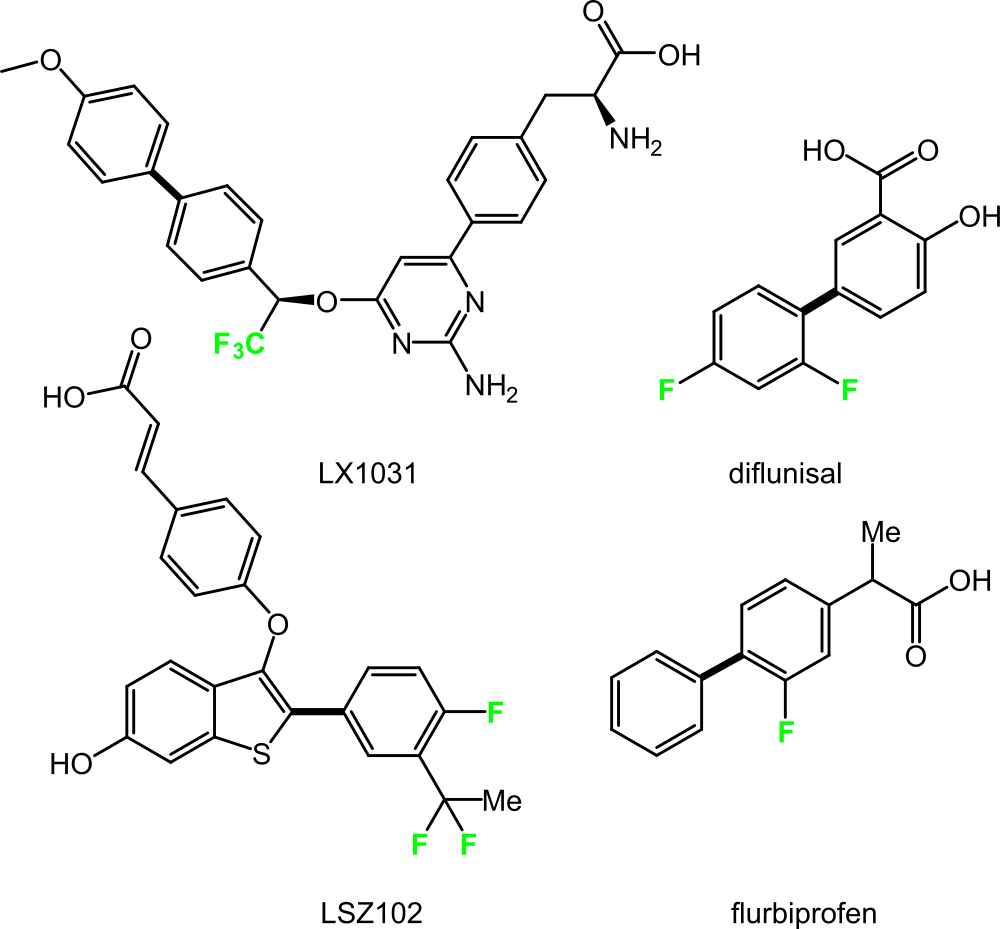
Figure 1. Fluorine-containing pharmaceuticals obtained via the Suzuki-Miyaura reaction.
ortho-Palladated oxime-derived palladacycles are known as efficient (pre)catalysts for the Suzuki-Miyaura reaction [4,5]; however, their aliphatic counterparts, such as complex 1, have not previously been tested in this capacity (Figure 2).
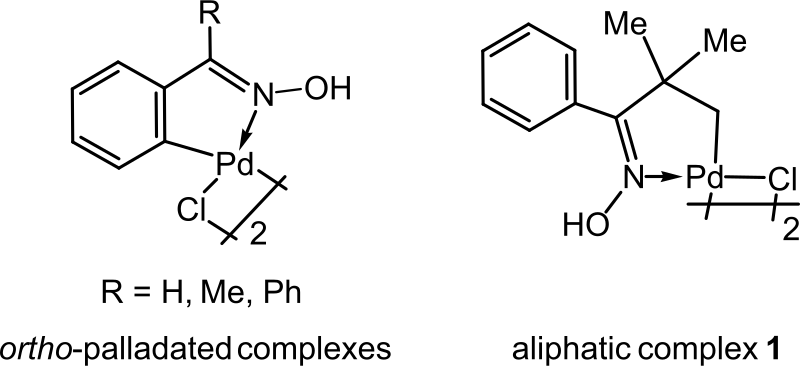
Figure 2. Known oxime-derived palladacycles.
Results and Discussion
The aim of this work was synthesis of aliphatic palladacycle 1 based on tert-butylphenyl oxime and investigation of its catalytic activity in the Suzuki-Miyaura cross-coupling of aryl halides with fluorine-containing arylboronic acids.
The dimeric oxime-derived palladacycle 1 was prepared according to a reported procedure [6] by palladation of tert-butylphenyl oxime 2 with Li2PdCl4 (Scheme 1). It should be noted that C–H bond activation in this case proceeds regioselectively at one of methyl groups of tert-butyl substituent, while ortho-position of phenyl ring remains unaffected.
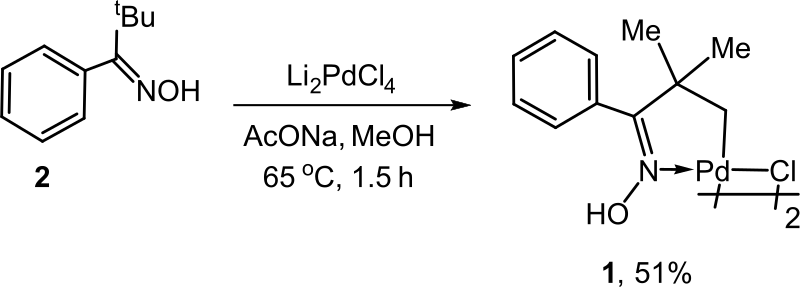
Scheme 1. Preparation of palladacycle 1.
Preliminarily, activity of complex 1 as a (pre)catalyst was evaluated in the Suzuki-Miyaura reaction of PhB(OH)2 with 4-bromoanisole and 4-bromoacetophenone, bearing electron-donating and electron-withdrawing groups, respectively (Scheme 2).
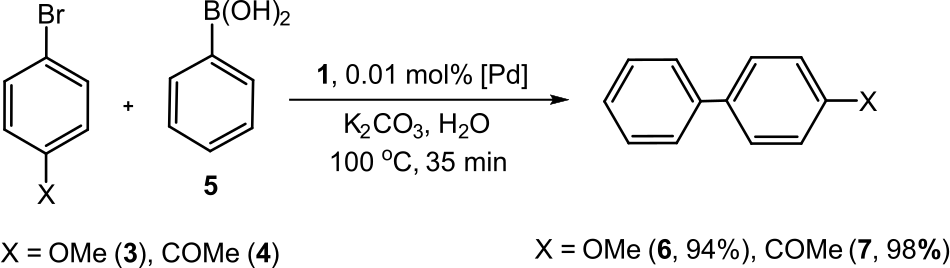
Scheme 2. Catalysis of the Suzuki-Miyaura reaction by palladacycle 1.
The aliphatic oxime-derived complex 1 at a fairly low loading (0.01 mol% [Pd]) efficiently catalyzed reaction with both substrates in water within a short time (35 min). Thus, catalytic activity of this palladacycle in the Suzuki-Miyaura reaction is comparable to that of the known ortho-palladated oxime-derived complexes [7].
In the next stage of this work, we evaluated catalytic activity of palladacycle 1 in the Suzuki-Miyaura cross-coupling of aryl bromides series with a deactivated CF3-substituted arylboronic acid.
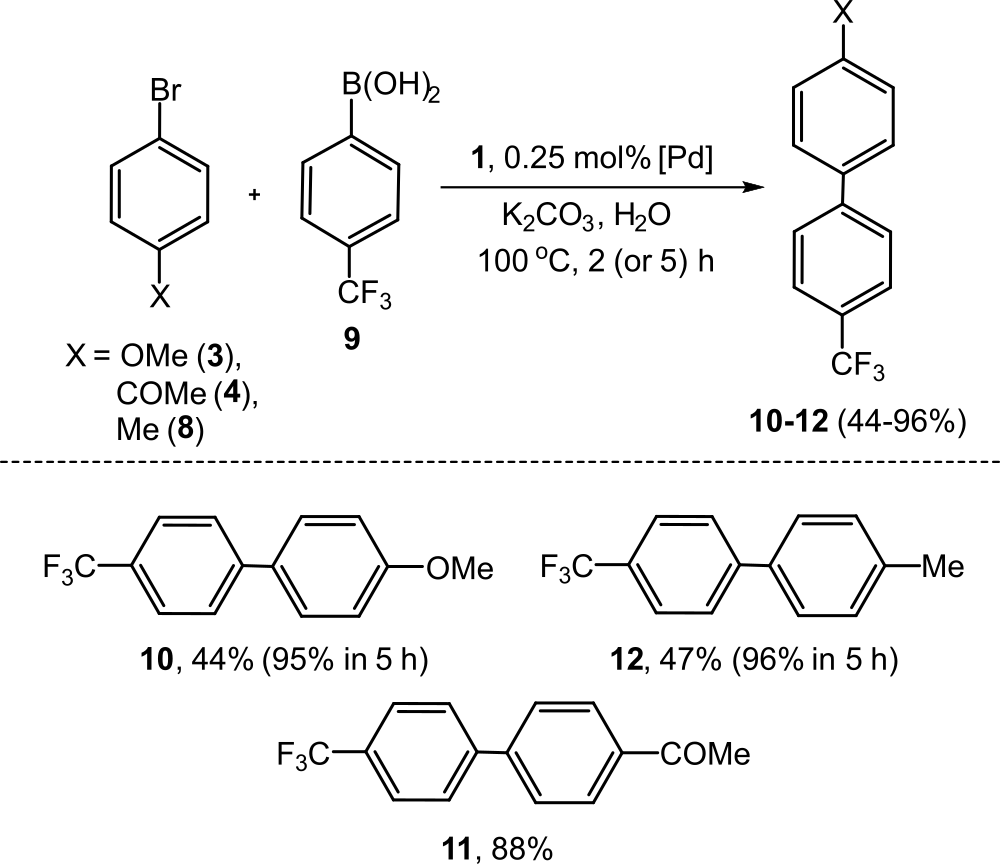
Scheme 3. Catalysis of the Suzuki-Miyaura reaction by palladacycle 1 for synthesis of CF3-substituted biaryls.
In the case of activated bromide 4 bearing an electron-withdrawing group, conversion to the target biaryl 11 was 88%; however, when switching to substrates 3 and 8 with electron-donating substituents, conversion dropped to 44% and 47%, respectively (Scheme 3). The result was significantly improved by extending reaction time from 2 to 5 h (95% and 96%).
Diflunisal is a well-known drug for the treatment of rheumatoid arthritis, osteoarthritis, primary dysmenorrhea, and cardiac amyloidosis from the group of nonsteroidal anti-inflammatory drugs (NSAIDs) [8]. Its structural analogue 15 bearing an aldehyde group was obtained in 89% yield under mild conditions (Scheme 4).
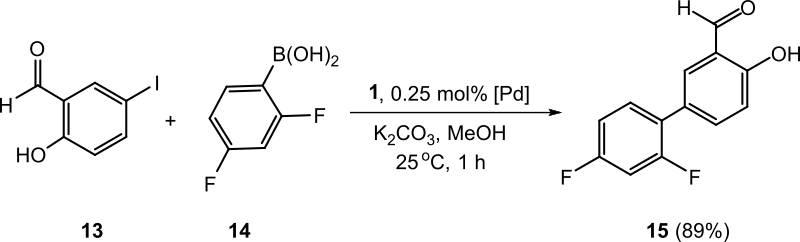
Scheme 4. Synthesis of an analogue of the anti-inflammatory agent diflunisal.
Conclusions
Thus, the aliphatic dimeric palladacycle 1 based on tert-butylphenyl oxime exhibited high catalytic activity in synthesis of fluorine-containing biaryls via the Suzuki-Miyaura reaction. Moreover, this complex was shown to be suitable for preparation of more complex biologically oriented structures, such as a diflunisal analogue.
Experimental Section
1Н and 19F NMR spectra were recorded in CDCI3 on a Bruker Avance 300 instrument operating at 300 and 282 MHz, respectively. Chemical shifts are reported in the δ scale (ppm), and coupling constants are given in Hz. All reactions were carried out without protection from light, moisture, and air. Reaction progress was monitored by TLC on Merck plates (silica gel 60 F254, 0.25 mm).
Synthesis of palladacycle 1
A mixture of pivalophenone oxime 2 (1 equiv., 0.050 g, 0.282 mmol), Li2PdCl4 (1 equiv., 0.0740 g, 0.282 mmol), and CH3COONa·3H2O (1 equiv., 0.0384 g, 0.282 mmol) in MeOH (3 mL) was stirred at reflux in air for 1.5 h. The reaction mixture was then evaporated to dryness. After purification on a dry column (SiO2, h = 3.5 cm, d = 2.5 cm; eluent – dichloromethane), dimeric complex was obtained as a cream-colored powder in 51% yield (0.0457 g, 0.072 mmol). 1H NMR (300 MHz, CDCl3) δ 8.14 (s, 1H), 7.51-7.40 (m, 3H), 7.30-7.19 (m, 2H), 2.05 (s, 2H), 1.21 (s, 6H).
General procedure for the Suzuki-Miyaura reaction
A mixture of aryl bromide (1 equiv.), 4-(trifluoromethyl)phenylboronic acid 9 (1.5 equiv.), K2CO3 (5 equiv.), and palladacycle 1 (0.01 or 0.25 mol% [Pd]) in H2O (2 mL) was stirred at reflux in air for the indicated time. The reaction mixture was cooled, diluted with water (3 mL), and extracted with dichloromethane (3 × 5 mL). The combined organic fractions were dried over MgSO4 and evaporated to dryness. The samples were dissolved in CDCl3 and transferred into NMR tubes. The conversion was determined by ¹H NMR spectroscopy. Isolation of individual products was carried out by chromatography on a dry column (SiO2, h = 3.5 cm, d = 2.5 cm; eluent – hexane/dichloromethane, gradient from 10:1 to 1:1).
4-Methyl-4'-(trifluoromethyl)biphenyl 12:
1Н NMR (300 MHz, CDCl3) δ 7.69 (s, 4H), 7.51 (d, J = 8.0 Hz, 2H), 7.29 (d, J = 8.0 Hz, 2H), 2.42 (s, 3H).
19F NMR (282 MHz, CDCl3) δ –62.36.
4-Methoxy-4'-(trifluoromethyl)biphenyl 10:
1Н NMR (300 MHz, CDCl3) δ 7.66 (s, 4H), 7.55 (d, J = 9.1 Hz, 2H), 7.01 (d, J = 9.1 Hz, 2H), 3.87 (s, 3H).
19F NMR (282 MHz, CDCl3) δ –62.14.
4-Acetyl-4'-(trifluoromethyl)biphenyl 11:
1Н NMR (300 MHz, CDCl3) δ 8.06 (d, J = 8.4 Hz, 2H), 7.73 (s, 4H), 7.69 (d, J = 8.4 Hz, 2H), 2.65 (s, 3H).
19F NMR (282 MHz, CDCl3) δ –65.7.
Synthesis of 5-(2,4-difluorophenyl)-2-hydroxybenzaldehyde 15
A mixture of 2-hydroxy-5-iodobenzaldehyde 13 (1 equiv., 0.0265 g, 0.107 mmol), 2,4-difluorophenylboronic acid 14 (1.5 equiv., 0.0253 g, 0.160 mmol), K2CO3 (5 equiv., 0.0739 g, 0.535 mmol), and palladacycle 1 (0.25 mol% [Pd], 0.000085 g, 0.000134 mmol) in MeOH (1 mL) was stirred at room temperature in air for 1 h. The reaction mixture was then acidified with 10% hydrochloric acid until a red litmus paper reaction and extracted with dichloromethane (3 × 5 mL). The combined organic fractions were dried over MgSO4 and evaporated to dryness, affording 0.025 g (89%, 0.0952 mmol) of a white solid powder. 1Н NMR (300 MHz, CDCl3) δ 11.06 (s, 1H), 9.95 (s, 1H), 7.76-7.60 (m, 2H), 7.39 (m, 1H), 7.08 (d, J = 8.6 Hz, 1H), 7.03-6.88 (m, 2H).
Acknowledgements
This work was financially supported by the Ministry of Science and Higher Education of the Russian Federation (№ 075-03-2026-024) using the research equipment of the Center for Molecular Composition Studies of INEOS RAS.
References
- E. P. Gillis, K. J. Eastman, M. D. Hill, D. J. Donnelly, N. A. Meanwell. Applications of Fluorine in Medicinal Chemistry. Journal of Medicinal Chemistry, 2015, 58, 8315-8359. DOI: 10.1021/acs.jmedchem.5b00258
- M. J. Buskes, M.-J. Blanco. Impact of Cross-Coupling Reactions in Drug Discovery and Development. Molecules, 2020, 25, 3493. DOI: 10.3390/molecules25153493
- M. Farha, A. R. Akbarzadeh, M. Rabbani, A. M. Ghadiri. A retrospective-prospective review of Suzuki-Miyaura reaction: From cross-coupling reaction to pharmaceutical industry applications. Polyhedron, 2022, 227, 116124. DOI: 10.1016/j.poly.2022.116124
- C. Najera. Oxime-Derived Palladacycles: Applications in Catalysis. ChemCatChem, 2016, 8, 1865-1881. DOI: 10.1002/cctc.201600035
- M. P. Timerkaeva, O. N. Gorunova. Catalytic activity of C,N-palladacycles in the Suzuki-Miyaura reaction. ИНЭОС OPEN, 2024, 6, 126-137. DOI: 10.32931/io2321r
- A. G. Constable, W. S. McDonald, L. C. Sawkins, B. L. Shaw. Transitionmetal-Carbon Bonds. Part 45.' Attempts to Cyclopalladate Some Aliphatic Oximes, NN- Dimethylhydrazones, Ketazines, and Oxime O-Ally1 Ethers. Crystal Structures of [Pd2(CH2C(CH3)2C(=NOH)CH3)2CI2] and [Pd(CH2C(=NNMe2)C(CH3)3)(acac)]. J. Chem. Soc. Dalton. Trans., 1980, 1992-2000. DOI: 10.1039/DT9800001992
- L. Botella, C. Najera. Cross-coupling reactions with boronic acids in water catalysed by oxime-derived palladacycles. J. Organomet. Chem., 2002, 663, 46-57. DOI: 10.1016/S0022-328X(02)01727-8
- P. Snetkov, S. Morozkina, R. Olekhnovich, M. Uspenskaya. Diflunisal Targeted Delivery Systems: A Review, Materials, 2021, 14, 6687. DOI: 10.3390/ma14216687.
ARTICLE INFO
Received 05 May 2026
Accepted 09 June 2026
Available
online June 2026
Recommended for publication by PhD M.A. Manaenkova
eLIBRARY Document Number (EDN) ZFMRFU

Fluorine Notes, 2026, 166, 5-6