Received: April 2026
DOI 10.17677/fn20714807.2026.03.02
Fluorine Notes, 2026, 166, 3-4
POLYURETHANE ELASTOMER OF REDUCED FLAMMABILITY CONTAINING FLUORINATED AMINE AND CHLOROPARAFFIN
I.A. Politsimako1, S.V. Kudashev1, V.F. Zheltobryukhov1, G.L. Gizzatova 2
1 Volgograd State Technical University, 28 Lenin Avenue, Volgograd, 400005 Russia
e-mail:
kudashev-sv@yandex.ru
2 Volgograd State Agrarian University, 26 Universitetskiy Avenue, Volgograd, 400002 Russia
Abstract. The effect of a mixture of halogen-containing flame retardants based on fluorinated amine synthesized by the interaction of tris-(2-aminoethylamine) and 1H,1H,3H-trihydroperfluoropropane-1-ol and chloroparaffin on the flammability of polyurethane elastomer was studied. The structure of the modified polymer was studied by X-ray diffractometry. It is revealed that there is a reorganization of the amorphous structure of the heterochain polymer under consideration, which helps to reduce the flammability of the obtained materials.
Keywords: fluoropolymers; polyurethane elastomers; fluorinated amines; modification; stabilization; chloroparaffins; flammability.
Introduction
Improving the properties of polyurethane materials is an urgent task due to their widespread use as monolithic sports and roofing coverings [1, 2]. Organoelement compounds, as well as their immobilized forms on various media (clays, graphite), are used as burning retardants for polyurethanes. In [3-6], the effect of a number of poly- and perfluorinated compounds on the structure of a number of heterochain polymers was shown, which reduced the flammability of the obtained fluorinated composites.
One of the directions in the creation of flame-retardant polymers is the simultaneous presence in the modifier molecule of amino groups of varying degrees of fluorine substitution and polyfluorinated fragments capable of collectively leading to the reorganization of the polyurethane structure and participating in the termination of free radical processes [7] occurring under conditions of exposure to elevated temperatures and flames. The synergistic effect on thermal stability and reduced flammability can be achieved by the additional introduction of polychlorinated hydrocarbons.
The aim of the work was to study the flammability of a polyurethane elastomer containing the bisalkylation product tris-(2-aminoethylamine) 1H,1H,3H-trihydroperfluoropropane-1-ol and chloroparaffin.
Experimental
Preparation of the elastomeric composition. The basic polyurethane elastomer was obtained using a laboratory mixer by mixing (mixing speed 250 rpm-1) for 10 min. 100 wt.h. oligoesterpoliol (Laprol 5003-2–B10 (hydroxyl number 35 mg KOH/g, mass fraction of water not more than 0.05%, Jiahua Chemical Co., LTD), 1 wt.h. of the branching chain agent (glycerin clean for analysis, JSC «EKOS-1»), 1.5 wt.h. of the plasticizer (dioctyladipinate DOA, the content of the basic substance 99.7% (wt.), LLC «Vitakhim SPb»), 1.5 wt.h. surfactant (oxyethylated monoalkylphenol Neonol AF 9-12, mass fraction of water < 0.5%, NPC PROMKHIMPLAST LLC), 0.1 wt.h. of urethane catalyst (2.5% solution of di-n-butyldilaurate of tin in white spirit, PTK Neftepromkomplekt LLC). Next, 20 wt.h. of isocyanate (Desmodur T80, 2,4-isomer content 80.5%, «Wanhua») was added to the reaction mass and mixed again for 7 minutes.
A polyurethane elastomer modified with fluorinated tetraamine and chlorparfine was obtained in the same way as described above by introducing the specified modifier in an amount of 5 wt.h. and 10 wt. h. into the reaction mass at the stage of mixing oligoesterpoliol, glycerol, dioctyladipinate, oxyethylated monoalkylphenol and a urethane catalyst.
Fluorinated tetraamine was obtained according to Scheme 1 by catalytic N-polyfluoroalkylation of tris-(2-aminoethyl)amine (tkip = 114 °C (15 mm Hg), d = 0.976 g/ml, n20D = 1.497, «Keyingchem») 1H,1H,3H-trihydroperfluoropropane-1-ol (basic substance content 99.5% (wt.), JSC «HaloPolymer») in the presence of catalytic amounts of montmorillonite (base substance content 99% (wt.), TOO «B-Clay») in a sealed glass ampoule at 80 ° C for 2 hours at an ultrasound frequency of 40 kHz, followed by heating to 120 ° C for 6 hours. Fluorinated tetraamine was a yellow oily substance with a temperature of = 131-133 °C (15 mmHg).
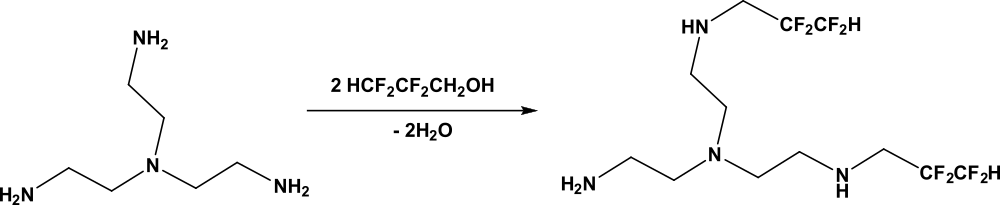
Scheme 1.
Chlorinated paraffin of the HP–1100 brand (mass fraction of chlorine, %, not less than – 70; melting point 75 ° C) produced by JSC Caustic (Volgograd) was used as a burning retarder.
The obtained compositions of the reference and modified polyurethane elastomer were poured into molds and kept at room temperature (cold curing method) until the Shore A hardness of the elastomer reached a plateau. The flammability of polymer bars with a length of 120 mm, a thickness of 4 mm and a width of 10 mm was assessed in accordance with current methods (GOST 21793-76, GOST 28157-89 (method A)). The error in determining the oxygen index value did not exceed ± 0.5% vol. X-ray images of film samples at large diffraction angles were recorded on an automated Bruker D8 Advance diffractometer. Survey parameters: SIKA radiation (λ = 1.5418 Å), Ni filter, error in measuring diffraction angles did not exceed 0.005°. The experimental diffractograms were processed using the «Diffrac software.Eva» and «Topas».
Results and discussion
The density of the spatial grid and the nature of its defects, the nature of the intermolecular bonds between polymer chains, and the ratio between chemical and physical nodes in the polyurethane grid can have a significant effect on its flammability [3-5]. Analysis of the topological structure of the mesh of the modified polyurethane elastomer indicated an increase in the crosslinking coefficient with the introduction of fluorinated amines [8, 9]. In [9], using X-ray photoelectron spectroscopy, small-angle X-ray scattering, calorimetry, and NMR spectroscopy, it was shown that fluorinated amine «integrates» into polyurethane macromolecules during the migration polymerization of isocyanate and polyol, leading to branching of macromolecular chains, and fluorinated fragments participate in non-covalent intra- and intermolecular interactions, reducing segmental mobility macromolecular chains.
According to X-ray diffraction data («into the lumen» geometry), the X-ray images of the studied polymer samples are of the same type and are represented by a wide halo typical of amorphous polymers (Table 1). However, the simultaneous introduction of fluorinated amine and chloroparaffin leads not only to an increase in the intensity of the amorphous halo, but also to a decrease in the radial half-width by Δ2θ = 0,5º, which is due to the partial orientation of the polymer macromolecules (rigid and flexible segments are amorphous) under the influence of the halogen-containing additives used and an increase in the degree of structural perfection due to an increase in the intermolecular order in the flexible segment of polyurethane.
Table 1. X-ray diffraction data of the studied polyurethane samples.
|
Sample |
Intensity of the amorphous halo, conl. units |
Angular position of the amorphous halo 2θ,º |
Angle range 2θ of the amorphous halo, º |
|
The initial polyurethane elastomer |
47 |
18,0 |
10,4-31,8 |
|
Modified polyurethane elastomer containing fluorinated tetraamine and chloroparaffin |
60 |
18,5 |
11,0-30,1 |
The combination of changes in the structure of the modified polyurethane causes a decrease in its flammability (Table 2). Burning of the initial polyurethane is characterized by abundant droplet deposition, igniting hygroscopic cotton, sparking and smoking flame.
Table 2. The results of the study of the flammability of polyurethane samples.
|
Sample |
Oxygen index, % vol. |
Burning speed, mm·min-1 |
|
The initial polyurethane elastomer |
18,0 |
74,2 |
|
Modified polyurethane elastomer containing fluorinated tetraamine and chloroparaffin |
25,0 |
50,5 |
However, during the combustion of a modified polyurethane elastomer containing fluorinated tetraamine and chloroparaffin, a significant part of the surface was covered with dense coke, which serves as a thermal and diffusion barrier to the burning front of the material, allowing the process to be shifted towards a lower thermal effect due to more efficient heat dissipation, thereby reducing the rate of heat release and the possibility of ignition of the released combustible products. Burning the process of the combustion of the material, which is used as a thermal and diffusion barrier for the combustion front of the material, allowing the process to be shifted towards a lower thermal effect due to more efficient heat dissipation, thereby reducing the rate of heat release and the possibility of ignition of the released combustible products.
Thus, the modification of elastic polyurethane with a mixture of fluorinated amine and chloroparaffin contributes to the reorganization of the amorphous phase of the polymer matrix, leading to a decrease in the flammability of the resulting material.
References
- Thomas S., Datta J., Haponiuk J. Polyurethane polymers: Composites and nanocomposites. Elsevier, Amsterdam, Netherlands, 2017. 632 р.
- Clemitson I. R. Castable Polyurethane Elastomers. – CRC Press (Taylor & Francis Group), 2015. 272 p.
- Morgan A.B., Wilkie C.A. Flame Retardant Polymer Nanocomposites. – Wiley-Interscience. 2007. 451 p.
- Kudаshev S.V. Methods of introducing poly- and perfluorinated fragments into a macromolecular system (Review) // Fluorine notes, 2020, 3(130). DOI 10.17677/fn20714807.2020.03.02. URL:http://en.notes.fluorine1.ru/public/2020/3_2020/article_2.html.
- Kudashev S. V. Modifikaciya ryada geterocepnyh polimerov kompoziciyami na osnove poliftorirovannyh spirtov i montmorillonita, Avtoreferat dissertacii…doktora himicheskih nauk (special'nost' 02.00.06). – VolgGTU, Volgograd, 2020, 48 s.
- Kudashev S. V., Shul'ga Yu. M., Medvedev V. P. Vliyanie struktury ftorsoderzhashchego amorfnogo poliuretana na ego goryuchest' // Kauchuk i rezina. 2019. T. 78. № 5. - C. 296-300.
- Politsimako I.A., Kudashev S.V., Zheltobryukhov V.F., Kumbrasyeva S.V. The structure of paramagnetic centers and the analysis of the elementary stages of the mechanism of the stabilizing effect of fluorinated tetraamine on the ozone aging process of a modified polyurethane elastomer // Fluorine Notes: online journal. 2026. № 1 (164). DOI: 10.17677/fn20714807.2026.01.02, URL:http://en.notes.fluorine1.ru/public/2026/1_2026/article_2.html.
- Kudashev S. V., Policimako I. A., Zheltobryuhov V. F. Struktura i svojstva poliuretanovyh elastomerov, modificirovannyh poliftorirovannym tetraaminom // Kauchuk i rezina. 2025. T. 84, № 4. C. 202-207. - DOI: 10.47664/0022-9466-2025-84-4-202-207.
- Kudashev S.V., Shulenina A.V., Peters G.S., Policimako I.A., Klimov V.V., Zheltobryuxov V.F. Fotoximicheskaya destrukciya i agressivostojkost` ftorsoderzhashhix modificirovannyx poliuretanovyx elastomerov // Fizikoximiya poverxnosti i zashhita materialov. 2025. T. 61, № 4. C. 432-441. https://doi.org/10.31857/S0044185625040119.
ARTICLE INFO
Received 21 April 2026
Accepted 02 June 2026
Available online June
2026
Recommended for publication by PhD O.V. Bryzgalova
eLIBRARY Document Number (EDN) ZQHVVF

Fluorine Notes, 2026, 166, 3-4