Received: March 2026
DOI 10.17677/fn20714807.2026.02.02
Fluorine Notes, 2026, 165, 3-4
Catalytic effect of fluorinated amine on the formation of modified polyurethane elastomer
I.A. Politsimako1, S.V. Kudashev1, V.F. Zheltobryukhov1, G.L. Gizzatova 2, A.A. Shapkin1
1 Volgograd State Technical University, 28 Lenin Avenue, Volgograd, 400005 Russia
e-mail: kudashev-sv@yandex.ru
2 Volgograd State Agrarian University, 26 Universitetskiy Avenue, Volgograd, 400002 Russia
Abstract: The effect of a catalytic system based on tin di-n-butyl dilaurate and fluorinated tetraamine synthesized by the interaction of tris-(2-aminoethylamine) is investigated and 1H,1H,3H-trihydroperfluoropropane-1-ol, for the curing process of the polyurethane composition. An increase in the viscosity of the reaction mass was found when measured under isothermal conditions and an increase in the values of the rheokinetic constants. Using the methods of quantum chemistry, a possible mechanism of the catalytic effect of fluorinated tetraamine on the urethane formation reaction is considered.
Keywords: fluoropolymers; polyurethane elastomers; fluorinated amines; modification; structure formation; curing; catalysis.
Introduction
The catalytic interaction of di- and polyisocyanates with polyols produces polyurethanes, elastic products of which have been used as coatings for various purposes [1,2]. The features of the operation of these coatings (simultaneous exposure to UV radiation, aggressive media, photochemical and microbiological destruction, surface abrasion) lead to multiple processes of destruction of the crosslinked polymer.
To stabilize the properties of elastic polyurethanes, fluorinated compounds are of particular importance, which can be introduced at the stage of polymer synthesis or by surface treatment of monolithic sports and roofing coatings [3-8]. The products of alkylation of tris-(2-aminoethylamine) with polyfluorinated alcohols H(CF2CF2)nCH2OH, having amino groups of varying degrees of substitution and a fluorinated fragment in their structure, make it possible to improve the properties of the resulting modified elastomer [9-11]. In this regard, it is of interest to study the effect of fluorinated amines on the urethane formation process in order to improve the formulations of polyurethane compositions.
The aim of the work is a theoretical and experimental study of the catalytic effect of fluorinated tetraamine synthesized by bisalkylation of tris-(2-aminoethylamine) 1,1,3-trihydroperfluoropropane-1-ol affects the formation of a modified polyurethane elastomer.
Experimental
Preparation of the elastomeric composition. The basic polyurethane elastomer was obtained using a laboratory mixer by mixing (mixing speed 250 rpm-1) for 10 min. 100 wt.h. oligoesterpoliol (Laprol 5003-2–B10 (hydroxyl number 35 mg KOH/g, mass fraction of water not more than 0.05%, Jiahua Chemical Co., LTD), 1 wt.h. of the branching chain agent (glycerin clean for analysis, JSC «EKOS-1»), 1.5 wt.h. of the plasticizer (dioctyladipinate DOA, the content of the basic substance 99.7% (wt.), LLC «Vitakhim SPb»), 1.5 wt.h. surfactant (oxyethylated monoalkylphenol Neonol AF 9-12, mass fraction of water < 0.5%, NPC PROMKHIMPLAST LLC), 0.1 wt.h. of urethane catalyst (2.5% solution of di-n-butyldilaurate of tin in white spirit, PTK Neftepromkomplekt LLC). Next, 20 wt.h. of isocyanate (Desmodur T80, 2,4-isomer content 80.5%, «Wanhua») was added to the reaction mass and mixed again for 7 minutes.
A polyurethane elastomer modified with fluorinated tetraamine was obtained similarly to the method described above by introducing the specified modifier in an amount of 5 wt.h. into the reaction mass at the stage of mixing oligoesterpoliol, glycerol, dioctyladipinate, oxyethylated monoalkylphenol and a urethane catalyst.
Fluorinated tetraamine was obtained according to Scheme 1 by catalytic N-polyfluoroalkylation of tris-(2-aminoethyl)amine (tkip = 114 °C (15 mm Hg), d = 0.976 g/ml, n20D = 1.497, «Keyingchem») 1H,1H,3H-trihydroperfluoropropane-1-ol (basic substance content 99.5% (wt.), JSC «HaloPolymer») in the presence of catalytic amounts of montmorillonite (base substance content 99% (wt.), TOO «B-Clay») in a sealed glass ampoule at 80 °C for 2 hours at an ultrasound frequency of 40 kHz, followed by heating to 120 °C for 6 hours. Fluorinated tetraamine was a yellow oily substance with a temperature of = 131-133 °C (15 mm Hg).
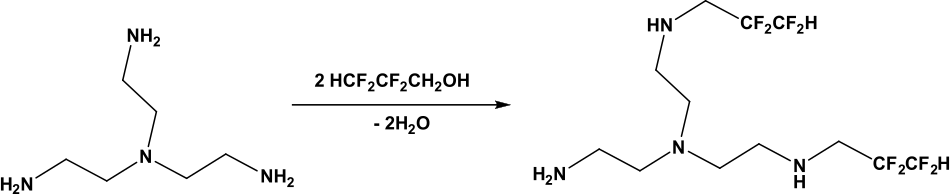
Scheme 1.
The obtained compositions of the reference and modified polyurethane elastomer were poured into molds and kept at room temperature (cold curing method) until the Shore A hardness of the elastomer reached a plateau.
Research methods. Rheological properties were studied at 25±0.1 °C (shear rate 1 s-1) on a viscometer with a VIS-R-BM thermostat (Geotester). The arithmetic mean of three parallel definitions was taken as the test result. The rate constants of viscosity increase were calculated for two sections of anamorphoses of rheokinetic curves obtained by logarithming along the axis of dynamic viscosity values η (Pa·s) for the dependence of viscosity on the curing time (min) η –τ. All η –t dependencies are characterized by the presence of an initial phase (induction period), of varying duration, within which the value of η varies slightly, and then increases intensively according to a law close to exponential. In the coordinates lnη–τ, the experimental dependences have the form of two rectilinear sections with different angular coefficients and corresponding rate constants of the viscosity of the reaction mass Kη1 and Kη2.
Quantum chemical studies in the approximation of an isolated particle in the gas phase with geometry optimization in all parameters using the DFT–PBE0/6–311g** and ab initio methods based on STO–3G** were performed in the GAMESS and Gaussian 09 software products.
Results and discussion
The process of structure formation of polyurethane elastomers is quite complex and includes multiple chemical and physico-chemical processes that collectively lead to the formation of a crosslinked polymer [1,2]. A structural feature of the modifier used is the presence of a reactive primary amino group, which, under conditions of migration polymerization of diisocyanate and polyol, is able to interact with the NCO groups of 2,4- and 2,6-toluylenediisocyanate to form disubstituted urea (Scheme 2).

Scheme 2.
A study of the kinetics of curing polyurethane compositions revealed that the introduction of a modifier increases the viscosity of the reaction mass when measured under isothermal conditions (Table). The increase in the rate constants of the viscosity of the reaction mass in the case of polyfluorinated tetraamine may be due to the catalysis of the urethane formation process with the participation of a tertiary nitrogen atom.
Table. The values of the rate constants of the viscosity of the reaction mass during the formation of polyurethane elastomers.
|
The catalyst |
Gelation time, min |
Rheokinetic constants of the curing rate Кη |
|
|
Кη1·10-2, min-1 |
Кη2·10-2, min-1 |
||
|
tin di-n-butyl dilaurate |
43 |
0.77 |
3.00 |
|
fluorinated tetraamine * |
66 |
0.53 |
2.21 |
|
tin di-n-butyl dilaurate and fluorinated tetraamine * |
29 |
2.12 |
5,50 |
* – a modifier that performs an additional function of a catalyst.
Further rheokinetic studies made it possible to establish that the introduction of an excess of fluorinated tetraamine leads to a slowdown in the increase in viscosity of the cured compositions (the effect of dilution of the composition). The samples obtained with a ratio of [NCO / Σ{OH+(NH2,NH)}] < 0.75 are gel-like products (no fully structured polymer is formed). The highest degree of transformation and the effectiveness of the engagement is realized with the ratio of reacting groups equal to [NCO / Σ{OH+(NH2,NH)}] = 1.
According to NMR data from 119Sn [12], the formation of donor-acceptor complexes occurs due to vacant 5d orbitals of SnIV tin di-n-butyldilaurate and lone electron pairs of oxygen and nitrogen isocyanate groups and fluorinated tetraamine, which together contributes to the most effective elongation of the OH bond of the polyol (designated as R-OH in Scheme 3) and facilitating the formation of urethane.
At the first stage, the mutual orientation of the reacting molecules (1) and their dipole-dipole interactions occur. According to the DFT–PBE0/6–311g** method, there is an increase in the partial charge on the carbon atom of the group from NC+0.306O to NC+0.419O and a decrease in the partial charge on the tertiary nitrogen atom of fluorinated tetraamine from ≡N–0.268 to ≡N–0.378. Energy barriers to the formation of ion pairs (2a) and (2b) are close and amount to 47 kcal/mol and 48 kcal/mol, respectively (according to the ab initio method 46 and 47 kcal/mol), and the dipole moments are 4.8 D and 4.6 D. The length of the C–N bond in structures (2a) and (2b) is comparable and amounts to 1.383 Å and 1.381 Å, respectively (according to the ab initio method, 1,381 Å and 1,380 Å).
The addition of the R–OH nucleophile (calculated using the example of a glycerol molecule) leads to the formation of structure (3) having a dipole moment of 7.8 D, in which two ion pairs N+···–N and O+···–O are simultaneously present (total energy is E0 = –10 463 kcal/mol). In this case, there is not only an increase in the length of the C–N bond to 3.980 Å (according to the ab initio method, 3.988 Å), but also the length of the +O–H bond to 3.924 Å (in the initial R–OH, the length of the O–H bond is 0.961 Å), indicating their rupture, with the formation of endpoints products.
Thus, the combined use of tin di-n-butyl dilaurate and fluorinated tetraamine reduces the gelation time and increases the rheokinetic curing constants, which is associated with the catalytic effect of fluorinated tetraamine on the urethane formation reaction.
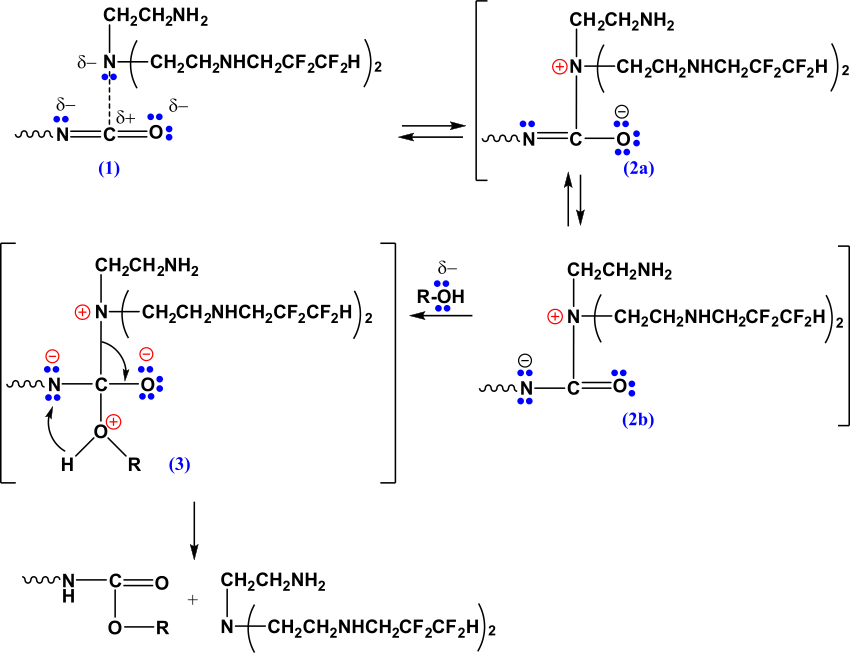
Scheme 3.
References
- Thomas S., Datta J., Haponiuk J. Polyurethane polymers: Composites and nanocomposites. Elsevier, Amsterdam, Netherlands, 2017. 632 р.
- Clemitson I. R. Castable Polyurethane Elastomers. – CRC Press (Taylor & Francis Group), 2015. 272 p.
- Ebnesajjad S., Morgan R. A. Fluoropolymer Additives. Elsevier, William Andrew, 2019. P. 57–66.
- Smirnova O., Glazkov A., Yarosh A., Sakharov A. Fluorinated Polyurethanes, Synthesis and Properties // Molecules. 2016. V. 21. N 7. Р. 1–10. https://doi.org/10.3390/molecules21070904
- Wu Z., Tang L., Dai J., Qu J. Synthesis and properties of f luorinated non-isocyanate polyurethanes coatings with good hydrophobic and oleophobic properties // J. Coat. Technol. Res. 2019. V. 16. Р.1233–1241. http://dx.doi.org/10.1007/s11998-019-00195-5
- Li N., Yang R., Tian Y., Lu P., Huang N., Li H., Chen X. Synthesis of durable hydrophobic fluorinated polyurethanes with exceptional cavitation erosion resistance // Tribol. Int. 2023. V. 177. ID. 107973. https://doi.org/10.1016/j.triboint.2022.107973
- Ponomarenko V.A., Krukovskij S.P., Aly`bina A.Yu. Ftorsoderzhashhie geterocepny`e polimery`. – M.: Nauka, 1973. 304 s.
- Malichenko B. F. Ftorsoderzhashhie poliamidy` i poliuretany`. – Kiev: Naukova dumka. 1977. 231s.
- Kudashev S.V., Shulenina A.V., Peters G.S., Policimako I.A., Klimov V.V., Zheltobryuxov V.F. Fotoximicheskaya destrukciya i agressivostojkost` ftorsoderzhashhix modificirovannyx poliuretanovyx elastomerov // Fizikoximiya poverxnosti i zashhita materialov. 2025. T. 61, № 4. C. 432-441. https://doi.org/10.31857/S0044185625040119.
- Politsimako I.A., Kudashev S.V., Zheltobryukhov V.F., Kumbrasyeva S.V. The structure of paramagnetic centers and the analysis of the elementary stages of the mechanism of the stabilizing effect of fluorinated tetraamine on the ozone aging process of a modified polyurethane elastomer // Fluorine Notes: online journal, 2026, Iss. 1 (164), DOI: 10.17677/fn20714807.2026.01.02, URL:http://en.notes.fluorine1.ru/public/2026/1_2026/article_2.html.
- Politsimako I.A., Kudashev S.V., Klimov V.V., Zheltobryukhov V.F. The structure of free radicals formed during photochemical and thermal aging of fluorinated polyurethane // Fluorine notes: online journal, 2025, Iss. 3 (160), DOI: 10.17677/fn20714807.2025.03.02, URL: http://en.notes.fluorine1.ru/public/2025/3_2025/article_2.html.
- Kudashev S.V., Politsimako I.A., Zheltobryukhov V.F. Investigation by rotational viscometry methods, NMR 119Sn spectroscopy and quantum chemistry of the effect of a catalytic system based on tin di-n-butyldilaurate and polyfluorinated tetraamine on the curing process of elastic polyurethanes // Fluorine notes: online journal, 2024,Iss. 4 (155), DOI 10.17677/fn20714807.2024.04.01, URL: http://en.notes.fluorine1.ru/public/2024/4_2024/article_1.html.
ARTICLE INFO
Received 17 March 2026
Accepted 08 April 2026
Available online April
2026
Recommended for publication by PhD O.V. Bryzgalova
eLIBRARY Document Number (EDN) UBJEQM

Fluorine Notes, 2026, 165, 3-4