Fluorine Notes, 2008, 59, 3-4
A BREAKTHROUGH IN CHEMICAL TECHNOLOGIES OF FORMING THE MULTIPLE BOND WITH FLUORINE ATOMS AND PERFLUOROALKYL SUBSTITUENTS AT IT
A.N. Il'in*, G. G. Furin *614113, Russia, Perm, ul. Lasvinskaya, 98,
JSV Halogen (continuation) 3. Dehalogenation and Polyfluorohaloidalkanes' Dehalogenation The detachment of halogen hydrogens from hydrofluorohydrocarbons at temperature range of 200-500 oC and over catalysts, for example salts of transition metals allows obtaining of fluoroalkenes. This method is used rather widely not only for laboratory practice, but it has also been implemented for commercial production as it foes selectively and has got a high yield of target products. Thus, at hexafluoropropane's passing through the flow reactor at 200-500 oC over chromium trifluoride they have obtained pentafluoropropylene [87]. Aqueous alkali solutions can be used for that purposes. For example, KOH-H2O system proved to be effective for obtaining of perfluorobutenes [88-90].
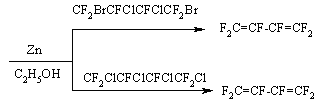
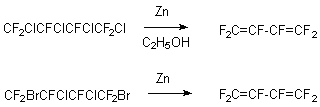
One of the approaches to synthesis of conjugate olefines is dechlorination process and debromination of fluorochlorohydrocarbons by zinc influence in ethyl alcohol (for the review of data refer to [91]).
The derivatives containing chlorofluoroalkyl fragments can also be introduced into the reaction of dechlorination, the action of metallic zinc in dimethylformamide or N-methyl-2-pyrrolidone results in formation of multiply bond [92].
The obtained monomer is used to synthesize polymers, applied as solid electrolytes, electrodes etc. For example, its co-polymerization with vinyliden fluoride produces polymer, the treatment of which using lithium carbonate in methyl alcohol results in forming of solid electrolyte, that decomposes at 250 oC [93]. Dehalogenation of compounds of the CF2Z1XFZ2(CF2)nCXYOCFZ3CF2Z4 (X = H, F, Cl, Br, I; n = 1-3; Z1-Z4 = Cl, Br, I; n = 1-3) formula in the medium of dimethylformamide in the atmosphere of inert gas at 50-55 oC and pressure equal to 3 MPa results in forming of fluorine containing diens of the [CF2=CF(CF2)nCXYOCF=CF2] formula [94]. At n = 1, and X = Y = Cl the dien's yield accounted to 62 %. Hexafluorobutadien-1,3 is obtained by dehalogenation of polyhalogenbutanes CF2X1CFX2CFX2CF2X1 ( X1, X2 = I, Br, Cl) using dispersed zinc in the medium of polar organic solvent [95]. The synthesis of conjugated olefins includes as well the process of dechlorination and debromination of fluorochlorohydrocarbones by zinc influence in ethyl alcohol [91].
The simple and economical way to obtain the
CF2=CF(CF2)n-4CF=CF2
(n = 4-20) diens, used to obtain fluoroelastomers was described
the authors of work [96] by deiodination of I(CF2)nI
(N = 4-20) compounds over metallic zinc and N-containing organic
solvent (DMF, Et3N, Pyridine, quinoline,
N-methyl-2-pyrrolidone, N,N-dimethylaceotamide) in the medium of
inert solvent (perfluoroalkanes, perfluoamines) within the
temperature range of 80 - 150 oC. At the same time
defluorination of perfluoroalkanes goes really hard. Thus, the
influence of metallic zinc over [(
One of the diens' obtaining methods is thermal reaction of perfluoroolefines. It should be remembered, that further transformations of diens at high temperatures could be possible, which leads to forming of cyclic compounds as by-products. Perfluoroolefines, which heating at high temperature goes over the metals are subject to defluorination. Thus, perfluoro-3,4-dimethylhex-3-en (tetrafluoroethylene tetramer) produces dimers of different structure depending on the nature of metal, which later transform into the derivatives of cyclobutene [98].
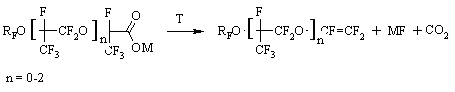
The defluorination of perfluorocycloalkenes goes according to the analogous pattern [99]. 4. Decarboxylation of Perfluorocarboxylic Acids and Some of Its Derivatives as Perfluoroolefines' Obtaining Method The pyrolysis of perfluorocarboxylic acids, their anhydrides and esters as well as their salts is an important obtaining method of perfluorolefines. For example, over a catalyst, consisting of a carrier (activated carbon, magnesium oxide, calcium, barium, zinc, aluminium, nickel, silicon oxides), motivated by halogenide of alkali metal at 100-450 oC results in forming of polyfluorolefines and their derivatives [100]. During thermal decarboxylation of carboxylic acids' dry salts obtained out of oligomers of hexafluoropropylene oxide the corresponding vinyl ethers are formed with super yield [101].
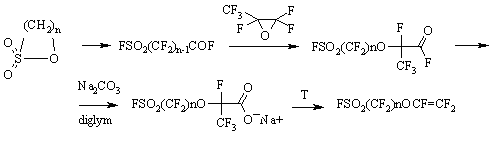
The perfluorovinyl ethers with end group of sulfofluoride are obtained according to this method, if the pyrolysis of the corresponding salt obtained from sultone is carried out [102]. The yield of perfluoro-4(fluorosulphonyl)butoxivinyl ester for example accounted to 74 %.
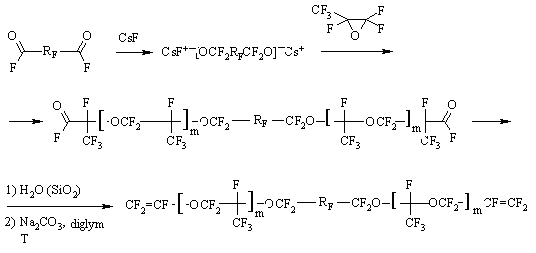
The perfluorovinyl ethers like that are used as monomers for the synthesis of ion-exchange resins. If you filter oligomeric fluoroanhydrides over the layer of dry metal oxides, such as ZnO, CaO, SiO2 at 275-400 oC then you can reach a quantitive transformation grade with vinyl ethers yield up to 95 %. The reaction with sodium carbonate in diglym produces almost quantitive yield at an almost full grade of transforming [101]. At that, for example for perfluoro-2-propoxypropionylfluoride the reaction goes at 60 oC compare to 300 oC in the case, when a dry salt was used. Few of fluorine containing bivinyl ethers were obtained out of difluoroanhydrides of polymeric perfluorocarboxylic acids obtained by interaction of difluoroanhydrides of carboxylic acids and hexafluoropropylene oxide over CsF [103]. Such monomers are used for synthesis of polymeric materials which are non-inflammable, thermally stable and possess good temperature properties.
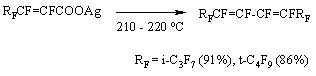
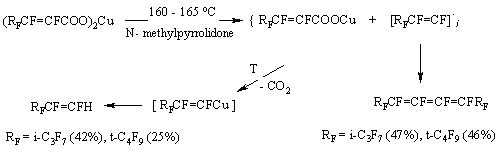
It is well known, that pyrolysis of silver perfluorocarboxylates results in forming of perfluoroalkanes, which are the products of dimerization of radicals, formed at oxidative decarboxylation of initial salts. The authors of work [71] used that approach for the synthesis of perfluorinated conjugated diens starting from silver salts of unsaturated carboxylic acids. Thus, the decomposition of silver salts of perfluoro-4-methylpent-2-enic and perfluoro-4,4-dimethylpent-2-enic acids results in forming of perfluorodiens in the form of 1E,3E-S-cis-isomers with the yield of 87-89% [71].
Copper salts may be used as well, though in that case a by-product is formed, which is 1-hydro-3-trifluoromethylperfluorobut-1-en [71].
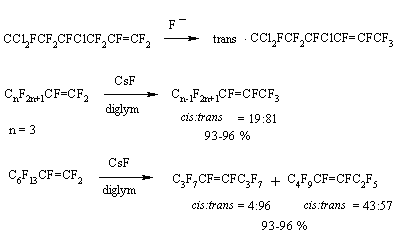
5. Isomerization of Perfluoroolefines, Catalyzed by Fluoride-ion The isomerization of fluoroalkenes over electron- seeking catalyst was shown quite a long time ago [104]. It allows obtaining the olefins of different structures. Thus, terminal perfluoolefines are isomerized into internal perfluorolefines under the influence of ion-fluoride [105,106].
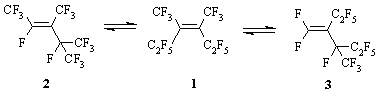
Both terminal and internal perfluolefines are subject to isomerization over ion fluoride, producing as a rule the mixture of isomeric internal olefins. For example, the tetramer of tetrafluoroethylene 1 is isomerized under the influence of ion-fluoride, producing isomers 2 and 3 [107].
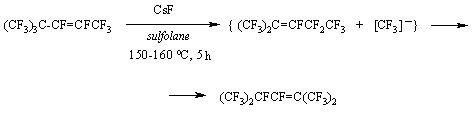
In the cause of that when nucleophilic agents are influencing internal perfluorolefine due to ion-fluoride being formed during the process its isomerization is possible forming other isomers, which can react with nucleophilic reagents, producing the products of other structure. If the rate of reaction with nucleophil is higher for such isomers than for the one of initial olefine, then we will obtain their derivatives. During the influence of ion fluoride on branched internal perfluoolefines not only the isomerization with multiple bond is possible but also the re-grouping, at which the mignation of anion CF3- takes place. Intermediate trifluormethyl anion was catched by the reaction with perfluoropyrimidine. This also leads to the forming of new perfluoroolefine, which can produce the reaction product of an unexpected structure [76].
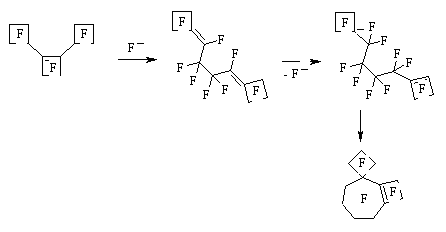
The generation of carbanions under the influence of anion-fluoride can result in transformation of an initial structure. Thus at the influence of CsF on a perfluorocyclobutene trimer a seven-member cycle is formed [108].
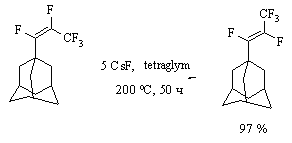
The influence of kinetic and thermodynamical control on the fluoroalkenes isomerization process allows obtaining of the olefins of a certain structure. For example, it is proved[109], that in case of adamantane replaced perfluoropropylene at a low temperature (0 oC) only Z-isomer is obtained (kinetic control), while at a high temperature (CsF, 200oC) they receive E-isomer
To be continued |


 5-C5Me5)Fe]
and LiO3SCF3 on perfluoro-2-methylpentane
and perfluoromethylcyclohexane produces multiple bond products
of the very low yield [97].
5-C5Me5)Fe]
and LiO3SCF3 on perfluoro-2-methylpentane
and perfluoromethylcyclohexane produces multiple bond products
of the very low yield [97]. 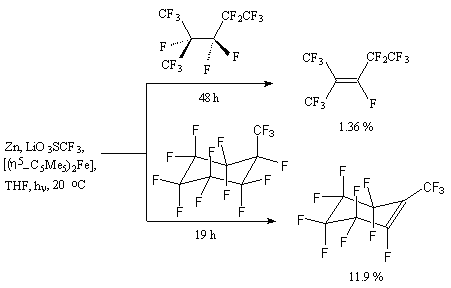

Fluorine Notes, 2008, 59, 3-4