Fluorine Notes, 2007, 53, 3-4
FLUORINE MODIFIED ALIPHATIC DICARBOXYLIC ACIDS ESTERS AS SEMI-PRODUCTS OF FLUORINE MATERIALS PRODUCTION
G. G. Furin, L. M. Pokrovsky, A. A. Il'yin*, U. L. Bachmutov *, A. N. Il'yin*, L. M. Ivanova* Novosibirsk Institute of Organic Chemistry , Russian
Academy of Science 630090, Novosibirsk,
Here we have considered the opportunity of obtaining the fluorine containing esters of aliphatic acids and maleinic acid using commercially available partly fluorinated alcohols for the purpose to create production technology for fluorine containing materials. We have discussed Here as well the perspectives of their application as surfactants, additives for oils, liquid heat-transfers, bases for hydrosystems and lubricating oils.
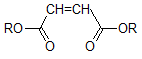
The rushing development of fluoroorganic compounds chemistry is tightly bonded with the techniques need for new materials. The production of such perfluorinated organic compounds, which meet the modern demands by their thermal physic and dielectric characteristics, work in a wide temperature range and thermal loads and already have found their practical application has been developed [1,2]. The total replacement of hydrogen atoms for fluorine atoms in an organic molecule results in the sharp change of a number of characteristics, what is used for creating a new generation of materials with splendid working characteristics. The availability of a stable production base is an important point for wide use of new fluorine materials. Commercially produced perfluorolefines had been the main raw materials' base till recent time. In this regard partly fluorinated alcohols obtained commercially by aliphatic alcohols influencing tetrafluoroethylene and hexafluoropropylene under the conditions of radical initiators' presence attract our attention [3-5]. They became one of the initial ones to obtain different compounds during fluororganic synthesis [2]. The modification of existing polymer materials by polyfluorinated telomeric alcohols allows changing to a great extent the complex of their physical and chemical properties expanding by that the application opportunities of such compositions for perspective directions [6]. It is enough to mention the opportunities of polyacrylates and methacrylates modified using fluorine by their ester part for creation of the shielding coats on textile materials [7]. Such fluorine alcohols proved to be effective O-nucleophiles and based on that a number of fluorine materials had been created. For example, the modification using fluorine in ester part of such unsaturated acids as acrylic [8], maleinic [9, 10], and fumaric [11] is of our interest. Modified by their ester fragment mono- and di-carboxylic acids form the base for production and wide application of structural materials, liquid heat-transfers, hydrosystems and lubricating oils for high-speed airplanes, protectants from steel, copper and other metals corrosion [12-14]. High thermal endurance and oxidization stability, good viscous properties for a wide range of temperatures, high self-ignition temperature (reaching over 400 oC), stability to hydrolysis and pyrolysis are just some of their advantages compare to the hydrocarbon analogues. that 's why the constant interest for that class of the organic substances is not surprising. A special attention was paid to the maleinic acid esters, used as monomers when obtaining elastomers [15], as hydraulic liquid and additives for lubricating oils [15,16]. Sodium and potassium salts of perfluoroalkylmaleates of H(CF2)nCH2OC(O)CH=CHCOOH ( n = 1-12) formula are used as surfactants [10, 17], wetting agents [10], hydraulic liquids [18] and antisoiling agents [19]. To improve the lubricating properties of oils based on fluorosiliconorganic liquid a 0,5-1% of fluorine containing maleinic acid ester of formula R(CF2)nCH2OC(O)CH=CHC(O)OCH2(CF2)nR, where R = H, F; n = 2-6 [16,20] (surface tension mN/m of such esters is equal: at n = 2 - 31.21; n = 4 - 27.57; n = 6 - 25 [15]) is introduced as an additive. Co-polymers of 1-octen with modified alcohols of F(CF2CF2)nCH2CH2OH (n = 3,4,5) type and maleinic acid esters are used as stable carpet coloring agents [21]. alcohols of RCH2OH (R = C7F15, perfluorocyclohexyl) type were used to obtain esters of itaconic and fumaric acids applied for fabrics impregnation to make them water-, soil-, and fat-repellent [22]. Here for this work we Have determined our goal as obtaining the maleinic acid ethers (look preliminary message [23]) and esters of dicaboxylic acids (adipinic, succinic and malonic) with the use of new partly fluorinated alcohols. It is known, that interaction of fluorine
containing alcohols and maleinic acid anhydride results either
in acid fluoroalkoxymaleinates [14, 17] or in esters of maleinic
acids [8-10,24]. Thus, at equimolar ratio in case of fluorine
alcohols R(CF2CF2)nCH2OH
(R = H, F; n = 1-3) at 90-120 oC and period of 10-20
h in the presence of catalytic quantities of sulphuric acid with
the yield of 36-45 % [9], and at 50-75 oC (10-40 h)
without catalyst with the yield of 37 % [8,20] acid esters of
fluoroalkoxymaleinates are formed. RFCH2CH2OH
fluorocontaining alcohols react with anhydride of maleinic acid
in the same way that is at 50-55 oC and period of 6 H
in the presence of Et3N in toluene acid
fluoroalkoxymaleinates (in the form of cis-isomers) are
formed with the yield of 97.3 %. At the same time
regardless of the origin of the fluorine alcohol at the
reagents' ratio of 1:2 the esterification of maleinic acid using
fluorine alcohols in the presence of carbon sulphide or catalytic quantities of
sulphuric acid at 110 oC (7 h) in toluene
[9,12,16,22,24] or oleum [16,17] and at 20 oC (24 H)
in the presence of triethylamine results in
bis(fluoroalkoxy)-maleinates. The esterification of fluorine
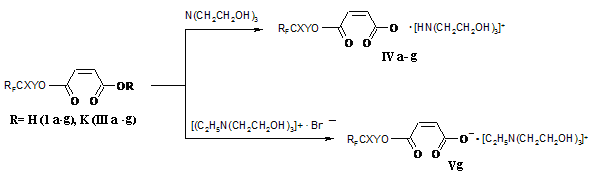
modified acid maleinate by 1,3-bis( Here we have drawn the optimization of the modes of carrying out the interaction process of polyfluorinated alcohols and maleinic acid anhydride. It has been determined, that when using the equimolar quantities of reagents and in the presence of catalytic quantities of triethylamine regardless of the used fluorine alcohol structure acid esters of maleinic acid Ia-g in the form of cis-isomers are obtained with the high yields, while at the ratio of reagents equal to 1:2 - the ethers of maleinic acid IIa-g in the form of cis-isomers as well (scheme 1, table 1). Their composition and structure are confirmed by the data of the elemental analysis, molecular weight and NMR 1H and 19F spectra (table 2), IR specta. Ie and IIe compounds are obtained in the form of the diastereoisomer mixture. In the IR spectra you can find the presence of the intensive absorption fields, caused by valence oscillations of the groups: C=C (1750 cm-1), CF2 (1250-1050 cm-1) and double bond C=C (1640 cm-1). Scheme1
Table 1. Analytical Data of Polyfluoroalkoxymaleinates
Table 2. NMR 1H and 19F spectra of maleinic acid esters
The yield of ethers of maleinic acid depends on the structure of the used alcohol or catalyst. Thus, in case of linear polyfluorinated alcohols the yield as a rule, depends on the length of carbon chain, while for the branched in an α-position alcohols a special demands play an important role and while they grow the yield of target products drops. Over the KOH the forming of mixtures of the corresponding ethers of maleinic acid and their potassium salts occurs regardless of the structure of alcohol used. Thus, the interaction of maleinic acid anhydride and 2,2,3,4,4,4-Hexafluorobutanol-1 and 2,2,3,3-tetrafluoro-1-dimetHyl-propanol-1 over KOH results in formation of mixture of potassium salt (Z)-4(2,2,3,4,4,4-hexafluorobutoxy)-4-oxo-but-2-enic acid IIIa and its ester IIa and potassium salt (Z)-6,6,7,7-tetrafluoro-5-metHyl-4-oxohept-2-enic III j and its ester II j respectively. The synthesis of the IIa-g esters can be carried out in a most convenient manner if we influence the anhydride of maleinic acid of corresponding fluoroalcohol in the medium of boiling toluene over the small quantities (0.1-0.05 moles) of concentrated sulphuric acid with azeotropic distillation of water (reaction period no longer than 3 Hours) at stirring which is required. In some cases we can observe the formation of two maleate isomers. Thus, when obtaining the bis(1,1,5-trihydrooctafluoropentoxy)maleate we can get the mixture of two isomers with the ratio about 48:36, that , is probably caused by maleinic acid isomerization into fumaric acid. At the same time, the tertiary alcohols CF3CHFCF2C(CH3)2OH and HCF2CF2C(CH3)2OH couldn't have been introduced into the reaction with maleinic acid anhydride under that conditions. We should note, that the excess of the fluoroalcohol used after the distillation doesn't require the additional purification and can be used again. Before [17] it was proved, that at interaction of acid ester of maleinic acid, for example in the medium of dimethyl formamide with glycidyltrimethylammonium chloride the salts were obtained. At 54 oC the salt [C6F13CH2CH2OC(O)CH=CHCH(OH)CH2NMe3]+*Cl- (yield 59.8 %) was isolated. We could also expect the forming of salts by carboxylic group by the influence of either trialkylamines or of quaternary ammonium salts. It is proved indeed, that at triethanolamine influence on I a-g acid esters of maleinic acid the corresponding IV a-g salts are formed (scheme 2). Influencing of some quaternary ammonium salts on IIIa, IIIg potassium salts we obtained V a, V g salts respectively. Such salts are foaming and surface active (according to our information the surface tension for that salts was about 27.59 mN/m and 24.55 mN/m ). that data points out the higher foaming ability and surface activity compare to potassium salts of IIIa,IIIg. Scheme 2
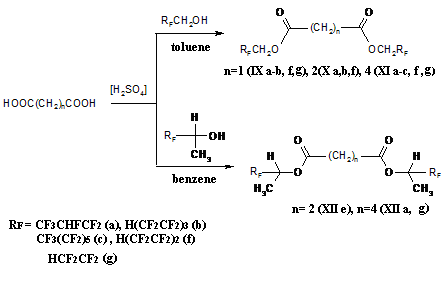
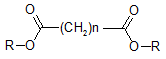
In the work [25] we have shown the opportunity of esterification of a number of aliphatic dicarboxylic acids by the influence of partly polyfluorinated alcohols over concentrated sulphuric acid. Thus, the esterification of glutaric acid and its methyl derivatives [26,27] is carried out by the partly fluorinated alcohols influence over the sulphuric acid [12], para-toluenesulpho acid [13] ( 1 % of the alcohol mass) both in the toluene [14], and in polychloroalkanes [28]. At that , the obtained compounds found their application as effective lubricants and hydraulic liquids [29]. α-n-Dodecylsiccinic anhydride is esterified by F(CF2)6CH2OH fluorocontaining alcohol under analogous conditions [30]. We've also got indications that esterification can be done by the mixture of telomeric alcohols H(CF2CF2)nCH2OH (n = 4, 6) of adipinic acid [31], and esterification of malonic acid with the CF3(CF2)6CH2OH alcohol [11 ]. We have studied the reaction of esterification of linear aliphatic dicarboxylic acids (VI - VIII) by fluorine containing alcohols, which passes over the catalytic quantities of concentrated sulphuric acid in toluene forming ethers (IX b-d), (X c-e), (XI a-e) (scheme 3). In case of esterification by secondary alcohols we have obtained the ethers (XIIe), (XIIIb,e). the characteristics of compounds are listed in table 3. Scheme 3
Table 3. Analytical Data of Fluorocontaining Esters of Dicarboxylic Acids
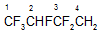
Table 4. NMR 1H and 19F spectra of Dicarboxylic Acids Esters
The distillation of water is carried out by separation of azeotrope with toluene or benzene. The etherification is sensitive to the structure of aliphatic dicarboxylic acid. Thus, by decreasing of the length of hydrocarbon bridge the yield of corresponding ester drops, while at transfer from malonic acid to adipinic acid we can observe the increase of target product (Table 3). The reaction should be carried out at mixing the reaction mixture due to the low solubility of intermediate products in toluene. The structure of ethers is confirmed by the data of NMR 1H and 19F (Table 4), IR spectra and elemental analysis. At that , the position of signals in NMR spectra are typical for initial fluorine alcohols and they slightly differ from it. In IR spectra the oscillations of OH group are not presented and intensive oscillations are appearing at 1790 cm-1 (C=O) and C-F bonds (1308-1124 cm-1). As for the oscillations of C-H bonds well they are in the area of 2920-2950 cm-1 and depending on the used acid are of complicated structure. Experimental Part NMR 1H and 19F spectra were obtained at Bruker WP 400 SY spectrometer (400, 188 MHz respectively) regarding inner standards hexamethyldisiloxane (HMDS), C6F6. IR-spectra were recorded Specord M-80 (CCl4) spectrometer; chromato-mass-spectra (energy of ionizing electrons is 70 eV) were registered using chromatograph with mass-selective detector (Hewlett Packard G 1800 A GCD) (we used the column of 30 m length, 0.25mm diameter, coated on the inner side with the 0.25 µm layer of copolymer 5% diphenyl -95% dimethylsiloxane (HP-5), gas-carrier-helium, 1 ml/min, evaporator temperature equals 280 oC. The temperature of column was increasing starting from 50 (stopped for 2 min) at a rate of 10 degree per min reaching 280 oC (it was held at that point for 5 min). All reactions were controlled using NMR 19F method. The analysis of reaction mixtures was carried out at chromatograph LHM 72 (15 % SE-30, SKTF-803, QF-1, Chromosorb W, colum 4000 mm, diameter 4 mm). Characteristics of new compounds and analytical data regarding them are listed in Tables 1 and 3. Common Synthesis Methods for Polyfluoroalkoxymaleates The mixture of 49 g (0.5 mole) of maleinic anhydride and 58 g (0.5 mole) of 1,1,3-trihydrotetrafluoropropanol-1 was heated while being mixed at the T of 85 oC during 40 h, the reaction mixture was cooled, the precipitated crystals were separated and re-crystalized out of toluene. We obtained 83 g (74 %) of tetrafluoropropylmaleate , boiling point is 70-71 oC. Other polyfluoroalkoximaleates were obtained the same way (Table 1). Common Synthesis Methods for Dicarboxylic Acid Esters The mixture of 24.5 g of maleinic acid (or dicarboxylic acid), 249 g of 1,1,7-trihydrodecafluoroheptanol-1, 2 ml of concentrated sulphuric acid and 250 ml of toluene was boiled along with stirring at 110-120 oC and toluene azeotrope with water was distilled. The reaction mixture was cooled, neutralized by 3%-solution of sodium bicarbonate and washed through with water till the neutral reaction (according to litmus), dried with CaCl2. Upon the distillation of toluene in the vacuum of water-jet pump, the residuum was distilled twice in vacuum. We obtained bis(1,1,7-trihydrodecafluoroheptoxy)maleate (IIb) with the yield of 70.7 %, b. p. 152-153 oC/ 2-3 mm Hg., n20D 1.3460 [according to data [24] b. p. 149-153 oC/ 5 mm Hg., n30D 1.3470, and according to [12] - 167 oC / 2 mm Hg.]. At standing the compound is crystallized, melting point is 62-63 oC. Analogously we have obtained bis(polyfluoroalkoxy) maleates: II f (85 %), II g (82 %). Their characteristics correspond to the ones represented in [9,12], and the characteristics of IIc (yield 92 %) agree with data [21]. Synthesis Methods for Esters of Aliphatic Dicarboxylic Acids Mixture of 0.01 g-mole of dicarboxylic acid, 0.02 g-mole of corresponding fluoocontaining alcohol and 2 ml of concentrated sulphuric acid is being boiled along with distillation of toluene azeotrope with water in 100 ml of toluene or benzene. After distillation of 0.02 g-mole of water, the reaction mixture is cooled and 70 ml of toluene is distilled in vacuum of water-jet pump. Then it is washed through with 3% solution of sodium bicarbonate up to neutral reaction (according to litmus), dried with CaCl2. It is distilled in the vacuum, the characteristics of the products are listed in Table 4. CONCLUSIONS
REFERENSES [1] Novoe in technologii soedinenii ftora. Transl. in jananeze. Red. A.V. Fokin. M. : Mir. 1984. 591 P. [2] Furin G.G.,Il'yin A.A., Bakhmutov Yu.L. et al. // Nauka proizvodstvu. 2004. № 5. p. 26-36. [3] Pat. 2150459 Russia (2000), Cl. 7 C 07 C 31/38. [4] Il'yin A.A., Bakhmutov Yu. L., Ivanova L.M. et al. // ZH. Prikl. Khim.,2004, v. 77, N. 1, p.. 102-105. [5] Wood C.D., Michel U., Rolland J.P., DeSimone J.M. // J. Fluorine Chem., 2004, v. 125, N 11. p. 1671-1676. [6] Furin G.G., Il'yin A.A., Ivanova L.M. et al. // Khimia in intereses ustoichivogo razvitiuya. 2005. v. 13. p. 831-838. [7] V.B. No, G.G. Furin. Fluorine containing polymer materials based on unsaturated acids modified according to ester fragment and their practical application. Fluorine Notes 2005. v. 4(41), July-Aug., v. 5(42), Sep.-Oct., v. 5(42), v. 6(43), Nov.-Dec. [8] Goldin G.S., Averbach K.O., Nekrasova L.A. // Zh. Prikl. Khim., 1977, v. 50, N. 4, p. 908-913. [9] Goldin G.S., Averbach K.O., Nekrasova L.A., Kisin A.V. // Zh. Obshch. Khim., 1977, v. 47, N. 5, p. 1086-1088. [10] Goldin G.S., Averbach K.O., Nekrasova L.A. // Zh. Prikl. Khim, 1984, v. 57, N. 7, p. 1577-1581. [11] Ger. Offen 1918079 (10.04.1968). CI. C 07c C 08f. Fluorinated esters of fumaric acid. [12] Pat. 3262881 U.S. (20.07.1966). Cl. 252-372. Metal carboxylate antioxidants for fluoroesters. [13] Raghavanpillai A., Burton D.J. // J. Fluorine Chem., 2006. v. 127. p. 456-470. [14] Pat. 3081342 U.S. (12.03.1963). CI. 260-485. III. Fluoroalkyl esters. [15] Goldin G.S., Averbach K.O., Nekrasova L.A., et al. // Zh. Prikl. Khim,1985, v. 58, N. 6, p. 1349-1353. [16] Pat 526655 USSR , Cl. C 10 M 1/30 [17] Pat. 3204378 Germany [18] Alifaticheskie ftorsoderzhashie soedineniya. // Ed/ I.L. Knyniynz. M. : Press. Inostran. Lit. 1961. 345 p. [19] Pat. 3135012 Germany [20] Pat. 3128303 U.S., CI. 260-485 (1964) [21] PCT Int. Appl. WO 2711219 (1997). ICM : D 06 M 015-277; ICS : D 06 M 015-263; 015-356 [22] Pat. 3868408 U.S., CI. 260-485À (C 07 C 69.52; C 07 C 69/60) [23] Il'yin A.N., Bakhmutov Yu.L., Il'yin A.A., Ivanova L.M. // Seminar "Ftorpolymers materials : fundamental/ application aspect in production" 9-11 Aug. 2003. Istomino. Ozero Baikal. Abstracts. CO-14, p. 109-110. [24] Pat. 47-89630 Japan [25] Filler R., Fenner J.V., Stokes C.S., et al. // J. Am. Chem. Soc., 1953. V. 75. P. 2693-2695. [26] Pat. 3412140 U.S., CI. 260-485. Polyfluorinated glutarate esters. [27] Murphy C.M., O'Rear J.G., Ravner H., et al. // J. Chem. And Eng. Data., 1959. v. 4. p. 344-346. [28] Pat. 2894971 U.S. [29] Pat. 63-45238 Japan, CI. Ñ 07 Ñ 69/63; C 07 C 69/657 [30] Pat. 3219687 U.S., CI. 260-485 [31] Commercial Fluoroorganic Products, St. Petersburg, Khimia. 1996. p. 481-482. |
|||||||||||||||||||||||||||||||||||||||||||||||||||||||||||||||||||||||||||||||||||||||||||||||||||||||||||||||||||||||||||||||||||||||||||||||||||||||||||||||||||||||||||||||||||||||||||||||||||||||||||||||||||||||||||||||||||||||||||||||||||||||||||||||||||||||||||||||||||||||||||||||||||||||||||||||||||||||||||||||||||||||||||||||||||||||||||||||||||||||||||||||||||||||||||||||||||||||||||||||||||||||||||||||||||||||||||||||||||||||||||||||||||||||||||||||||||||||||||||
 -hydroxypropyl)-1,1,3,3-siliconorganic
maleinates produces corresponding esters of maleinic acid [8].
-hydroxypropyl)-1,1,3,3-siliconorganic
maleinates produces corresponding esters of maleinic acid [8].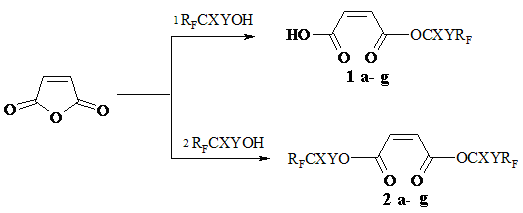
 ,
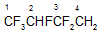
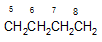
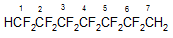
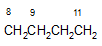
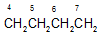
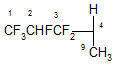
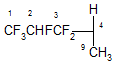
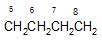
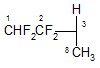
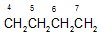
ppm ( structure, J Hz)
,
ppm ( structure, J Hz)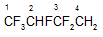












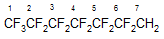
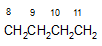
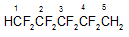
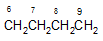


Fluorine Notes, 2007, 53, 3-4