Fluorine Notes, 2006, 47, 3-4
ELECTROCHEMICAL FLUORINATION (ECF) OF TOLUENE AND BENZOTRIFLUORIDE IN THE PRESENCE OF TRIALLYLAMINEV.A.Matalin a, G.I.Kaurova a, V.V.Berenblit b, V.I.Gribel a a FSUE RSC "Applied Chemistry", St.Petersburg,
Dobrolubov ave. 14, E-mail: Matalin@list.ru Electrochemical fluorination (ECF) in anhydrous hydrogen fluoride on nickel anodes is a frequently applied method for converting hydrocarbons or partly fluorinated organics into their perfluorinated analogues though keeping intact the functional groups or structure of the original substance that involves some heteroatom. For the first time the method was described in the late 1940th by J.Simons, and then further developed by many researchers [1] who applied it to the fluorination of organics soluble and conductive in HF, with molecules containing C-O, C-N, C-S or C-P bonds. Among numerous practically useful perfluorinated substances synthesized by ECF method, such as perfluoroalkyl amines and ethers, derivatives of perfluorocarbonic acids and sulfoacids, they usually do not mention perfluorocycloalkanes as all attempts to produce those substances by the electrolysis of their hydrocarbon analogues insoluble in electrolytes mostly failed. However, the development of a method for perfluorocycloalkanes manufacture is an important practical issue, because those fluorocarbons are known for quite unusual combination of their physico-chemical properties. In spite of large molecular masses they have low boiling points, critical temperatures and pressures; their high liquid density, expansion and compressibility coefficients provide very low sonic speed in those media. Surface tensions and refraction indices of those substances are much lower than those of any other liquid. They are distinguished for their excellent insulation properties and their unique chemical and biochemical stability makes them "practically untoxic". The synthesis of perfluoromethylcyclohexane (PFMCH) through ECF of toluene with very low yields are described in [2], while in the case of benzotrifluoride when the yield was 47% [3] the arrangement of non-interrupted electrolysis was hindered by electrolyte gumming in the process of electrolysis. Earlier it has been shown [4] that those effects are suppressable by adding some depolarizer that would fix the stationary electrolysis regime. It is particularly important in the case when ECF chemicals are non-soluble in HF and non-conductive, because such additive provides both conductivity of electrolyte and solubility of the original substrate in it. In this our study we attempted to apply ECF in the synthesis of perfluorinated cycled paraffins with the help of an electrolyte additive that undergoes electrolysis without electrolyte gumming and its fluorination results in some products of practical significance. In this connection we conducted a comparative study of the function of the yield of PFMCH in ECF of toluene and benzotrifluoride using n-triallylamine (TAA) ((CH2=CHCH2)3N) for a depolarizing additive, as its ECF occurs in stationary mode at the conditions of continuous electrolysis and results in a mixture of perfluorotripropylamine with perfluoro-N-propyl-5- or -6-member heterocycles with high yields [5]. Experimental procedure To produce perfluoromethylcyclohexane by ECF method we applied the electrolysis of benzotrifluoride or toluene mixed with triallylamine used for electrolytic additive. Electrochemical fluorination was conducted in a carbon steel Simons electrolyser of volume 660ml, provided with a water-cooled coil and a stack of nickel electrodes with the surface of anodes 500cm2. The electrolyser was provided with a reflux condenser for condensation and recycling of hydrogen fluoride carried with electrolysis gases. During those experiments the current load was 15A permanently, and the current density was 0.03A/cm2. For electrolyte we used a solution that contained 5% (mass.) benzotrifluoride or toluene and 5% (mass.) of triallylamine in liquid anhydrous hydrogen fluoride. To keep the concentration of organics in electrolyte permanent the initial organic blend was being fed 1-2 times hourly in amounts appropriate to their consumption coefficients. In ECF of toluene/triallylamine mixture the designed electricity consumption Q, was much higher than in ECF of benzotrifluoride. The ECF products with densities exceeding that of electrolyte were collected at the bottom of the electrolyser and drained over equal time periods. Crude product was pour off under water and neutralized with soda. Then the crude product was cleaned from non-fluorinated products with water-alcohol alkaline solution and dried with the help of silicagel. Dried crude product was directed to rectification in order to separate into three fractions: head fraction with tboiling 52-54 oC, target fraction with tboiling 76-78 oC and heavy fraction with tboiling 129-131oC. The fraction components were identified by their NMR F19 at Bruker
Spectrospin AM-500 at frequency 470,572MHz in C6F6 solution used for the
internal standard. The composition was analyzed by GL-chromatograph «Zvet-100»
equipped with a katharometer and a column charged with silochrome-80 with 20%
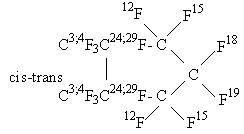
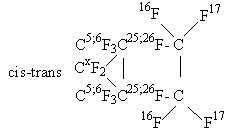
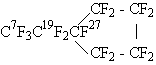
α,α,α-tris- Two structures were identified in the head fraction: perfluorocyclohexane and perfluoromethylcyclohexane stereo-isomers resulting from its cycle contraction. The target fraction at 76-78oC contained up to 80% of perfluoromethylcyclohexane CF3-c-C6F11 (with well-known NMR 19F spectrum [6]) and its isomers resulting from its cycle contraction identified as perfluoro-1,1-dimethylcyclopentane and its stereoisomers: perfluoro-1,2-dimethylcyclopentanes, perfluoro-1,3-dimethylcyclopentanes and perfluoroethylcyclopentane, their main characteristic signals in NMR 19F spectra being shown in Table 1. Table 1
The heavy fraction was a blend of perfluoroalkyl- and cycloalkylamines with its composition (%mass) as follows: 20.3 - perfluorotri(n-propyl)amine, 41.2 - perfluoro-N-(n-propyl)-cis-3,4-dimethyl-, 18.7 - perfluoro-N-(n-propyl)-cis-3,4-dimethyl- pyrrolidine [n-C3F7-N<c-C4F6(-3,4-CF3)2] and 19.3 perfluoro-N-(n-propyl)-3-methylpiperidine (n-C3F7-N<c-C5F9-3-CF3), their spectra being well known [5]. Experimental results and discussion The experimental conditions and results of ECF of toluene and benzotrifluoride mixtures with triallylamine are shown in table 2. Table 2
The observed yields-by-substance and yields-by-current do not contradict those shown in literature [2, 3, 5], and the usage of n-triallylamine for electrolyte additive allows increasing of the yield of useful fluorination products up to 78%. The target ECF fraction contains up to 20% of the products that due to cyclohexane ring contraction. Those isomers forming eutectic with PFMCH, decrease the mixture freezing point by 30?C (to compare with PFMCH) down to minus 65oC. Electrolysis being stable in time, this study opens technological opportunities for the high-yield manufacture of a number of organofluorochemicals for medical and technical applications in the unified ECF process of benzotrifluoride/triallylamine mixture. Conclusions The possibility is shown to produce PFMCH with rather good yield in the presence of TAA used for an electrolyte additive. The process may be depicted as combined fluorination of two classes of substances. The process occurs with good yield-by-current, it is stable in time and technologically applicable. Among the main electrolysis products are perfluorinated tertiary amines widely applied in industry, medicine, military industry, etc. Thanks to its process peculiarities the proposed method allows improving of some characteristics of electrochemical synthesis of perfluoromethylcyclohexane from benzotrifluoride and cut down its prime cost owing to simultaneous manufacture of some other marketable reaction products, namely perfluorinated tertiary amines. List of references
|
|||||||||||||||||||||||||||||||||||||||||||||||||||||||||||||||||||||||||||||||||||||||||||||||||||||||||||||||||||||||||||||||||||||||||||||||||||||||||||||||||||||||||||||
 -cyanacetophenone. The GCL composition is in good agreement with the
signal intensities in NMR 19F spectra.
-cyanacetophenone. The GCL composition is in good agreement with the
signal intensities in NMR 19F spectra. 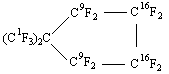
Fluorine Notes, 2006, 47, 3-4