Fluorine Notes, 2006, 47, 1-2
Obtaining of Perfluoroalkylsulphofluorides from SultonesC.M. Nurgalieva*, T.A. Bispen**, A.I. Ilyin*, D.D. Moldavsky** Perfluororganic compounds have their own market, which had formed long ago, and a stable demand. Introducing one or another functional group into perfluororganic molecule allows to obtain virtually universal compounds possessing full range of necessary characteristics, that goes far beyond the scope of their application. The demand for perfluorinated compounds grows constantly in the chemical materials market and is determined by the unique combination of chemical, thermal and dynamic, dielectrical and physical and mechanical characteristics. Perfluorinated compounds are chemically stable in a wide range of temperatures: from -260oC to +350oC [1-6], that allows using them as dielectrical- heat-transfers [7], polymerizing emulsifiers [8-13], lubricating oils [14], ion-exchange membranes and composition materials in aggressive media. Emulsifiers based on perfluorinated acids derivatives of common formula RfCOX are used to obtain super stable dispersions of fluorocarbon polymers of different brands [15]. Perfluorinated derivatives of sulphonic acids of common formula RFSO2X along with surface active influence [14,15] were spread among organic synthesis to introduce alkyl groups into composition of heterocyclic and sulphur-organic molecules[16,17,18], and also in production of colorants, anti-oxidants, UV-stabilizers and chemical sources of current [19, 20,21]. The wide spread of portable electronic devices: notebooks, cellular phones, video cameras, portable measuring devices and analyzers requires power-intensive, easy to recharge, environmental friendly batteries, condensers, supercondensers and galvanic cells with long functioning term. Conducting additives for electric ranges are known for a long time, but their application is limited in regards with thermal instability of compounds applied today. When producing Li-ionbatteries and two-layer condensers they use lithium hexafluorophosphate and quatemary alkylammonium tetrafluoroborate [20]. These salts are easy hydrolyzed when contacting air humidity or water traces in solvent isolating anhydrous hydrogen fluoride. Along with toxicity an anhydrous hydrogen fluoride very negatively influences recycle and reduction of electrical and chemical cell [6, 22]. Tris(trifluoromethylsulphonyl)methanide and their analogs are offered and tested as alternative for these systems [20-22]. Thus, imides of formula (CF3SO2)2NH, CF3SO2NHSO2(CF2)3CF3 and others are used for obtaining intercalated compounds like CXN(SO2CF3)2. Today such compounds are obtained by interacting of anhydrides and halogenanhydrides of perfluoroalkylsulphonic acids with ammonium or phosphonium bases [20, 23, 24]. Their using greatly improves the operational characteristics of electrical and chemical elements and simplifies the generating scheme of cathinoid part of chemical source of current. However, the high cost of perfluoralkylsulphonylhalogenides (PFASH) make difficult their application. The lower homologues of perfluoroalkylsulphonyl fluorides (PFASF) are of commercial interest. Different directions of PFASH synthesis have been worked out while looking for efficient obtaining method. At that, the following factors have been taken into account: yield of target products, composition of intermediate compounds, technological effectiveness of methods, quantity and composition of waste products, the possibility of their utilization, cost and availability of starting material. In Table 1 you can see the practicable versions of PFASH synthesis, the number of main stages according to the process chemistry and apparent yield by the sum of all the stages. Table 1. Apparent Directions of PFASH Synthesis
As a result of analysis of literary information and preliminary laboratory tests conducted by the author it was found, that there was quite a big number of synthesis methods of lower homologues of PFASH, though only few were applicable for commercial production, among which we can single out 2 main directions. 1. Obtaining of Functional Derivatives out of Perfluoroorganic Material. 2. Fluorinating of Alkylsulphonylhalogenides using all up-to-date known ways, including:
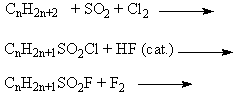
Perfluorolefines or perfluoroalkyliodides obtained out perfluorolefines, which commercial production is put into practice in this country, are used as starting materials for implementation of the first direction. Electrochemical fluorinating method of methylsulphonyl chloride implemented for commercial use at Angarsk Electrolysis Chemical Combine along with big power imputs is based on imported raw material, what can be practical only at conditions of monopoly production. Attempts to obtain perfluoroethylsulphonyl fluoride (hereinafter PFESF) by electrochemical fluorination proved to be of little avail for commercial application, because the yield of target product is 60 - 65%, a significant amount of close boiling admixtures is formed, that impedes its isolation using rectification. When using ethylsulphonyl fluoride obtained by interaction of ethylsulphonyl chloride and anhydrous hydrogen fluoride in the presence of chrome and magnesium catalyst (GIPH-55) at 170 - 2000C, we managed to increase the yield up to 83%. (The work was held at RSC "Applied Chemistry") But the isolation of target product (as the researches of the authors showed) is a rather complicated task. Only about 25% of formed PFESF is removed with the hydrogen flow, the rest of it due to good solubility of target product in HF stays inside the electrolyzer. Its isolation requires rectification of the mixture containing PFESF (b.p. =+80C) and anhydrous hydrogen fluoride (b.p. =+19,50C). PFESF can be isolated via neutralization anhydrous hydrogen fluoride by alkali or extracting using perfluorinated liquids, that allows to isolate up to 70% of PFESF contained in electrolyzer, but extragents are expensive and scarce products. If raw mateirals' base of unsubstituted alkylsulphonylchlorides was available the using of two-step scheme of fluorination had been planned (1):
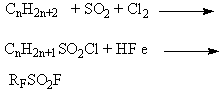
Hydrofluorination method at chrome-magnesium catalyst is put into practice for production of pentafluoroethane. Under laboratory conditions authors have carried out the experiments regarding hydrofluorination of alkylsulphonylchlorides using local technology [25] and further fluorination of obtained alkylsulphonylfluoride according to scheme 1. In the presence of chrome and magnesium catalyst the chlorine for fluorine substituting reaction in ethylsulphonylchloride under the influence of anhydrous hydrogen fluoride goes quantitatively. According to the results of experimental researches the yield counts to 90-95%. Obtained ethylsulphonyl fluoride was fluorinated in static mode of operation by 100% fluorine in steel reactor at gradual increasing of temperature from minus 70 up to 0oC. Fluorine was fed into by portions by its finishing. The yield of PFESF amounted to 70%. Upon attempting to accelerate the process the yield dropped down to 25-30% as a result of thermal destruction, caused by difficulties of heat removing. That researches hadn't found their further development because of raw materials' base missing. Nowadays active work is being done in the field of production of PFASF, which on the one hand is marked by an attempt to escape from ECF and on the other by an attempt to work out the obtaining technology for inexpensive source materials for the following exhaustive fluorination. Source materials for commercial electrochemical fluorination are obtained by Raid method at interaction between alkanes, sulphurous anhydride and chlorine at room temperature and UV-irradiation according to the following reaction (2):
Using other methods: oxidation of dialkyldisulfides and thiols (reaction 3 and 4) hasn't found commercial application because of very high-priced equipment, that is connected with strong corrosive action of used oxidizing mixtures [28, 29,30].
Raid reaction is typical for parafines. According to the information [31] such reaction is not typical for olefines, because their electron density is excessive due to the presence of double bond
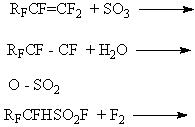
According to the results of the experiments after UV-irradiation of the mixtures containing hexafluoropropylene, sulphurous anhydride and chlorine in mole proportion 1:1:1 the 1,2-dichlorohexafluoropropane becomes the main reaction product (98%) sulphochlorides content is less than 0,5%. An attempt to sulphochlorinate the monohydropentafluoroethane appeared to be a little luckier. The yield counted to 3%. In this case fluorine atoms provide chemical inertness of starting compound. In a number of works [32, 33] they offer a one stage synthesis method of PFASH by reaction between perfluorolefine and haloidsulphuryl (7):
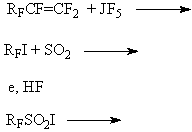
Sulphuryl fluoride (and chlorofluorosulphuryl too) , used for this synthesis are reactive compounds, which interact with end multiple bond of perfluorolefine. However, this synthesis method has a number of disadvantages, namely:
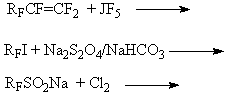
Works of Chinese research workers [27, 34, 35] are of indisputable interest. Authors used perfluoroalkyliodides and perfluoroalkylbromides, which in the presence of initiators generate perfluoroalkyl radicals. Using cheap reducing agent - Na2S2O4 (sodium diothionite) obtained out of perfluoroalkylhalogenides of the common formula RfX (where X-Br, I, RfCCl, R - alkyl radical) we can obtained perfluoroalkylsulphonic acids salts under rather mild conditions with the yield up to 80% according to the reaction (8)
Obtained sodium perfluoroalkylsulphinate is being chlorinated by elemental fluorine until they obtain perfluoroalkylsulphonyl chloride according to the reaction (9)
While laboratory tests using dithionite method went on we had stated, that the yield according to the scheme (reaction 8, 9) amounts to 70 -76%. To be continued |

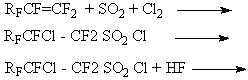




 - electrones, as a result of which only corresponding chlorine containing parafines can be a single additive compound. Perfluorinated olefines also contain double bond



Fluorine Notes, 2006, 47, 1-2