Fluorine Notes, 1999, 7, 3-4
Trihalomethanesulfenyl chlorides: preparation and use
T.E. Fiodorova
Dichloromethanesulfenyl chloride (DiCl),Cl2FCSCl and chlorodifluoromethanesulfenyl chloride
(DiF) ClF2CSCl possess the ability to react with compounds of different classes and can
be used as starting materials for synthesis of various organofluorine compounds including those with
high bioactivity which are used for protection of plants. DiCl and DiF are liquids of yellow color
with the following constants
|
Boiling point |
nd |
dn |
|
|
Cl2FCSCl |
99.5 |
nd20 1,4828 |
d20 1,6141 (1) |
|
97-98 |
nd25 1,4767 |
[2] |
|
|
ClF2CSCl |
52 |
nd20 1,4195 |
1.5344 (3) |
Detailed data on configuration of the molecules of these compounds, their spectra and other characteristics
are given in (4). 1. Methods to produce
1.1. Dichlorofluoromethanesulfenyl chloride
DiCl was produced in the late 50-s by different researchers practically at the same time .
E. Kober produced it mistakenly taken for trichloromethanesulfenyl fluoride (perchloromethane mercaptane),Cl3C-S-C , and HgF2 in methylene chloride (5). Later W.A.Sheppard and I.F.Harris repeated this synthesis and on the basis of reactivity characteristics and F NMR spectra determined that the reaction product was DiCl (2). The reaction mechanism was studied by H.Kloosterziel (6).
K. Petrov produced DiCl by two ways: dichlorofluoromethanesulfenyldiethyl amide decomposition with
dry hydrogen chloride in a medium of absolute ether (in 23% yield) or without it ( in 55% yield)
and by chlorine replacement with fluorine in trichloromethane sulfenyl chloride with hydrogen
fluoride (in 23% yield) (1). This reaction has been assumed as a basis for industrial method
of DiCl production. This method was improved by Farben fabriken Bayer AG ( Bayer AG from 1973y.):
they managed to increase the yield at vigorous stirring of the components, elevated temperature
and pressure and also to arrange the process in continuous mode on an industrial scale. Great
attention was paid to the choice of equipment arrangement and construction materials because
heavy metals and their salts decompose the starting mercaptane as well as DiCl itself (7). In the late 80-s a method to produce DiCl in 79.1% yield was proposed by means of interaction of
benzylthiocyanate with hexaethyltriamidophosphite and trichlorofluoromethane followed by treatment
of benzyldichlorofluoromethyl sulfide produced with chlorine (8).
1.2. Chlorodifluoromethanesulfenyl chloride
Attempts to produce DiF in satisfactory yields directly from Cl3C-S-Cl using fluorides failed because of C-S bond breaking. Thus, interaction of Cl3C-S-Cl with NaF at a temperature above 100oC resulted in the formation of F3C-SCl, DiF in amount of 3 mole% and disulfide (F3C-S)2 (9).
That is why staircase reactions were used. So, according to (10), chlorodifluoromethanechloromethanesulfide, CClF2SCH2Cl preliminarily produced was treated with a mixture of HCl-Cl2 under exposure of a mercury lamp for a long time ( over a day) and DiF was produced in 13% yield.
Paper (3) describes a method to produce DiF according to the following scheme:
| CCl3SCl + (C2H5)2NH |  |
CCl3SN(C2H5)2 |
| CCl3SN(C2H5)2 |  |
F2ClC-SN(C2H5)2 + CFCl2SN(C2H5)2 + CCl3SN(C2H5)2 |  |
|
CF2ClSCl + CFCl2SCl+ CFCl2SCl + CCl3SCl |
The mixture was readily separated by distillation. The following data on the yields of the products in dependence on the temperature were obtained:
|
ToC |
Chlorodifluoromethanesulfenyl chloride |
Dichlorofluoromethanesulfenyl chloride |
| 55 | 0,7 | 37 |
| 67 | 24,5 | 21 |
| 75 | 21,7 | 2 |
DiF is formed in a quantitative yield at –78oC by treatment of thiocarbonyl difluoride with chlorine.
| SCF2 + Cl2 |  |
ClF2CSCl (11,12) |
Referring to the same data, there is a method of CFCl2SCl fluorination by antimony trifluoride in the presence of antimony pentachloride at 150oC in trimethylsulfone to produce DiCl.
Interaction of trichloromethyldiethyl amino sulfide with hydrogen fluoride results in the formation of DiCl and products of C-S bond cleavage. (14)
| CCl3SN(C2H5)2 |  |
CFCl2SCl + CF2ClSCl + CCl3F + CCl3SCl (14) |
Methods to produce DiF and DiCl by CCl3SCl fluorination with fluorides of metals and nonmetals were patented in East Germany in the late 80-s.
The reaction takes place at complete conversion of the starting mercaptane at a temperature below its boiling point.
Apparently, the authors managed to find out the conditions under which mercaptane and the goal products did not decompose in the presence of compounds of heavy metals and DiCl was produced directly from CCl3SCl in a yield not lower than that in the staircase method of producing DiF described in (3).
| CCl3SCl( 1mol) + NH4F (2 mol) | |
75% DiCl + 5% DiF (15) |
| CCl3SCl + fluorides Fe,Al,Cr (0,5 mol) | |
52%DiCl + 9% DiF (16) |
| CCl3SCl (1 mol) + HF(1,4 mol) | 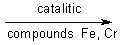 |
67,5% DiCl + 28% DiF + 4,3% F3CSCl (17) |
2. Application of DiCl and DiF.
Investigations of chemical properties of DiCl and DiF were started in the late 50-s in a number of countries also: in Russia, the USA and especially widely in Germany.
The first studies have shown that DiCl and DiF may be used for synthesis of various organofluorine compounds.
In Russia difluorochloromethane- -chloroethylsulfide unknown earlier was produced by reaction of DiF with ethylene
(18), difluorothiocarbonyle and fluorochlorothiocarbonyle were produced by reduction of DiCl and
DiF by tin (19). It was shown that interaction of DiCl and DiF with potassium cyanide resulted in
the formation of thiocyanate (20) and their interaction with nitric acid led to the formation of
trihalonitrosomethanes and sulfochlorides (21). The reaction of DiCl addition to olefins: cyclohexanone,
allyl chloride and propylene was studied also and the appropriate sulfides were produced (1).
-chloroethylsulfide unknown earlier was produced by reaction of DiF with ethylene
(18), difluorothiocarbonyle and fluorochlorothiocarbonyle were produced by reduction of DiCl and
DiF by tin (19). It was shown that interaction of DiCl and DiF with potassium cyanide resulted in
the formation of thiocyanate (20) and their interaction with nitric acid led to the formation of
trihalonitrosomethanes and sulfochlorides (21). The reaction of DiCl addition to olefins: cyclohexanone,
allyl chloride and propylene was studied also and the appropriate sulfides were produced (1).
In the USA (DuPont) W.Sheppard and J.Harris obtained bis(dichlorofluoromethyl)disulfide by shaking up DiCl with diethyl ether and KI, at interaction of DiCl with (CH2Cl)2-dichlorofluoromethyl-2-chlorocyclohexysulfide they produced other compounds also (2).
2.1. Developments of Bayer AG.
Investigators of Bayer AG have found that DiCl possesses optimal biocidic activity and having developed an industrial technology for its production started to produce highly efficient compounds to protect plants both of selective action regards a certain type of disturbing factors and of a wide spectrum of activity with fungicidic, pesticidic and other properties.
Compounds of different classes were studied in reactions with DiCl but the strongest biocidic potency was observed in compounds containing N-SCFCl2 group (N-sulfenyl ) (70).
Major investigations were carried out on different amines, imines, amides, aromatic and aliphatic, with different substituents as well heterocyclic compounds.
A reaction was carried out in a medium of organic solvent in the presence of triethylamine or pyridine (24). The reaction takes place according to the equation:
RfSCl + (C2H5)3N + RNH RNSRf + [(С2H5)2NH]+Cl-
To exclude interaction of amine with DiCl, the reaction was carried out at a reduced temperature ( such a side reaction is described in paper (83)).
The following compounds were taken as the starting materials for the reaction with DiCl :
- Amines, amides
- N-trifluoromethylarylamines with different substituents; N-sulfenylamides obtained are used as pesticides (23)
- substituted sulfamides; N-sufamides are fungicides (30,32,34,36),
- substituted formamides with DiCl form N,N-bis(sulfenyl)formamides possesing microbiocidic activity (45)
- derivatives of sulfonamides: N-sulfenylbenzenesulfonamides obtained are used as pesticides (57,59) and as microbiocides (43). N-sulfenylphenethylsulfonamides are effective fungicides (51)
N,N-diethyl-N'-aryl-N-sulfenyl sulfamides are used as wood preservatives (54)
- Imides
- Chlorocyanide
a) Phtalimide with DiCl forms N-sulfenylphtalimides showing antiparasitic activity (22).
b) Dimethylmaleimides form N-sulfenyl-substituted derivatives which are microbiocides as sulfenyl succinimides (46).
c) Imides containing isocyclic, aromatic or hydroaromatic rings in their structure form sulfenylated imides used as fungicides (47).
d) Derivatives of phtallimides form N-sulfenyl-substituted derivatives used as fungicides (42).
- Heterocyclic compounds.
| Cl2FCSCl + ClSN | |
Cl2FCSN:CCl2(33) |
Sulfenylisocyanide dichloride obtained is an intermediate product for producing other compounds, sulfenyl isothiocyanate, for example (65)
a) Hydantoine derivatives; N-sulfenylhydantoines obtained possess a strong fungicide (26,48) or microbiocidic (50) activity;
b) Benzotriazoles; sulfenylbenzotriazoles are also highly efficient fungicides (25)
c) imidazole derivatives
Derivatives of N-sulfenylbenzimidazoles (61) and N' N-disulfenylimidazoles are effective antimicrobial compounds (29);
d) triazole derivatives
N-sulfenyl derivatives possess fungicidic activity (49)
e)pyranopyrazole derivatives
N-sulfenyl derivatives are fungicides (52)
f) Indazole derivatives
N-sulfenyl indazoles show fungicidic activity (55)
g) Oxozole derivatives
Substituted 2-sulfenyl-1,3-oxazoles were used against nematodes (64)
5. Ethers of phosphoric (phosphonic) acid
The ethers with DiCl form thiophosphates used as insecticides (27) and N-sulfenylphosphonic acid ester amides used as insecticides and fungicides (41)
6. A number of investigations were carried out to produce derivatives of pyrazole. Compounds with insecticidic activity were produced by multistage synthesis (56,58,60,62)
7 .Interaction of DiCl with various amines was used to produce compounds used for further synthesis of isocyanates (38) and other derivatives (39,40,44).
8. Interaction of DiCl with compounds containing active C-H bond results in formation of intermediate compounds for synthesis of herbicides (66,67).
Continued in the next volume
Fluorine Notes, 1999, 7, 3-4