Synthesis and Characterization of Two New Fluorocomplexes,
[(C4H9)4N][VCl3F]
and [(C4H9)4N][ScCl3F]
Maryam Hajighahramania, Shahriare Ghammamyb,*,
Kheyrollah Mehrania,Tahmineh Banibairamia
a Department of Chemistry, Islamic Azad
University, Ardebil, Iran
b,*Department of Chemistry, Faculty of Science, Imam Khomeini
International University, Ghazvin, Iran,
E-mail: shghamami@ikiu.ac.ir or shghamamy@yahoo.com
Abstract:
The reaction between tetrabutylammonium fluoride and ScCl3 and VCl3 produced two new ionic fluorocomplexes with tetrabutylammonium
cation. One of them is tetrabutylammonium fluorotrichloroscandate (III),
(C4H9)4N[ScCl3F], TBAFS, that
is easily synthesized in a nearly quantitative yield using a direct reaction
of ScCl3 and tetrabutylammonium fluoride. Another is tetrabutylammonium
flurotrichlorovanadate (III), [(C4H9)4N][VCl3F],
TBAFV, that has been synthesized by reaction of tetrabutylammonium fluoride
with VCl3 salt. These compounds were characterized by IR, UV/Visible,
19F-NMR, 13C-NMR and 1H-NMR techniques.
The electronic and vibrational spectra of TBAFS and TBAFV have been measured
and studied.
Keywords: Synthesis, Characterization, Tetrabutylammonium
flurotrichlorovanadate (III), Tetrabutylammonium fluorotrichloroscandate (III).
Introduction
Nobel gas compounds have always been of great interest to both theoretically
and experimentally oriented chemists [1], particularly the fluorides have
been subject of an intense scientific discussion since the first synthesis
of such a compound [2,3]. This is because of the important prerequisites
for a fluorinating agents to be useful are its mildness, versatility, selectivity
and operational simplicity. The subject of this investigation is prepared
inorganic fluorides and complexes[4]. Another reason that encouraged researchers
for synthesizing this rang of fluorinated compounds is the fewer and rare
amounts of the spectroscopic data of this compounds especially 19F-NMR
data. Some of the reported data [5-8] about tungsten complexes collected
and shown in Table 1. For the above reasons and in the course of our investigations
on fluorocompounds of transition metals [9-13] and in continuation of our
studies on the use of tetrabutylammonium fluoride (C4H9)4NF
as a fluorinating agent [14] and after the synthesis of the (C4H9)4N[ScCl3F],
(C4H9)4N[VCl3F], we were prompted
to react ScCl3 and VCl3 with (C4H9)4NF.
We had prepared and reported synthesis of a number of [ScCl3F]-
and [VCl3F]- anions with tetraalkylammonium counter ion previously
[15,16]. We have managed to prepare two new fluorocompounds of vanadium and
scandium that are the analog of the above transition metal compounds. Fluorotrichloroscandate
(III) and flurotrichlorovanadate (III) have not been synthesized and reported
so far. In this paper a direct, simple and one-step method has been used
to synthesize these compounds. There were two primary incentives for selection
of (C4H9)4N+ as the counter ion.
Firstly, quaternary ions such as tetrabutylammonium are often used as phase
transfer catalysts. Secondly, quaternary ions such as tetrabutylammonium
are used as crystal growing agents.
Results and discussion
We had reported the synthesis of a number of halometales, with the belief that
those reagents could be used for the fluorination of organic substrates.
It has been shown that halometales were useful as new fluorination agents
for organic chemists [9,10]. Those compounds showed fluorination properties
like as other previous reported halometales [11-13 We now report the synthesis
of the TBAFV that is analog of the above mentioned vanadium compounds. The
advantages of the new method are:
a) there is no side product,
b) the reaction is quite fast,
c) mild conditions and
d) the accompanied
color change that providing visual means for ascertaining the progress of
the reaction.
Tetrabutylammonium
flurotrichlorovanadate (III) (C4H9)4N][VCl3F]
(TBAFV)
(C4H9)4N[VCl3F] was prepared by the
reaction of (C4H9)4NF and VCl3 in a 1:1 ratio in MeCN solvent as follows:

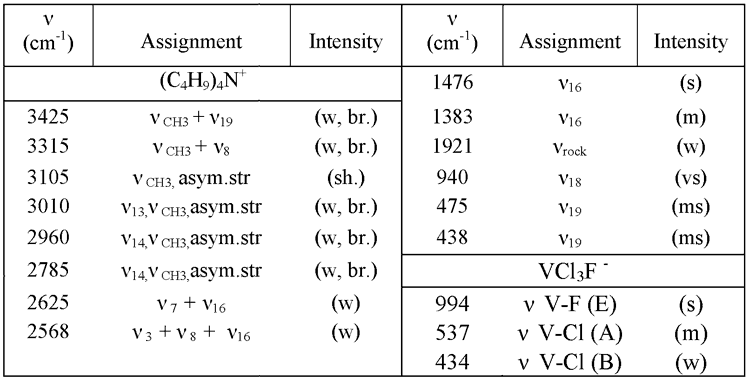
In the vibrational spectrum of this compound the known bands of cation and anion
were seen such as νV-F (A1) that was found at 994.53 cm-1 that confirmed with literature data (Table 1). There are two absorptions
in the compound electronic spectrum. Electronic spectrum of TBAFV shows two
shifts for acetonitrile at 212 nm (ε= 281 mol.-1lit.cm-1) that belongs
to 1E→1A
(e→a1) transition and for vanadium at 342 (ε=
549 mol.-1lit.cm-1) that belongs to 1E→1E (e→e) (Table 3). These transitions are expected as
in mono substituted vanadate ions, because of the position of vanadium
in the first series of transition metal elements and making of strong
crystalline field complexes.
The expected signals were found in the 1H-NMR and 13C-NMR.
Tetrabutylammonium fluorotrichloroscandate (III), [(C4H9)4N][ScCl3F]
(C4H9)4N[ScCl3F] was prepared
by the reaction of (C4H9)4NBr and ScCl3 in a 1:1,1 ratio in MeCN solvent as follows:

In the vibrational spectrum of TBAFS the cationic and anionic bands were seen
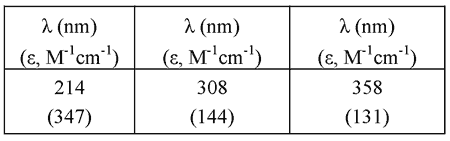
such as νSc-F that was found at 884.29 cm-1 that along the literature data (Table 2). There are three absorption bands
in this compound electronic spectrum (Table 4). The expected signals were
found in the19F-NMR, 1H-NMR and 13C-NMR.
Experimental
Material and instruments
Acetonitrile (Fluka, P.A.) was distilled several times from phosphorus pentaoxide
before use, thereby reducing its water content to <4 ppm. Tetrabutylammonium
fluoride was bought from Merck. ScCl3 and VCl3 (Merck,
p.a.) were used without further purification. Solvents were purified by standard
methods. Infrared spectra were recorded as KBr disks on a Shimadzu model
420 spectrophotometer. The UV/Visible measurements were made on an Uvicon
model 922 spectrometer. 1H and 13C-NMR were recorded
on a Bruker AVANCE DRX 500 spectrometer at 500 and 125 MHz, respectively.
All the chemical shifts are quoted in ppm using the high-frequency positive
convention; 1H and 13C-NMR spectra were referenced
to external SiMe4. Vanadium and scandium were estimated iodometrically.
The percent compositions of elements were obtained from the Microanalytical
Laboratories, Department of Chemistry, OIRC, Tehran.
Synthesis of Tetrabutylammonium fluorotrichloroscandate
(III),[(C4H9)4N][ScCl3F]
Tetrabutylammonium fluorotrichloroscandate (III), [(C4H9)4N][ScCl3F]
was prepared by dissolving ScCl3 (0.162 g, 1.07 mmol) in MeCN
and addition of this solution to a solution of tetrabutylammonium fluoride
(0.338 g, 1.07 mmol) in MeCN under stirring at room temperature until a white
precipitate was formed. After 2 hours stirring, the mixture was filtered,
washed with ether and dried at room temperature. The tetrabutylammonium salts
are some what hygroscopic, and it better stored under a layer of hexane,
whereas all of the salts aren't photosensitive and moisture-sensitive, both
in solution and solids. C16H36Cl3FNSc:
Cacl. %C, 46.55; %H, 8.72.
Found: %C, 48.40; %H, 8.91.
UV/Visible,
IR, 1H-NMR and 13C-NMR were all consistent with the
TBAFS structure. Mp: 130°C.
Synthesis of Tetrabutylammonium fluorotrichlorovanadate
(III),[(C4H9)4N][VCl3F]
Tetrabutylammonium flurotrichlorovanadate (III), [(C4H9)4N][VCl3F]
was prepared as follow: To a solution of a vanadium trichloride VCl3 (0.166 g, 1.05 mmol) in MeCN the solid powder tetrabutylammonium fluoride
(0.33 g, 1.05 mmol) was added under stirring at room temperature until a
green solid precipitate was formed. After 2 hours stirring, the mixture was
filtered, washed by ether, and dried at room temperature. C16H36Cl3FNV:
Cacl. %C, 45.88; %H, 8.6.
Found: %C, 47.62; %H, 9.01.
UV/Visible,
IR, 1H-NMR and 13C-NMR were all consistent with the TBAFV structure.
Conclusion
Two tetrabutylammonium fluoride salts of ScCl3 and VCl3 were synthesized simply. (C4H9)4N[VCl3F]
was prepared by the reaction of (C4H9)4NF
and VCl3 in a 1:1 ratio in MeCN solvent and (C4H9)4N[ScCl3F]
was prepared by the reaction of (C4H9)4NF
and ScCl3 in a 1:1,1 ratio in MeCN solvent. Electronic and vibrational
spectra of these two new Fluorocomplexes studied. These compounds were characterized
by IR, UV/Visible, and 13C-NMR and 1H-NMR techniques.
Production of these compounds shows the ability of tetrabutylammonium fluoride
in fluoride addition to transition metal and main group elements compounds.
References
- Nobel gas compounds (Ed. H. H. Hyman) 1967 (university of Chicago: Chicago,
IL)
- N. Bartlett, Proc. Chem. Soc. 1962, 218, 1
- M. Lein, G. Frenking, J. Chem. 2004, 57, 1191
- E. L. Muetterties, j. Am. Chem. Soc. , 1959, 81, 1084
- A. Lehtonen and R. Sillanpaa, Polyhedron (1994),13, 2519
- R. H. Grubbs, Comprehensive Organometalic Chemistry. (1982), 8,1193, ch.54,
New York
- S. Berger, S. Braun, H-O. Kalinowski, "NMR Spectroscopy of the Non-metallic
Elements " 1997, John Wiley & Sons Ltd.
- R. R. Schrock, Reaction of Coordinated Ligands, Plenum Press, New York, (1986)
- S. Ghammami, Synthesis and characterization of some complexes with Coordination
number greater than six, M.Sc thesis, Tarbiat Modarres University, 1995
- A. R. Farrokhi, Reaction of tetramethyl ammonium fluoride with some complexes
Of molybdenum, M.Sc Thesis, Tarbiat Modarres University, 1998
-
B. Sadeghi , Reaction of tetramethylammonium fluoride with some complexes
of rhenium, M.Sc Thesis, Tarbiat Modarres University, 1998
-
A. R. Abbasi, Reaction of tetramethylammonium fluoride with some Tungsten
Complexes, M.Sc Thesis, Tarbiat Modarres University, 2000. 13
-
A. Hosseinian, Reaction of tetramethylammonium fluoride with some Chromium
Complexes, M.Sc Thesis, Tarbiat Modarres University, 2000.
-
A. R. Mahjoub and K. Seppelt, J. Chem. Soc. Chem. Commun., (1991) 840
- Brauer, G., Handbuch der praparatiren anorganischen. Chemie. Enkel-verlag,
Stuttgart, 1960
- Mahjoub, A. R., Ghammami, S. Kassaee, M. Z., Tetrahedron Lett., 44 (2003)
4555
. Table 1. The
frequencies (cm-1) and assignment of cation and anion of TBAFV
Table
2. The frequencies (cm-1) and assignment of cation and anion of TBAFS
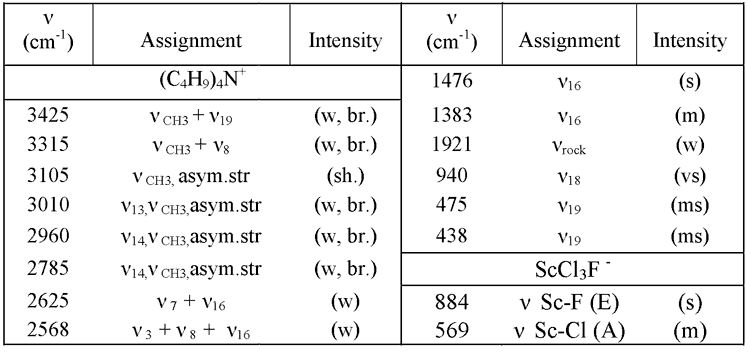
Table 3. Transitions specifications of TBAFV
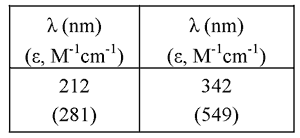
Table 4. Transitions
specifications of TBAFS
|