Introduction.
1. Approaches of fluorine modified ester fragment acrylates synthesis.
4. Polymerization and co-polymerization of fluorine containing acrylates.
5. Practical application fields of fluorine containing polymer materials based on
fluorinated acrylates and maleates.
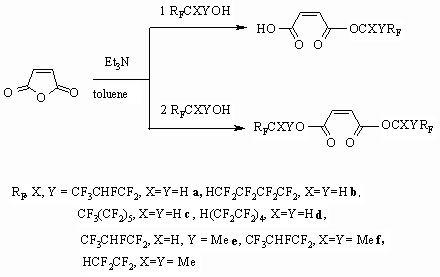
2. Maleic Acid Fluorine Containing Mono- and Diesters ObtainingAnother unsaturated acid - maleic acid as acrylic acid at catalysts' presence (concentrated sulfuric acid and sulfonated coal) reacts with fluoroorganic alcohols in benzene or toluene medium, producing fluoroorganic esters [83,107,108].

When using maleic acid anhydride fluorine containing mono- and diesters of maleic acid are formed depending on reagents' ratio [109-112]

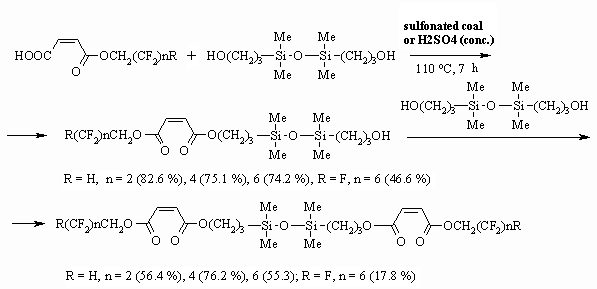
Esterification of fluoroalkoxymaleates acidic esters using 1,3-bis( -hydroxypropyl)-1,1,3,3-tetramethyldisyloxane in ratio 1:1 and 2:1 allows to obtain fluorocontaining, organosilicon maleates [113].
Maleic acid mono-esters salts are surfactants. They are obtained by glycyltrimethylammonium chloride reaction with mono-ester in dimethylformamide [110].
3. Sulphuric Acid Derivatives Synthesis Based on Fluorine Containing Ethers of Acrylic, Methacrylic and Maleic Acids and Their Salts.
An interest to surfactants based on fluororganic compounds aroused because of their wide application in may fields of economy. Adsorbing at border of phase break, they sharply change the nature and characteristics of surfaces. Creating of coatings and films at different organic and non-organic materials is in many aspects determined by adhesive and rheological characteristics of system, containing fluororganic components. Perfluorosulfoacids, perfluorosulfates, dodecylsuccinate bis-perfluoroctyl ether and others are used as surfactants. The surface tension study of a number of acrylic and methacrylic acid fluororganic esters revealed their high surface-active characteristics.
CH2=C(R)COOCH2(CF2)H
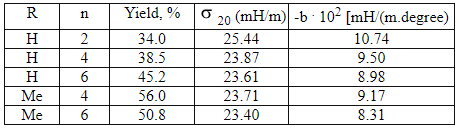
H(CF2)nCH2OOCCH=CHCOOCH2(CF2)nH
![nYield, % 20 (mH/m)-b . 102 [mH/(m.degree)]254.431.2110.01474.127.578.90675.025.817.89](/public/images/42_1/t2.png)
Surface tension  dependence on temperature t is approximized by linear equitation (average ratio error is 0.2 %) :
 t =
t = 20 + b (t - 20)
By increasing of a number of CF2 -groups surface tension and its temperature coefficient decrease, at that for methacrylates the tension is somewhat lower, than for acrylates with the same number of CF2- groups in chain. Mole surface energy of fluorine derivative acrylates and methacrylates is also arcwise dependant on a number of CF2- groups.
Sodium and potassium salts of maleic acid mono-esters are used as Surfactants and wetting agents [109].
Sulfopropionic and sulfo-isobutyric acids fluororganic esterss salts are of interest of researchers. One of approaches of their synthesis is sodium bisulphate attachment to acrylic and methacrylic acids esterss (yield is 64-84 %) [81].
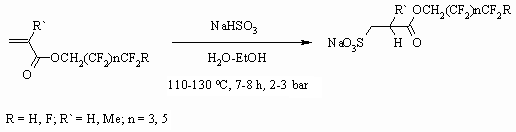
Surface activity of fluoroalkoxysulfopropionates and sulfoisobutyrates with the chain length of 5-7 carbon atoms is close to activity of hydrocarboxylic derivatives at water-air border.
NaO3SCH2CH(R')COOCH2(CF2)nCF2R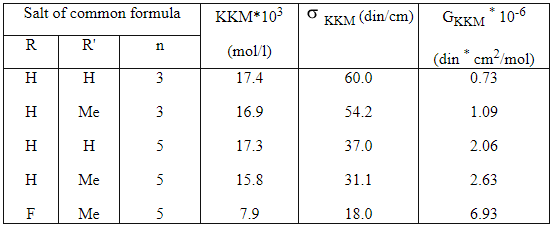
The introduction of sodium salt of 1,1-dihydrotridecafluoroheptylsulfobutyrate in concentration equal to 8*10 -3mol/l leads to decrease of surface tension from 72,75 to 18 and of interfacial tension 34,4 to 15 din/cm, that testifies rather high effectiveness of the present compound as surfactant.
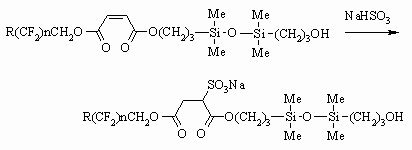
Method was also used for maleic acid di-esters. Thus, the interaction of bis(fluoroalkoxy)maleates and bisulfites of alkali elements results in formation of bis (fluoroalkoxy)sulfosuccinates salts with the yield of 64-74% [108].

Salts obtained are effective surfactants (for more information please look [114]).
In the work [113] there is a description of sulfosiccine acid fluorosilicon containing eaters mono- and di-sodium salts, obtained by sodium bi-sulfite action on organofluorosilicon maleates (yield is equal to 55-86 %).
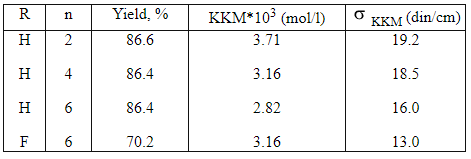
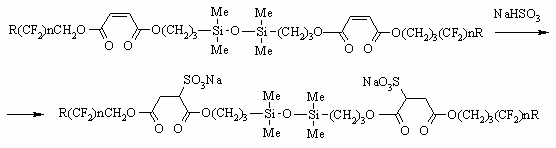
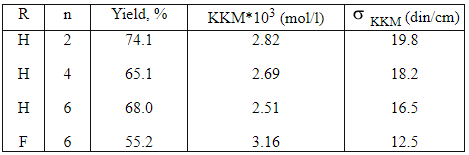
As we can see from the information above the fluorosilicon containing sulfosiccine acid ethers salts are effective surfactants. They while in small amounts (3-4*10-3 mol/l) sharply decrease water surface tension from 72,5 to 12-20 din/cm and interfacial tension (water-oligofluororganosiloxane) from 34,4 to 6-9 din/cm. By increasing of fluoroalkyl chain length the surface tension of salts increase.
To be continued