Fluorine Notes, 2005, 42, 3-4
NEW FLUORINE-CONTAINING POLYMERS USED FOR MODIFICATION OF CHEMICAL FIBRE SURFACE PROPERTIES
M.A. Chapurina*, L.S. Gal'braikh*, L.V. Redina*, L.S. Sletkina*, S.M, Igoumnov**, E.Yu. Maksareva**, K.E. Narinyan**
(*Moscow State Textile University: ** Joint-Stock Company "P&M-Invest")
A number of corresponding polyfluoroalkyl acrilates have been synthesized and the efficiency of their use for modification of chemical fibre surface with the aim of imparting the antiadhesive properties to them has been investigated on the basis of new monomers - alkyl fluoride esters of acrylic acid, differing in length and radical structure. It has been demonstrated that the highest level of these properties can be realized when using polyacrylates with long alkyl fluoride radicals of linear structure with no branchings and heteroatoms
As is well known, fluorine containing polymers possess unique characteristics, which are
determined by their chemical nature and structure of polymer chain. They are characterized
by high chemical stability, thermal stability, dielectrical properties, inertness etc. In
highly fluorinated fluorinated organic compounds intermolecular exchange forces are weak,
that explains their low surface tension. Weak intermolecular forces on the separation border
air-solid body in fluorine containing polymer compounds determine the forming of extremely
low surface energy surfaces. Due to this at introducing fiber into surface layer fluorpolymers
can sharply decrease its surface energy and lower wetting by liquids of different chemical
nature, including ones with low surface tension [1].
Using fluorine containing polymers
to lower wetting of fibers is one of most effective ways to obtain textile materials with
anti-adhesive (water-, oil-, dirt-repellent) properties. [2].
In world practice for this purpose latexes based on fluorine polymers, mainly polyfluoroalkylacrylates with long perfluoroalkyl radical had been invented and they are being widely used. Our (Russian) industry offers latex poly-1,1-dihydroperfluoroheptylacrylate-LFM-3 [3] to decrease wetting of fibers. According to the level of anti-adhesive characteristics, provided to textile material, it does not yield to foreign analogues, though it is expensive and its raw materials base is limited.
The works that have been done recently in the field of obtaining textile materials possessing
oil-, water-, mud-repellent characteristics are mainly dedicated to search for and creating
new compounds and compositions, which application would allow to lift up effectiveness of
treatment and also to simplify and reduce the price of production technology of both chemicals
themselves and modified materials.
It is known, that when we use poly-fluoroalkylacrylates
to modify textile materials surface characteristics the main facts determining the level
of these characteristics are length and structure of fluoroalkyl radical. Antiadhesive properties
of fiber begin to reveal themselves when at the end of chain it has no less than four perfluorinated
carbon atoms with CF3, and these properties increase greatly when chain length
increases. [2]. There is no information on the chain structure features influence, presence
of other atoms and groups in it in literature.
We in "P&M- Invest" have synthesized
several new types of fluorine containing monomers of acrylic row, which differ by length
and structure of fluoroalkyl radical and contain long linear or branched chains made of perfluorinated
carbon atoms at the end of radical. The cost of these products according to preliminary calculations
is much lower than cost of 1,1-dihyroperfluoroheptylacrylate used for production of latex
LFM-3. Below you can see the structure of fluoroalkyl radicals in monomer molecules of common
formula

Where R:
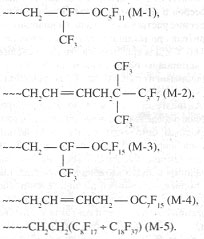
Here you can see the structure of polymer radical, making up the base of industrial latex LFM-3

and foreign chemical "Scotchgard- FC-251"

For the purpose of defining impact of structure of fluoroalkyl substituents in polymers, obtained on the base of new compounds, on the level of fiber wetting decrease we had carried out polymerization of monomers: M-1, M-2. M-3, M-4, M-5. The polymerization was carried out in solution of hexafluorobenzol at temperature of 80 oC in the presence of benzoyl peroxide. For all systems under investigation the monomer's conversion reached -90%.
M-1, M-3, M-5 polymers as poly-M-6 and poly-M-ck. Dissolve well in hexafluorobenzene and and
do not precipitate out of solution at polymerization. It turned out, that poly-M-2 and poly-M-4
didn't dissolve in hexafluorobenzene completely, that might have happened because of partial
lacing during synthesis, occurring as a result of chain transfer onto polymer.
The treatment of textile materials (we used viscose fiber and textile) was carried out using
equally concentrated 2-% polymer solutions in hexafluorobenzene at equal conditions (fiber
treatment by polymer solution, solvent removal at 100oC, heat treatment at 150-160oC).
For reference at the same conditions fibrous materials were treated with poly-M-6 and poly-M-ck.
isolated out of LFM-3 latex and "Scotchgard- FC-251" respectively.
Anti-adhesive
properties of modified materials were defined according to generally accepted, including
international methods: oil-repellent (My)-according to methods of 3M company [4], based on
definition of composition of heptane-oil mixture, not absorbing into modified material; water-repelling
(By) according to methods, based on definition of composition of isopropanol - water mixture,
which also doesn't absorb into modified material at liquid contacting fibrous substrates[5].
Besides that, we measured limiting wetting angle  o, i.e. angle, formed between drop of liquid and surface
of modified fiber. Liquid petrolatum and distilled water were used as wetting liquids.
o, i.e. angle, formed between drop of liquid and surface
of modified fiber. Liquid petrolatum and distilled water were used as wetting liquids.
As we can see judging by the information from the Table 1 all the polymers under investigation provide high level of anti-adhesive properties for fibrous materials, getting close to the known chemicals poly-M-6 and poly-M-ck in terms of efficiency of action.
The most high level of oil- and water-repellent properties of fiber can be reached when using polyfluoroalkylacrylates, containing long linear radicals. Branching and introduction of oxygen into fluoroalkyl radical lead to lowering the non-wetting effect of textile material. This can happen because of orienting processes rate lowering for the reason of space difficulties or because of forming conditions disturbance of homogeneous structure polymer layer on the surface of fiber when using polymers, in which fluoroalkyl radicals there is an oxygen atom.
It should be interesting to note, that polyfluoroalkylacrylates latexes treatment of fibrous materials at certain conditions, as we can see from poly-M-1 and poly-M-6 example, allows to reach the same effect as at solution treatment of these polymers.
The information obtained testifies the potential of practical use of new polyfluoroalkylacrylates to modify textile materials. It is necessary to provide the opportunity to obtain stable water disperse systems that is latexes on their base at technologically reasonable conditions to solve this goal and also we need to work out the their application conditions at treatment of textile materials.
Conclusions
- Based on new fluoroalkylates a number of polymers is obtained and their
fluoroalkyl radical structure influence on wetting decrease of fibrous materials
is investigated.
- It is stated, that linear structure long fluoroalkyl radicals polymers are characterized by highest efficiency.
- Branching of chain and introducing of oxygen atom into fluoroalkyl
chain result in decrease of modified fibres non-wetting effect.
REFERENCES
2. Isikawa N., Novoe v tekhnologii soedinenij ftora. M: Mir, 1984, s.404-416.
3. Sletkina L.S.‚ Repina L.V., Kolokolkina N.V., Khim. volokna. 1995, № 5.-s. 27-Z0.
4. Grajeck E., Petersen M.N.// Text. Res. J. 1962, № 4 - p. 320-331.
5. Raynolds S., Patent US 4147851.
6. Kurilenko A.I., Aleksandrova L.B.// Khim. volokna. 1965. № 3-s. 65-67.
Table 1. The Influence of Polyfluoroacrylates Fuoroalkal Radical Structure on Wetting
of Textile Material.
| Polymer-modifier |
My, conventional unit |
By, points |
Limiting wetting angle θo |
|||||
|
Liquid petrolatum |
Distilled water |
|||||||
| Solution | Latex | Solution | Latex | Solution | Latex | Solution | Latex | |
| Poly -M-1 |
100-110 |
100 |
5,0-5,5 |
5,0 |
- |
69-70 |
103 |
104-105 |
| Poly -M-2 |
100-110 |
- |
5,0 |
- |
64 |
- |
119 |
- |
| Poly -M-3 |
100-110 |
- |
5,0-5,5 |
- |
- |
- |
114-116 |
- |
| Poly -M-4 |
110 |
- |
5,0 |
- |
64-65 |
- |
116 |
- |
| Poly -M-5 |
120-130 |
- |
6,0-6,5 |
- |
90-92 |
- |
120-122 |
- |
| Poly -M-6 |
120 |
120 |
6,5 |
6,0 |
84 |
90 |
122 |
126 |
| Poly -M-ck |
120 |
120 |
6,5 |
6,5 |
- |
- |
- |
- |
Fluorine Notes, 2005, 42, 3-4