Other sulfides, containing electron-seeking substituents are also subject to anodic monofluorination
[64]. The information is given in table 12.
Fuchigami with colleagues has done his bit in understanding of anodic fluorination process passing ways
[100,109].
The system in which anodic fluorination is conducted is really important. Thus, by example of anodic
monofluorination of aryl-2,2,2-trifluoroethylsulfide the increasing of fluorination product yield
at transfer from Py* n(HF) system to Et3N* 3HF [110] system is registered.
Selective anodic fluorination of ethylphenylsulfanylacetate can be conduct in the flaw-type electrolyzer
at constant potential as well as in galvanostatic mode using anodes from OPTA, Pt or carbon in electrolyte
Et3N* 3HF and current density 15 mA/cm2 (yield of monofluorination product
is 61, 51 and 49 % accordingly) [98]. Anodic fluorination of sulfides, having electron-seeking substituents
in
 -position
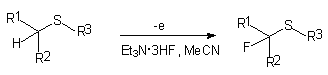
to sulfur atom (such groups as cyan, ethers, acyl and phosphates), enables to introduce selectively
fluorine atom into the same position [97].
-position
to sulfur atom (such groups as cyan, ethers, acyl and phosphates), enables to introduce selectively
fluorine atom into the same position [97].
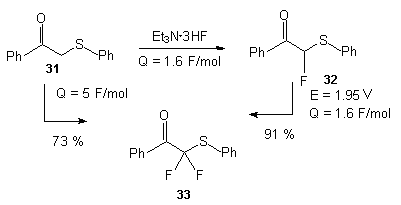
The highest yield of fluorination products is achieved in case of fluorination of PhSCH2CONHPr
(88 %) [97], 4-MeC6H4SCH2COOEt (78 %) [111] and PhSCH2COPh
(87 %) [108]. Mentioned way can be successfully used for fluorination of
-phenylthiosubstituted
cyclic carbonyl compounds as well as for obtaining of ,-difluoroderivatives
of ethyl--phenylthioacetate
The monofluorination mechanism of sulfur-containing compounds was not adequately explored. [6,8,9,64].
Many authors consider, that the process includes one-electrone oxidization of substrates with forming
of cation-radical. Subsequent steps of the process can pass in two: ether by elimination of proton
with generation of active radical, which oxidizes to cation under the action of current with generation
of sulfinic cation, which later reacts with fluoride-ion with forming of reaction product or
direct attack of carb-cation center by fluoride-ion occures
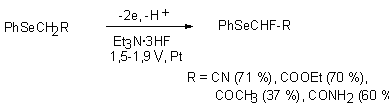
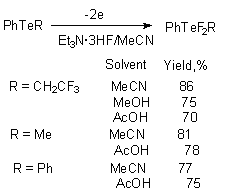
Selenium-containing compounds also react the same (table 14) [15,64,100,109,112-116].
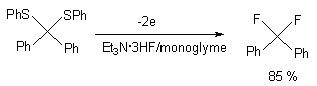
Interesting example of electrolytic fluorination is described in works [69,118], when at carbon atom
there are two phenyl groups and two SPh groups. In this case the substitution of SPh groups for fluorine
atoms occurs .
Sulfur-containing substitutes influence on anodic fluorination process is typical not only for aromatic
compounds, but also for heterocyclic ones. Thus, electrolytic fluorination of 2-benzothiazolyl- and
5-chloro-2-benzothiazolyl- sulfides using Et4NF*3HF system in dimethoxyethane
(DME) produces appropriate -monofluorinated sulfides [119].
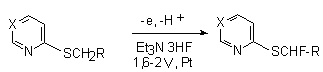
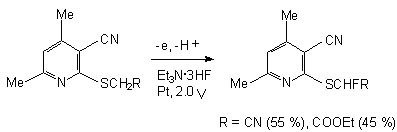
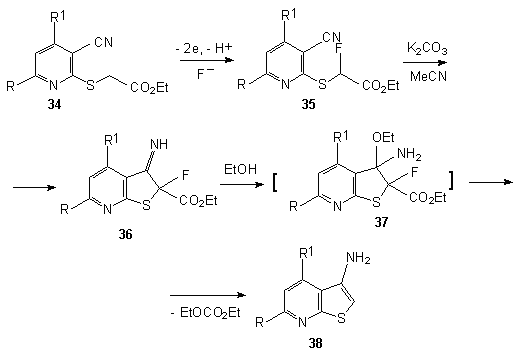
Laurent [108] and Fuchigami with their colleagues [64,86,109,120] discovered the formation of
-monofluoroderivative sulfides during anodic selective fluorination of nitrogen-containing heterocyclic
sulfides, which have electron-seeking substituent in methene group. Thus, the conduction of impulse
electrolysis of pyridine and pyrimidine derivatives in Et3N*3HF/MeCN medium with Pt
electrodes at 25 oC results in formation of monofluoroderivatives [114,120].
We'll note, that fluorination of these heterocyclic compounds by such fluorine reagents as triphthalate
N-fluoropyridinium and N-fluoro-3,5-dichloropyridinium
proved to be ineffective [121].
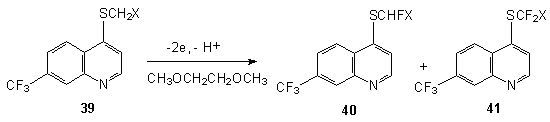
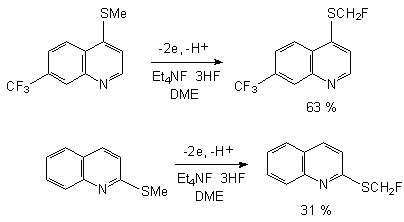
The solvent's influence on this reaction has been studied by Fuchigami [123]. It turned out, that
dimethoxyethane is the best solvent, acetonitrile is less effective though it’s mixture with
dimethoxyethane gives quite good results.
If in heterocyclic ring there is SMe groups the poor yield substitution of hydrogen from methyl group
by fluorine take place.
It should be noted, that such acknowledged fluorinating agents as N-fluoropyridinic salts [124]
showed absolute inertness at present objects. This allows to consider electrochemical fluorination
as alternative method for known fluorination processes and its further development and application
to other organic substrates can be expected.
Thus, the new approach to synthesis of hard-to-reach derivatives of sulfur and selenium with
S-CHF и SCF2, Se-CHF fragments is developed, some of which are high biologically active
[121]. In spite of seemed vagueness regarding commercial application the fluorination by electrolyte
method continues to attract active interest of researchers. The opportunity of moving the fluorination
centre from aromatic cycle onto functional groups, containing, for example active methene group,
creates real perspectives for development of convenient synthesis method of hard-to-reach monofluoroderivatives.
Polyfluorinated hydrocarbon synthesis using this method seems to be workable, that by all means
is important.
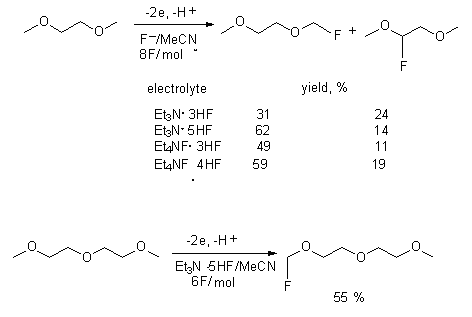
Dimethoxyethane and dimethyl ether of diglycol at anodic fluorination in electrolytes Et3N*5HF
and Et4NF*4HF give either mixtures of isomeric fluoroethers or monofluoroderivative
with fluorine atom located in the beginning of carbon chain [61].
As a whole, electrochemical fluorination method as way to low-fluorinated derivatives continues to
attract the attention of researchers, in spite of today’s vagueness regarding commercial application.
The presented material allows to make a conclusion that electrochemical monofluorination in electrolytes
- the complexes of anhydrous hydrogen fluoride and trialkylamines - is an important method of
obtaining of monofluorinated organic compounds, which opportunities steadily increase as far
as present method improves. At this different classes of compounds are entered into reaction,
that resulted in noticeable success of aromatic and heterocyclic monofluorinated derivatives
synthesis. The materials obtained have found practical application. Because of importance of
these organic compounds classes the improvement tasks of their obtaining technology are urgent
and stimulated by requirements of techniques. Obviously, the further research in this field will
go on both in extension of started before aspects of electrochemical process itself and in transfer
to fundamentally new decisions and approaches. Here it is important not only to formulate common
rules of organic compounds behavior in electrochemical fluorination process but also try to reveal
the specific particularities properties of the process, caused by fluorine atoms. Such substrates,
as can be seen from stated above, are noticeable more persistent in anodic oxidization conditions
and give noticeable higher outputs, that no doubt simplifiers the stage of target product extraction.
Thorough researches for development of our knowledge of electrochemical fluorination mechanism
should mean a lot.
1. Furin
G.G., Gambaretto G..P. / Direct fluorination of Organic Compounds.CLCUP,
Padova, Italy. 1996. 242 P.
2. Furin
G.G., Fainzilberg A.A. / Sovremennye metody ftorirovaniya organicheskih
soedinenij. M.: Nauka, 2000. 239 s.
3. Hara S.,
Yoneda N. // Yuki Gosei Kagaku Kyokaishi. 1998. Vol. 56. N 4. P. 312-319; C.
A., 1998. Vol. 128, 270161 (1998).
4. Uneyama
K. // Rev. Heteroatom. Chem. 1999. Vol. 20. P. 1-27.
5. Noel M.,
Suryanarayanan V., Shellammal S. // J. Fluorine Chem. 1997. Vol. 83. N 1, P.
31-40.
6. Rozhkov
I.N. / Anodic Fluorination in Organic Electrochemistry./ Eds. M.M. Baizer, M.
Lundt, Marcel Dekker : New York, 1983, pp. 805-825.
7. Rozhkov
I.N. / Organic Electrochemistry; 2nd ed. (Eds. Baizer M.M., Lund H. Marcel
Dekker : New York. 1983. Chapter 24.
8. Fuchigami
T. / Advance in Electron Transfer Chemistry. (Ed) Mariano P.S. JAI Press. CT.
1999. Vol. 6.
9. Fuchigami
T. / Organic Electrochemistry. (Rds.) Lund H., Hammerich O. Marcel Dekker : New
York. 4th ed. 2001. Chapter 26.
10.
Electrochemistry in the preparation of fluorine and its compounds. (Rds.)
Childs W.V., Fuchigami T. The Electrochemical Society, Inc. : Pennington. 1997.
11.
Fuchigami T., Nishiyama S. // Denki Kagaku (J. Electrochem. Soc., Jpn). 1997.
Vol. 65. P. 626-630.
12.
Silverster M.J. // Aldrichim. Acta. 1991. Vol. 24. P. 31-38.
13. Narizuka
S., Konno A., Matsuyama H., Fuchigami T. // Denki Kagaku (J. Electrochem. Soc.,
Jpn). 1993. Vol. 61. P. 868-869.
14.
Fuchigami T. // Farumashia. 1998. Vol. 34. N 11. P. 1118-1122; C.A. 1998. Vol.
129. 343125z.
15.
Fuchigami T., Higashiya S., Hou Y., Dawood K.M. // Rev. Heteroat. Chem. 1998.
Vol. 19. P. 67-78.
16. Momota
K., Morita M., Y. Matsuda Y. // Electrochim.Acta. 1993. Vol. 38. N 8.
P. 619-624
17.RozhkovI.N. //Uspekhikhimii. 1976. T. 45. v. 7. S. 1222-1250.
18. Rozhkov I.N., Buhtiarov A.V., Gal'pern E.G., Knunyants I.L. // Dokl. AN
SSSR. 1971. T. 199. S. 369.
19. Rozhkov I.N., Alyev I.Y. //Tetrahedron.1975.Vol. 31. N 8. P. 977-981.
20. Rozhkov I.N., Aliev I.YA.,
Knunyants I.L. // Izv. AN SSSR. Ser. khim. 1976. N 6. S. 1418-1421.
21. Rozhkov I.N., Buhtiarov A.V.,
Kuleshova N.D., Knunyants I. L. //Dokl. AN SSSR. 1970. T. 193. S. 1322; C. A.
1971. Vol. 74. 70878.
22. Knunyants I. L., Rozhkov
I.N., Buhtiarov A.V., Gol'din M.M., Kudryavtsev R.V. // Izv. AN SSSR. Ser. khim.
1970. N 5. S. 1207-1208; C. A. 1970. Vol. 73. 65752.
23. King
R.F., O`Malley R.F. // J. Org. Chem. 1984. Vo. 49. N 23. P. 2803-2809;
Carpenter J.F., Ekes L.H., King P.F., Mariani H.A., Mirza Zadeh M., O`Malley
R.F., Roman V.J. // J. Electrochem.Soc. 1983. Vol. 130. P. 2170.
24. Knunyants I. L., Rozhkov
I.N., Buhtiarov A.V. // Izv. AN SSSR. Ser. khim. 1971. N 6.S. 1369-1370;C. A. 1971. Vol. 75. 83478
25. Shen
X.-M., Hu C.-M. // Youji Huazue. 1993. Vol. 13. P. 122
26. Bensadat
A., Bodennec G., Laurent E., Tardivel R. // Tetrahedron Lett. 1977. N 43. P.
3799-3802.
27. Andres
D.F., Dietrich U., Laurent E.G., Marquet B.S. // Tetrahedron. 1997. Vol. 53. N
2. 647-658.
28. Andres
D.F., Laurent E.G., Marquet B.S., Benotmane H., Bensadat A. // Tetrahedron.1995.
Vol. 51. N 9. P. 2605-2618.
29. Rozhkov I.N., Buhtiarov A.V.,
Knunyants I. L. //Izv. AN SSSR. Ser. khim. 1972. № 5. S. 1130-1133.
30. Kono
K., Kimoto H., Katayama M., Fujii S., Yomerawa T., Momota K. / 14th
International Symposium on Fluorine Chemistry. July 31 - August 5, 1994,
Yokohama, Japan. Abstracts, 2P16, p. 263.
31. Shimizu
A., Yamataka K. / Pat. 62-127488 Japan (1987); Publ. C. A. 1988. Vol. 108.
28576.
32. Patent
Japan 61-256881 (1988).
33. Shimizu
A., Yamataka K. / Pat. 63-385991 Japan (1988); Publ. C. A. 1988. Vol. 109.
100859.
34. Makino
K., Yoshioka H. // J. Fluorine Chem. 1988. Vol. 39. N 3. 435-440.
35. Momota
K., Morita M., Matsuda Y. // Electrochim. Acta. 1993. Vol. 38. N 8. P.
1123-1130
36. Meurs
J.H., Sopher D.W., Eilenberg W. // Angew. Chem. Int. Ed. Engl. 1989. Vol. 28.
P. 927.
37. Fukuhara
T., Sawaguchi M., Yoneda N. // Electrochem. Commun. 2000. Vol. 2.N 4,
P. 259-261; C. A. 2000. Vol. 132. 285413 (2000).
38. Simidzu
A., Yamadala K. / Patent JP 63-111192 (1988)
39. Momota K.,
Yonezawa T., Hayakawa K., Kato K., Morita M., Matsuda Y. // J. Appl. Electrochim.
1995. Vol. 25. P. 621.
40. Momota
K., Kato K., Morita M., Matsuda Y. // Electrochim. Acta. 1994. Vol. 39. N 1. P.
41-49
41. Morita
M., Momota K., Horio H., Kato K., Matsuda Y. // Denki Kagaku. 1994. Vol. 62. N
12. P. 1196-1201.
42. Momota
K., Horio H., Kato K., Morita M., Matsuda Y. // Electrochim. Acta. 1995. Vol.
40. N 2. P. 233-240
43. Meurs
J.H.H., Eilenberg W. // Tetrahedron. 1991. Vol. 47. N 4/5. P. 705-717.
44. Bensadat
A., Bodennec G., Laurent E., Tardivel R. // J. Fluorine Chem. 1982.Vol.
20. N 3. P. 333-340.
45. Aliev I.YA., Rozhkov I.N., Knunyants I.L. // Izv. AN SSSR. Ser. khim. 1973. № 6. s.
1430, C.A. 1973, Vol. 79.91647
46. Momota
K., Kato K., Morita M., Matsuda Y. // Electrochim. Acta. 1994. Vol. 39. N 5. P.
681-690
47. Momota
K., Yonezawa T., Mukai K., Morita M. // J. Fluorine Chem. 1998. Vol. 87. N 2.
P. 173-178.
48. Laurent
E., Marquet B., Tardivel R. // Tetrahedron. 1989. Vol. 45. N 14. P. 4431-4444.
49. Shimizu
A., Yamataka K. / Patent Japan 88-111192 (1988); Chem. Abstr. 1989. Vol. 110.
84256p.
50. Bensadat
A., Bokennes G., Laurent E., Tardivel R. // Nouv. J. Chim. 1980. Vol. 4. P.
453-460.
51.
Sopherand D.W., Meurs J.H.H. / Pat. Appl. GB 2191480 (Brit. UK) (1987); C. A.
1988. Vol. 108. 212559.683.
52. King
P.F., Malley R.F. // J. Org. Chem. 1984. Vol. 49. N 15. P. 2803-2807.
53.
Carpenter J.F., Ekes L.H., King P.F., Mariani H.A., Mirza Zadeh M., O`Malley
R.F., Roman V.J. // J. Electrochem. Soc. 1983. Vol. 130. N 11. P. 2170-2172; C.
A. 1984. Vol. 100. 14410.
54. Laurent
E., Lefranc H., Tardivel R. // J. Fluorine Chem. 1987. Vol. 35. N 1. P. 54;
Nouv. J. Chim. 1984. Vol. 8. P. 345.
55. Bensadat
A., Laurent E., Tardivel R. // Nouv. J. Chim. 1981. Vol. 5. N 7. P. 397-411;
Chem. Abstr. 1081. Vol. 95. 168376.
56.
Selective Fluorination in Organic and Bioorganic Chemistry./ Ed. Welch J.T..
American Chemical Society : Washington, D.C., 1991.
57. Umemoto
T., Goto Y. // J. Fluorine Chem. 1986. Vol. 31. N 2. P. 231-236.
58. Childs
W.V., Christensen L., Klink F.W., Kolpin C.F./ Organic Electrochemistry. 3rd
ed./ Eds. H. Lunt, M.M. Baizer. Marcel Dekker : New York, 1991, P. 1103-1127.
59.
Gambaretto G.P., Napoli M., Franccaro C., Conte L. // J. Fluorine Chem. 1982.
Vol. 19. N 5. P. 427-436.
60.
Ballinger J.R., Teare F.W. // Electrochim. Acta 1985. Vol. 30. P. 1075.
61. Hou Y.,
Fuchigami T. // Tetrahedron Lett. 1999. Vol. 40. N 44. P. 7819-7822.
62. Laurent
E., Marquet B., Tardivel T., Thiebault H. // Bull. Soc. Chim. Fr 1986. P. 955.
63. Makino
K., Yoshioka H. / Pat. 09-29364 Japan (1989); Publ. C.A. 1989. Vol. 111.
78002g.
64.
Fuchigami T., Shimojo M., Konno A., Nakagawa K. // J. Org. Chem. 1990. Vol. 55.
N 25. P. 6074-6075.
65.
Fuchigami T., Narizuka S., Konno A. // J. Org. Chem. 1992. Vol. 57. N 14. P.
3755-3757.
66.
Fuchigami T., Narizuka S., Konno A., Momota K. // Electrochim. Acta. 1998. Vol.
43. N 14/15. P. 1985-1989; C.A. 1998. Vol. 129. 141845y.
67.
Higashiya S., Narizuka S., Konno A., Maeda T., Momota K., Fuchigami T. // J.
Org. Chem. 1999. Vol. 64. N 1. P. 133-137.
68. Ishii
H., Yamada N., Fuchigami T. // J. Chem. Soc., Chem. Commun. 2000. N 17. P.
1617-1618; C.A. 2000. Vol. 133. 350158y.
69. Yoshiyama
T., Fuchigami T. // Chem. Lett. 1992. N 10. P. 1995-1998; C.A. 1993. Vol. 118.
6677..
70. Narizuka
S., Fuchigami T. // J. Org. Chem. 1993. Vol. 58. N 16. P. 4200-4201.
71.
Sawaguchi M., Hara S., Fukuhara T., Yoneda N. // Isr. J. Chem. 1999. Vol. 39. N
2. P. 151-154; C. A., 1999. Vol. 131. 286337k.
72.
Fuchigami T., Tetsu M., Tajima T., Ishii H. // Synlett. 2001. N 8. P.
1269-1271.
73. Suda K.,
Hotoga K., Aoyagi M., Takanami T. // J. Chem. Soc., Perkin Trans, I. 1995. N.
9. P. 1327-1329.
74. Fuchigami
T. et al. / 16th Symposium on Fluorine Chemistry. Oct. 28-29, 1991, Nagoya,
Japan. Abstracts, O-35, p. 127.
75. Laurent
E., Marquet B., Tardivel R., Thiebault H. // J. Fluorine Chem. 1985. Vol. 29. N
2. P. 193.
76. Laurent
E., Tardivel R., Thiebault H. // Tetrahedron Lett. 1983. Vol. 24. N 9. P.
903-906.
77. Hou Y.,
Higashiya S., Fuchigami T. / 21st Fluorine Conference of Japan, Oct. 8-9, 1997,
Sapporro, Japan. Abstracts, O-19. p. 27.
78. Hou Y.,
Higashiya S., Fuchigami T. // Synlett. 1997. N 6. P. 655-656.
79. Hou Y.,
Higashiya S., Fuchigami T. // J. Org. Chem. 1997. Vol. 62. N. 25. P. 8773-8776.
80. Konno
A., Shimojo M., Fuchigami T. // J. Fluorine Chem. 1998. Vol. 87. N 2. P.
137-140.
81. Makino
K., Yoshioka H. / Jpn. Kokai Tokyo Koho JP 0129364 (1989); Chem. Abstr., 111,
78002g (1989).
82. Konno
A., Fuchigami T. / 21st Fluorine Conference of Japan, Oct. 8-9, 1997, Sapporro,
Japan. Abstracts, P-39. p. 80.
83. Kato K.,
Momota K. / The 18th Symposium on Electroorganic Chemistry. Nagoya, Japan,
1995. Abstracts. P. 101.
84. Hou Y.,
Higashiya S., Fuchigami T. // J. Org.Chem. 1999. Vol. 64. N 9. P.
3346-3349.
85. Makino K., Josioka K. / Patent JP 6429399 (1989)
86. Konno
A., Naito W., Fuchigami T. // Tetrahedron Lett. 1992. Vol. 33. N 46. P.
7017-7020.
87. Hou Y.,
Higashiya S., Fuchigami T. // Synlett. 1998. N 9. P. 973-974; C.A. 1998. Vol.
129. 302460m.
88. Sono M.,
Toyoda N., Shizuri Y., Tori M. // Tetrahedron Lett. 1994. Vol. 35. N 49. P.
9237-9238.
89.
Higashiya S., Sato T., Fuchigami T. // J. Fluorine Chem. 1988. Vol. 87. N 2. P.
203-208.
90.
Higashiya S., Sato T., Fuchigami T. / 21st Fluorine Conference of Japan, Oct.
8-9, 1997, Sapporro, Japan. Abstracts, P-40. p. 81.
91. Laurent
E., Marquet B., Tardivel R., Thilbault H. // Tetrahedron Lett. 1987. Vol. 28. N
21. P. 2359-2362.
92. Laurent
E., Marquet B., Tardivel R. // J. Fluorine Chem. 1990. Vol. 49. N 1. P.
115-126.
93. Laurent
E., Marquet B., Tardivel R. // Tetrahedron. 1991. Vol. 47. N 24. P. 3969-3980.
94.
Suryanarayanan V., Noel M. // J. Fluorine Chem. 1998.Vol. 91. N 2. P.
153-157.
95. Laurent
E., Marquet B., Roze C., Ventalon F. // J. Fluorine Chem. 1998. Vol. 87. N 2.
P. 215-220.
96. Kabore
L., Chebli S., Faure R., Laurent E., Marquet B. // Tetrahedron Lett. 1990. Vol.
31. N 22. P. 3137-3140.
97.
Fuchigami T., Shimojo M., Konno A. // J. Org. Chem. 1995. Vol. 60. N 11. P.
3459-3464.
98. Konno
A., Fuchigami T. // J. Appl. Electrochem. 1995. Vol. 25. N 2. P. 173-175;аЦешь, 1996. 23С3318.
99.
Fuchigami T., Naritsuka S., Konno A. // J. Fluorine Chem. 1991. Vol. 54. N 1-3.
P. 217.
100.
Fuchigami T. // Rev. Heteratom Chem. 1994. Vol. 10. P. 155-172.
101. Yoneda
N., Chen S.-Q., Hatakeyama T., Hara S., Fukuhara T. // Chem. Lett. 1994. N 5.
P. 849-850; C.A. 1994. Vol. 121. 45079.
102. Dinoiu
V., Fukuhara T., Hara S., Yoneda N. // J. Fluorine Chem. 2000.Vol. 103.
N 1. P. 75-80.
103. Hara
S., Chen S.-Q., Hatakeyama T., Fukuhara T., Yoneda N. // Tetrahedron Lett.
1995.Vol. 36. N 36. P. 6511-6514.
104. Yoneda
N. / Novel Trends Electroorg. Synth. [Pap. Int. Symp.] Ed. S. Torii.Springer
: Tokyo, Japan. 3rd, 1997 (Pub. 1998) 119-123; C. A. 1998. Vol. 129. 302391.
105.
Sawaguchi M., Hara S., Fukuhara T., Yoneda N. // Isr. J. Chem. 1999.Vol.
39. N 2. P. 151-154; C. A. 1999. Vol. 131. 286337.
106. Chen
S.-Q., Hoshio T., Fukuhara T., Hara S., Yoneda N. / 20th Japanese Symposium on
Fluorine Chemistry.Oct. 30-31, 1996, Nogoya, Japan. Abstracts, O-26, p.
65.
107. Hara
S., Chen S.-Q., Hoshio T., Fukuhara T., Yoneda N. // Tetrahedron Lett. 1996.
Vol. 37. N 47. P. 8511-8514.
108. Brigaud
T., Laurent E. // Tetrahedron Lett. 1990. Vol. 31.N 16. P. 2287-2290.
109. Konno
A. N., Nakagawa K., Fuchigami T. // J. Chem. Soc., Chem.Commun. 1991.
P. 1027-1029.
110.
Fuchigami T., Konno A., Nakagawa K., Shimojo M. // J. Org. Chem. 1994. Vol. 59.
N 20. P. 5937-5941.
111.
Fuchigami T., Nonako T., Konno A. / Pat 03 284662 Japan (1991); C. A. 1992.Vol.
116. 255309p.
112. Fuchigami
T., Yano H., Konno A. // J. Org.Chem. 1991. Vol. 56. N 24. P.
6731-6733.
113.
Narizuka S., Fuchigami T. // J. Org. Chem. 1993. Vol. 58. N 16. P. 4200-4201.
114. Erian
A.W., Konno A., Fuchigami T. // Tetrahedron Lett. 1994. Vol. 35. N 39. P. 7245-7248.
115.
Fuchigami T., Konnю A.
// J. Org. Synth. Chem. Jpn. 1997. Vol. 55. N 4. P. 301-312.
116.
Fuchigami T., Hayashi T., Konno A. // Tetrahedron Lett. 1992. Vol. 33. N 32. P.
3161-3164.
117.
Fuchigami T., Fujita T., Konno A. // Tetrahedron Lett. 1994. Vol. 35. N 24. P.
4153-4156.
118. Brigaud
T., Laurent A., Laurent E. // Phosphorus, Sulfur, Silicon, Relat. Elem. 1991.
Vol. 59. N 1-4. P. 447-450; C. A. 1991. Vol. 115. 49001h.
119. Hou Y.,
Higashiya S., Fuchigami T. // J. Org. Chem. 1997. Vol. 62. N 26. P. 973-976.
120. Erian
A.W., Konno A., Fuchigami T. // J. Org. Chem. 1995. Vol. 60. N 23. P.
7654-7659.
121.
Fuchigami T., Konno A. // Current Topics in Electrochemistry. 1993. Vol. 2. P.
155 (1993), Research Trends, Trivandrum, India.
122. Dawood
K.M., Fuchigami T. // J. Org. Chem. 1999. Vol. 64. N 1. P. 139-143.
123. Hou Y.,
Fuchigami T. // Electrochem. Commun. 1999. Vol. 1. N. 10. P. 445-448; C.A.
1999. Vol. 131. 357298m.
124. Umemoto
T., Tomizawa G. // Bull. Chem. Soc., Jpn. 1986. Vol. 59. P. 3625; J. Org. Chem.
1995. Vol. 60. N 20. P. 6563-6570.
125. Marat
R.K., Janzen A.F. // Can. J. Chem. 1977. Vol. 55. P. 3031.
126. Jansen
A.F., Wang P.M.C., Lemire A.E. // J. Fluorine Chem. 1983. Vol. 22. N 6. P.
557-559.
127.
McCarthy J.R., Peet N.P., le Tourneau M.E., Inbasekaran M. // J. Am. Chem. Soc.
1985. Vol. 107. N 3. P. 735-737.
128. Robins
M.J., Wnuk S.F. // Tetrahedron Lett. 1988.Vol. 29. N 45. P. 5729-5732.



 .
.