Fluorine Notes, 2002, 23, 1-2
Use of hydrogen fluoride and its complexes with bases for introduction of fluorine atoms into organic molecules
G.G.Furin
Novosibirsk Institute of organic chemistry named after N.N.Vorozhtsov
Siberian branch of the Academy of Science of Russian Federataion
Fax: +7-3822-344752
e-mail: furin@nioch.nsc.ru
Annotation
The review summarizes and systematizes up-to-date data on fluorinating ability of anhydrous hydrogen fluoride and its complexes with bases of unsaturated organic compounds, alcohols, diazoketones, hydrazones and oximes of ketones, 3,3-dialkyl-1-aryltriazenes, aryldiazosulfides etc.. It contains an analysis of main achievements in use of anhydrous hydrogen fluoride as a fluorinating agent to produce ozone-friendly freons in gas and liquid phases both without catalysts and in the presence of latter. There has been examined factors influencing opening three-membered cycles containing oxygen and nitrogen atoms. The review contains examples of practical application of different groups of fluoroorganic compounds, rational methods of their production and their role in development of modern industry .
Contents
Introduction. Hydrogen fluoride as a basic stock substance in chemical industry.
1. Fluorination with anhydrous hydrogen fluoride and its complexes with bases of compounds from different classes.
1.1.Hydrofluorination of unsaturated compounds
1.1.1. Influence of anhydrous hydrogen
fluoride on unsaturated compounds
1.1.2. Hydrofluorination of unsaturated
compounds by hydrogen fluoride complexes with bases
1.1.3. Reactions of anhydrous
hydrogen fluoride and its complexes containing bases with acetylene derivatives
1.1.4.
Fluorination of alkenes with hydrogen fluoride in the presence of catalysts
1.1.5.
Fluorination of unsaturated compounds with hydrogen fluoride in the presence
of electrophilic reagents
2. Processes of replacement of functional groups with fluorine atoms.
2.1. Replacement of oxy-group with fluorine under effect of hydrogen fluoride complexes
containing bases.
2.2. Reactions with hydroxylamines, hydrazones and oximes
of ketones.
2.3. Reactions with diazoketones, 3,3-dialkyl-1-aryltriazenes
and aryldiazosulfides.
2.4. Exchange reactions of haloids under effect of
hydrogen fluoride in the presence of catalysts
3. Opening nitrogen- and oxygen-containing three-membered heterocycles
3.1.Opening an epoxy ring by anhydrous hydrogen fluoride and its complexes with bases.
3.2. Opening nitrogen-containing three-membered heterocycles.
Conclusion.
References
3.1.Opening an epoxy ring by anhydrous hydrogen fluoride and its complexes with bases.
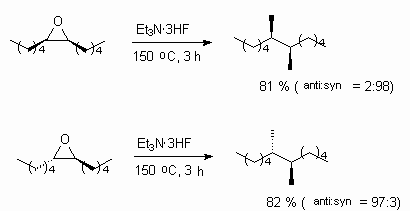
Symmetrically substituted oxiranes under the influence of Et3N/3HF open the epoxy cycle with highanti-syn selectivity to formsyn- andanti-fluoro-derivatives [358].
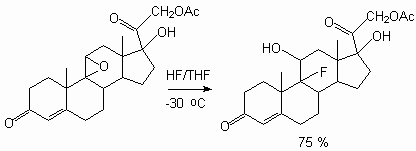
The reaction of opening the epoxy ring under the effect of hydrogen fluoride
to form  -fluoro-alcohols
is of great importance for steroids particularly [341,359,360]. The
influence of solvents and additives of urea type has been studied.
-fluoro-alcohols
is of great importance for steroids particularly [341,359,360]. The
influence of solvents and additives of urea type has been studied.
The position of the epoxy cycle in a molecule is not of great importance for the opening process, in all cases formation of fluoro-alcohol takes place and the solvent plays a considerable role [361-363].
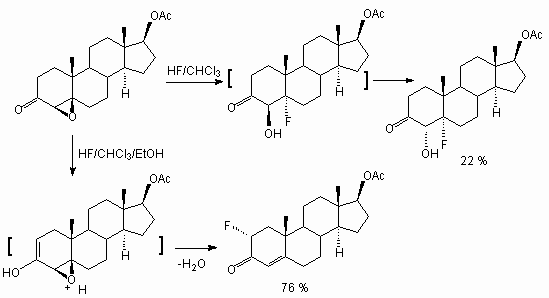
2,3-a- and b-epoxides of cholestane react with hydrogen fluoride in the presence of KF to form trans-dioxial derivatives [364].
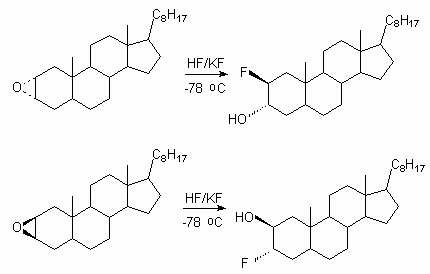
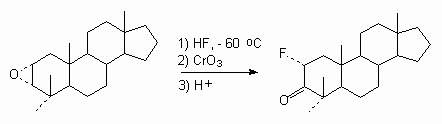
Simultaneous effect of oxidizers results in b-fluoro-ketone
as a reaction product [365].
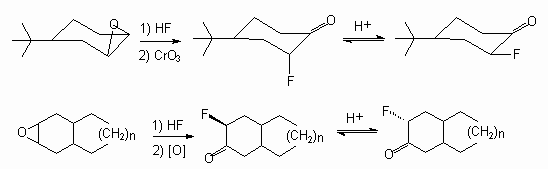
Different non-steroid epoxides under the effect of hydrogen
fluoride in the presence of oxidizers give
-fluoro-ketones also.
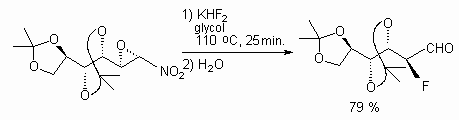
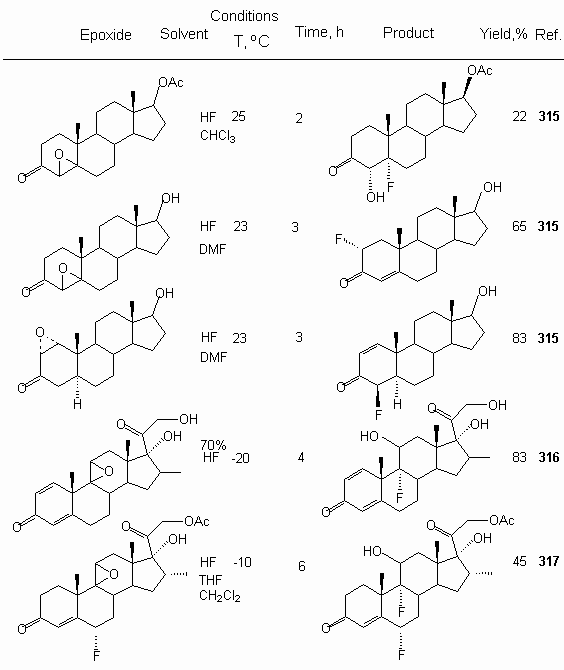
Good results are obtained when the reaction is carried out in ethylene glycol with using KHF2[319,324-326, 366]. The epoxy ring is opened under the influence of KHF2 for different classes also, such as sugars [367], prostaglandins (table 26)[323]. In these cases boiling in high-boiling solvents(such as ethylene glycol, dimethylformamide) is necessary that follows with formation of products in high yields.
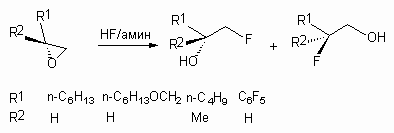
As a rule when KHF2 affects epoxides
containing one substituent at the epoxy ring
there are formed both isomeric fluoro-alcohols
which ratio depends on the substituent nature
(table 27)[345]. If there is a nitro-group
at the epoxy ring then  -fluoroaldehyde
is formed.
-fluoroaldehyde
is formed.
The use of KH[18F]F2 for opening the epoxy cycle makes possible introduction of 18F isotope [380].
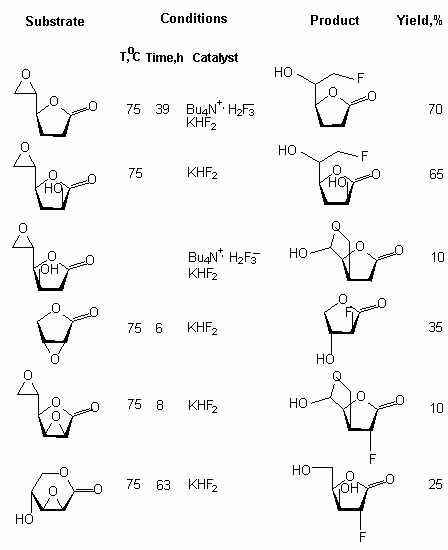
Tetrabutylammonium fluoride/2HF reacts only with very reactive epoxides and has found a rather limited application in hydrofluorination process [381-383]. But addition of KHF2 to this system makes possible to carry out the process which runs regioselectively and the reaction product yield is high enough [384-387].

| R | Time, h | Ratio | Yield, % |
| H | 30 a | 100:0 | 47 |
| Me | 3 | 100:0 | 74 |
| Ph | 8 | 100:0 | 90 |
| Bn | 6 | 96:4 | 74 |
a temperature of 80oC
Such a system is found very effective in hydrofluorination of epoxylactones which runs regioselectively to form fluorodesoxylactones (table 28)[388].Thus, treatment of 2,3-anhydro-L-erythrono-1,4-lactone with a mixture of collidine-3HF (70oC, 3 days) a mixture of 2-desoxy-2-fluoro-D-erythrono- and 3-desoxy-3-fluoro-threono-1,4-lactones is obtained [389]. Similarly , 6-bromo-2,6-didesoxy-2-fluoro-D-glucono-1,4-lactone is synthesized in 68% yield from 6-bromo-6-desoxy-D-monnono-1,4-lactone and Et3N* 3HF whereas the effect of collidine-3HF gives a mixture (2:1) of this lactone and 6-bromo-3,6-didesoxy-3-fluoro-D-altrono-1,4-lactone [389].
Either HF/Py system or KHF2 is used to open the epoxy cycle of cyclic compounds [390]. Epoxy-alcohols containing two or three substituents at the epoxy cycle can be opened by the effect of Et4NF*3HF in the presence of Ti(OPri)2F2 catalyst [391]. Here fluorodiols are formed and the process runs regioselectively [392].
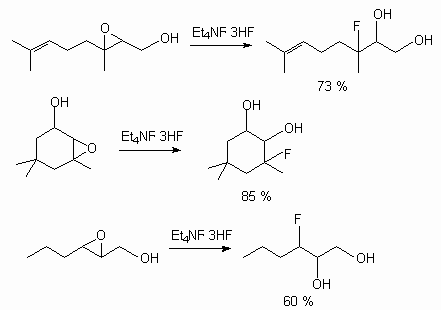
An increase in hydrogen fluoride quantity does not result in an increase in the fluorination product yield. Thus, when Et4NF* 3HF system is used the yield of fluoro-alcohol is 73% whereas in Et4NF*4HF it is only 67%, At the same time without catalyst the yield is only 22%.
Table 26. Opening the epoxy cycle under the effect of KHF2 complex
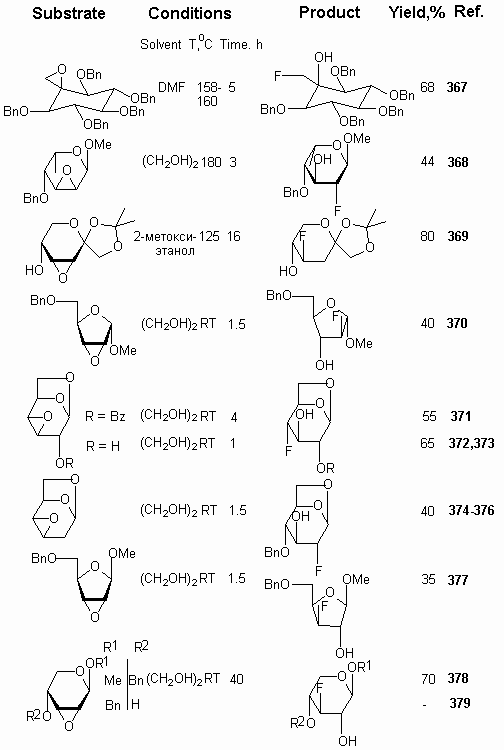
Table 27. Use of KHF2 for opening the epoxy cycle of different sustrates
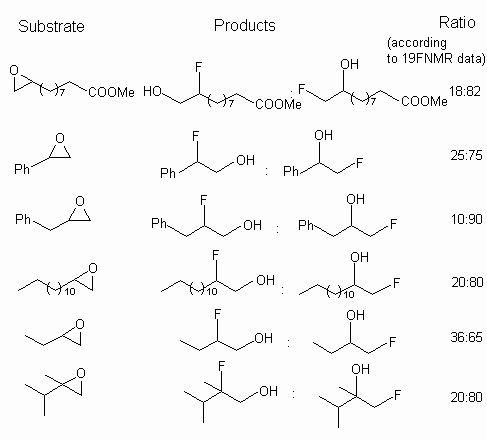
Table 28. Hydrofluorination of epoxylactones [388]
| |
In case of using optically active epoxyalcohols there are formed optically active fluoroalcohols [393,394]. Complexes of hydrogen fluoride with trialkylamines are used also [395-400]. But it should be noted that a great excess of HF/amines complex increases the percentage of oligomerization products.
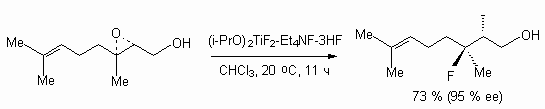
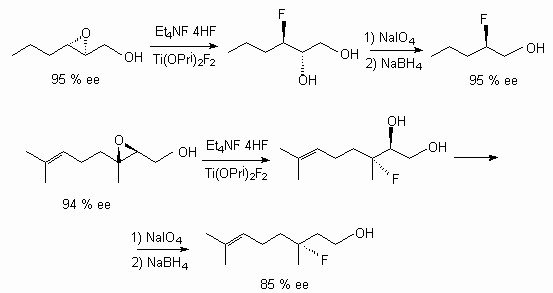
The use of (i-PrO)2TiF2-Et4NF-nHF system for opening the epoxy cycle
results in regio- and stereoselective fluorination of the cycle with formation of appropriate
fluoroalcohols [410]. That was used for synthesis of optically active 3-fluoro-1,2-diols.
Complexes
of (i-Pr)2NH*3HF are of great importance among hydrogen fluoride complexes and they
were successfully used for opening the epoxy cycle. But relatively elevated reaction temperatures
( from 78oC to 140oC) [41] made necessary to look for new complexes which
would be able to use under more mild fluorination conditions. Therefore in future this task will
find a solution because the result of this method gained a special attention. Nevertheless let
us treat a question of using a system of hydrogen fluoride-alkylamines for opening the epoxy
ring. In 1960 Jullien proposed for these purposes a system of (i-Pr)2NH*3HF which
was found effective and opened the epoxy cycle with high regio- and stereoselectivity at high
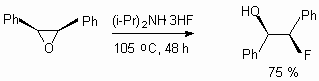
yield of the reaction products. (table 29)[341]. Thus, cis-2,3-diphenyloxirane gives syn-2-fluoro-1,2-diphenylethanol
[328].
Substituted epoxides of olefins are opened by the influence of (i-Pr)2NH*3HF system to
form -fluoro-
-hydroxy derivatives [402].

Steric factors of the substituents at the epoxy cycle influence considerably on the direction of regioselective opening the cycle (table 30), as a rule mixtures of two isomeric fluoroalcohols 32and 33 are formed [403]. A system of Me3N* 2HF opens the epoxy cycle in a similar way (table 30)[341]. If phenyl as a substituent is present at the epoxy cycle or in case of non-simmetrically substituted epoxides there are always formed two isomeric fluoroalcohols. In case of phenyl mainly fluoroalcohol is formed which fluorine atom is at the carbon connected with this substitutuent. A fluoroalcohol, which fluorine atom is at the carbon linked with a donor substituent, prevails for non-simmetrically substituted epoxides .
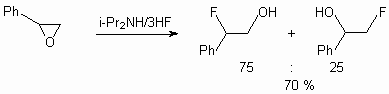
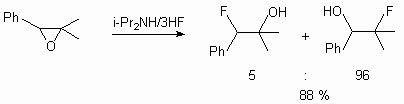
Hydrofluorination of indene and tetraline epoxides with (i-Pr)2NH*3HF complex results in formation of isomeric fluoroalcohols for indene and in formation of only one isomeric fluoroalcohol for tetraline [341].
Table 29. Opening the epoxy cycle under the influence of Pri2NH* 3HF [341]
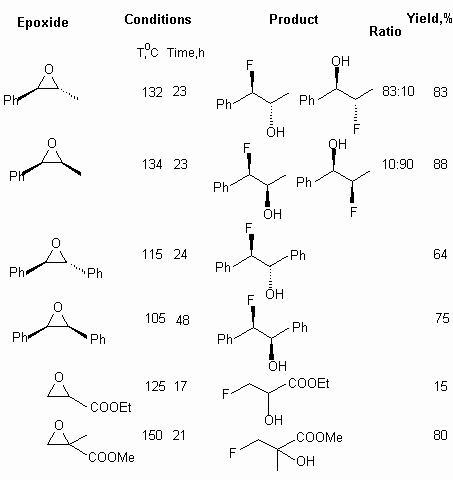
Table 30. Hydrofluorination of substituted epoxides under the effect of (i-Pr)2NH*3HF [402]

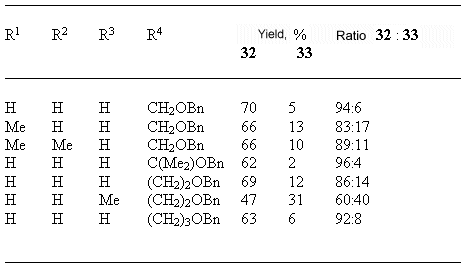
Table 31. Opening the epoxy cycle under the effect of Me3N*2HF [341]

Regioselective opening the epoxy ring under the effect of Me3N*2HF is observed for many
epoxides, in particular for cis- and trans-epoxide of isophorol (table 31). Thus, cis-epoxide
of isophorol gives 3-fluoro-1,2-diol whereas trans-epoxide of isophorol gives 2-fluoro-1,3-diol
[404,405]. That may be explained by the influence of the substituent in the -position
on conformation of transient state.

It should be noted that in many cases addition of a metal fluoride gives a desirable result. Apart different salts can be used as catalyst also, silicon derivatives in particular. Nucleophilicity of fluoride-ion is sufficient for realization of hydrofluorination in this case even in aqueous solutions of hydrogen fluoride. So phenyl-substituted epoxide under the influence of 47% hydrogen fluoride in the presence of silicon salts gives fluoroalcohol in a rather good yield [406].
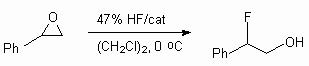
|
Catalyst |
Yield, % |
| (NH4)2SiF6 | 46 |
| (NH4)2SiF6, CsF | 67 |
| (NH4)2SiF6, SnF2 | 47 |
| Cs2SiF6 | 59 |
| BaSiF6 | 46 |
| (BnMe3N)2SiF6 | 21 |
Anhydrous hydrogen fluoride in diethyl ether does not react with di-substituted epoxides, whereas in aqueous 47% hydrogen fluoride in catalysis of (NH4)2SiF6 in toluene they give a mixture of fluoroalcohols in a yield up to 62%. The ratio of syn:anti isomeric fluoroalcohols depends on the catalyst used. Thus at the same yield of the reaction products (41-45%) the ratio of syn:anti is different [406].
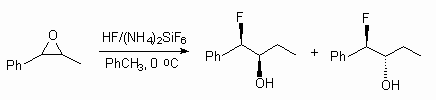
| HF | Catalyst (equiv) | Yield,% | Syn/anti ratio |
| 47% | (NH4)2SiF6 (5.0) | 45 | 7:1 |
| 47% | i-Pr2NEt (1.0) | 41 | 5:1 |
| 47% | (NH4)2SiF6 (5.0) CsF (1.2) | 45 | 20:1 |
| Anhydrous HF | PhSiF3 (5.0) | 25 | 11:1 |
Hydrofluorination of 2,2,3-tri-substituted epoxides and enoxysilane under the effect of aqueous 47% hydrogen fluoride in the presence of (NH4)2SiF6 gives solely one isomeric fluoroalcohol [406].
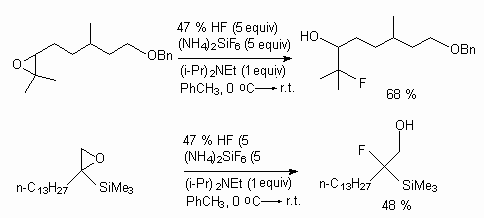
The authors suppose that the formation of prevailing quantity of syn-isomer is due to rearrangement of intermediate carbcation.
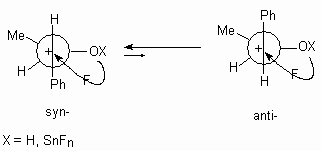
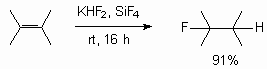
Silicon tetrafluoride was used as a catalyst also that is shown on the example of formation of 2-fluoro-2,3-dimethylbutane in hydrofluorination of 2,3-dimethylbutene-2[407].
The mechanism of opening epoxides under the effect of hydrogen fluoride and its complexes with bases has gained considerable attention of researchers. Several ways of the reaction course were proposed, they explain high regioselectivity of the process and the influence of the nature of the substituent at the epoxy cycle, the role of solvent and process conditions. They can be illustrated by the following scheme:
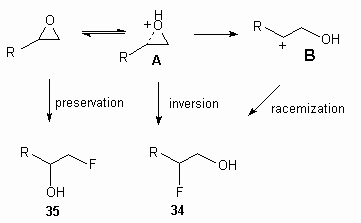
Electronic properties of the substituent influence regio- and stereoselectivity in hydrofluorination under the effect of HF/Py, i.e. 2-fluoro-2-phenylethanol 34was obtained from styrene oxide via secondary b-hydroxycarbenium ion (Sn1 process) at the account of high-stable benzyl cation, whereas 1,1,1-trichloro-3-fluoropropanol-2 35 (SN2 process) is obtained from 3,3,3-trichloro-2-epoxypropane. These two mechanisms may be realized in the hydrofluorination process. Steric factors are of great importance in determination of regioselectivity in opening the epoxy ring.
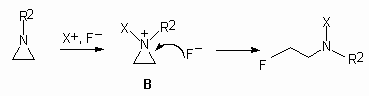
As it is seen from the data review [408] the opening of the aziridine cycle under the influence of different
nucleophilic reagents has drawn great attention. The effect of anhydrous hydrogen fluoride on aziridines
became an important method to produce interesting 1-amino-2-fluorocompounds i.e. -fluoroamines,
-amino- and
-fluoro-acids and b-fluoroazaalkanes [38, 407-418]. The process runs through an intermediate formation of quaternary
ammonium salt B in which fluoride-ion attacks carbon -atom
of the three-membered cycle.
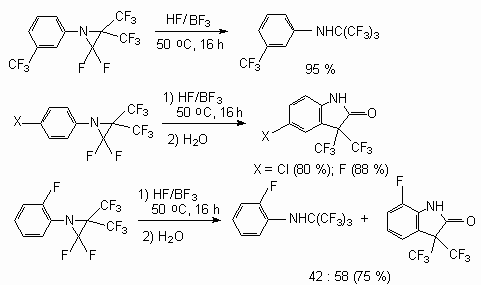
N-Aryl-2,2-difluoro-3,3-bis(trifluoromethyl)aziridines were obtained in a reaction of imines with difluorocarbenes by the effect of anhydrous hydrogen fluoride in the presence of BF3 as a catalyst, the three-membered cycle was open to form secondary amines [419]. But there was observed formation of cyclic compounds also in dependence on the nature of the substituent in the benzene ring. Opening the aziridine cycle runs at the account of initial protonation of the nitrogen atom, whereas opening cyclic compound takes place at the account of the attack of carbcation generated in the opening of the protonated cycle. The presence of BF3 in the system increases the Hammett acidity constant sharply and makes the cyclization process easier ( anhydrous HF(99.5%) has Ho = -11 and Ho of a 7% HF solution has a value of -16.6) [419].
Opening the cycle of 1-phenyl-1-allylaziridine under the effect of Et3N 3HF runs regioselectively to
form -fluoroamines.
Regioselectivity in this case also is determined by the nature of the substituent at the aziridine
cycle.
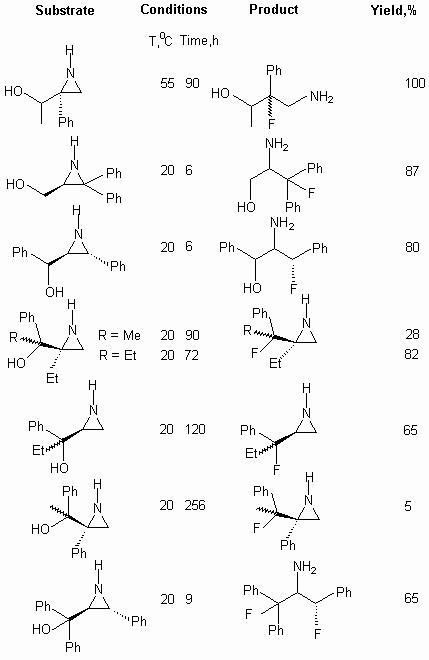
 a-Hydroxyaziridines by the effect of HF/Py complex depending on the reaction conditions are
converted into appropriate fluoroalcohols and in very many cases the OH group is replaced with fluorine
while the structure of the aziridine ring is not changed ( table 32)[234].
a-Hydroxyaziridines by the effect of HF/Py complex depending on the reaction conditions are
converted into appropriate fluoroalcohols and in very many cases the OH group is replaced with fluorine
while the structure of the aziridine ring is not changed ( table 32)[234].
Aziridines containing alkyl groups under the effect of hydrogen fluoride and its complexes with amines open the cycle to form 2- fluoroalkylamines [395, 413,416,420-424]. The effect of the mole ratio of HF/pyridine on regio- and stereo-selectivity can be explained as the effect of solvation of intermediate carbene ions.
Table 32. Effect of HF/Py on  -hydroxyaziridines
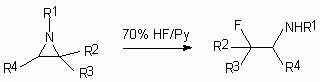
| R1 | R2 | R3 | R4 | T, oC | Time, h | Yield, % |
| H | Ph | H | H | 20 | 1 | 78 |
| H | Me | Me | Et | 70 | 24 | 90 |
| Et | Ph | H | H | 70 | 1 | 47 |
| cis-H | Ph | H | Me | 20 | 6 days | 69 |
| trans-H | Ph | H | Me | 20 | 5 | 71 |
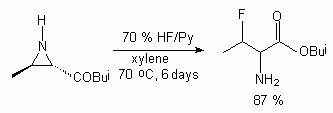
Opening the aziridine cycle with a 70% HF/Py system makes possible to obtain iso-butyl-3-fluoroalanine, methyl-3-fluorophenylalanine [407]. Stereochemistry of the reaction depends both on the fluorinations agent and on the aziridine structure. As a rule there is formed a mixture of diastereomeres [407, 411, 420] For example, two regioisomers of 2-fluorocyclohexylamine are formed in hydrofluorination of cis- and trans-eriminocyclohexanewith 70% HF/Py [412].
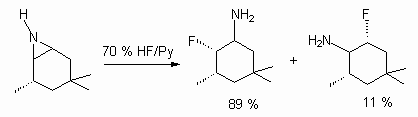
Great attention of researchers has been drawn to regioselectivity and stereochemistry of the cycle opening [413, 421]. In case of non-symmetrically substituted aziridines the both isomeric fluoroalkylamines are formed.

Phenylvinylaziridine reacts with HF/Py to form ,
-fluoroallylamine along with ,
-fluoroamine, but in this case the total yield of the reaction products is very small [421].

Bicyclic aziridines such as derivatives of pyranosidines and furanosidines are hydrofluorinated to form fluoroamine derivatives. So, aziridine derivative 36 under the effect of tetrabutylammonium fluoride gives (benzoyloamino) fluoropyranoside 37 [425,426].
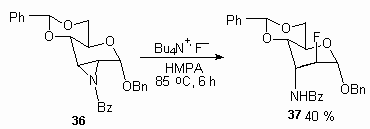
The availability of such substituents at the aziridine cycle as phenyl and nitrile brings to formation of only one isomeric product under the effect of 70%HF/Py system [420].

The HF/Py complex hydrofluorinates aziridines containing cyclic fragments 38 to form a mixture of fluorocycloamines 39and 40 with cis-isomers 40 prevalence. Probably , isomerization of trans-isomer 39 into cis-isomer 40 takes place in this process due to thermodynamic control [38].
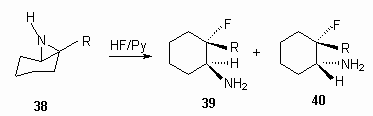 |
||
| R= Ph | 0 | 100 |
| Et | 22 | 78 |
| H | 33 | 66 |
Bicyclic aziridines 41 react with 1-azabicyclo[n.1.0.]alkane under the effect of hydrogen fluoride in diethylether or with HF/Py to give 3-fluoro-1-azacycloalkanes 42 [416,417].
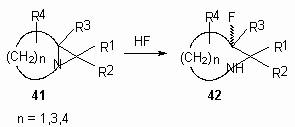
Stereochemistry in case of bicyclic aziridines also depends on the fluorinating agent used and on the reaction conditions. For example, interaction of bicyclic aziridine 43 with HF/Py results in formation of cis-3-fluoro-2,3-diphenylazetidine 44 at a short reaction time whereas an increase in the reaction time or using anhydrous hydrogen fluoride results in formation of trans-isomer 45 more thermodynamically stable [417].
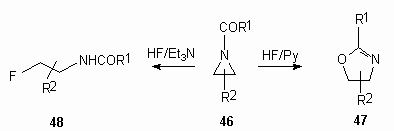
Aziridines containing alkyl group at the nitrogen are less reactive in comparison with the same containing carbonyl group. Heating N-activated aziridines ( COR 1 as the substituent at nitrogen) 46 with HF/Py gives oxazoline derivative 47 mainly and a small amount of fluoroamine 48, whereas the effect of Et3N*3HF complex results in the opposite picture [38, 411, 413]. That points to the importance of steric effects at the nitrogen atom and to the influence of effectiveness of the nucleophilic agent.
Interaction of cis-cyano-2- and cis-amido-2-aziridines with HF/Py complex results in formation of
-fluoro--amino
acid and esters in good yield. Cis-2-cyanoaziridine gives a mixture of threo- and erythro-2-amino-3-fluoronitrile
( ratio of 57:43)[410,414,415].

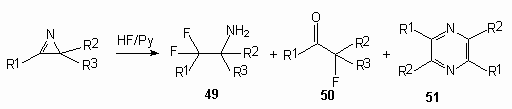
Phenyl-substituted azirine under the effect of HF/Py complex converts either into -fluoroketone or into  ,-difluoroamine [2,38,410,415,420,422,423,427].
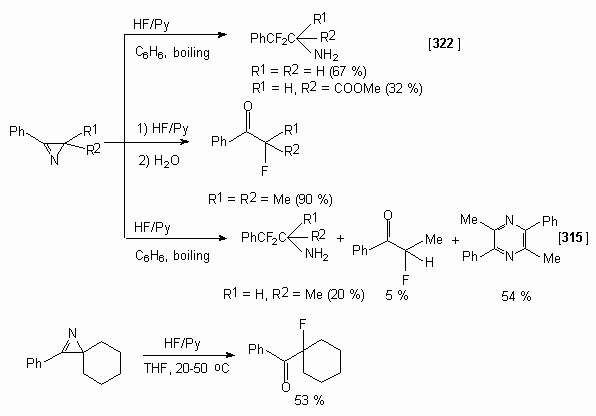
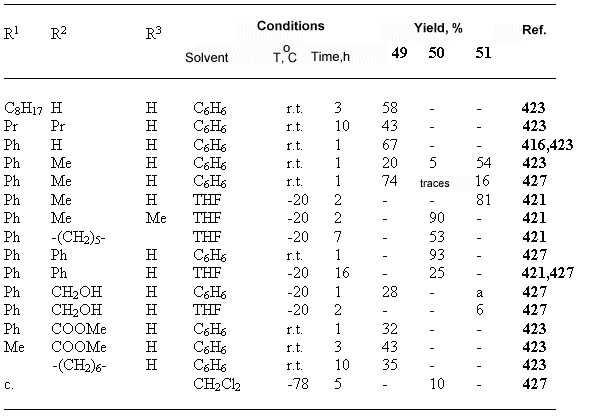
In a number of cases there was observed formation of pyrazine derivatives (table 33)[220, 221a, b, 416, 422].
It is supposed that interaction of azirine with hydrogen fluoride runs via initial protonation of the nitrogen atom of the azirine derivative with generation of cation A.
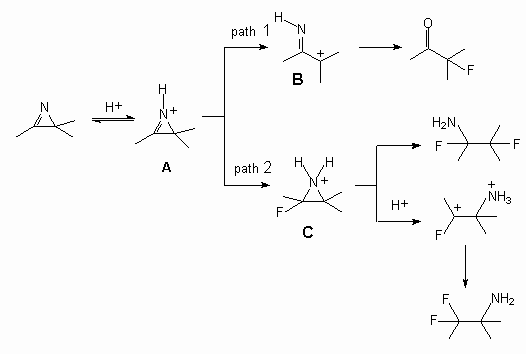
Further there are several ways to realize conversions of the cation:
1.conversion into intermediate B from which either -fluoroketones are formed or pyrazine at the expense of condensation of two molecules of intermediate
B.
2. Conversion into intermediate B from which  ,-difluoroamines are
formed via further conversions under the effect of the system proton .
,-difluoroamines are
formed via further conversions under the effect of the system proton .
Formation of compound 51 can be explained by the following scheme:

The substituents at the aziridine cycle plays the key role in realization of either direction. So, azirines
,containing alkyl substituents only, form ,-difluoroamines (
way 2 is realized) whereas those containing electron-acceptor groups form pyrazine derivatives and
-fluoroketones ( way 1 is realized) [427]. For example, interaction of 1-phenyl-3-hydroxyaziridine
with HF/Py results in formation of the appropriate pyrazine derivative and -fluoropropiophenone [427] . A temperature increase to 20-50
oC gives the pyrazine derivative only.
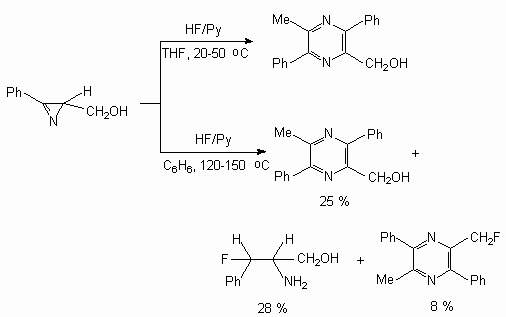
In this case cationoid intermediate B is not stabilized by one alkyl substituent and
electron-acceptor groups and the reaction runs via intermediate B. When two alkyl substituents or
one phenylgroup in position 2 are present, intemediate B is stabilized by these groups that results
in formation of -fluoroketone as the main product.
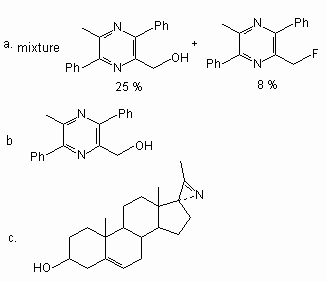
Steroids containing the azirine cycle under the effect of HF/Py in tetrahydrofurane give fluoroketones, not amines [38].
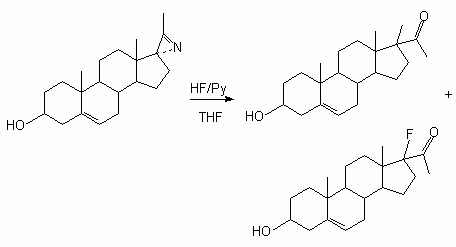
Table 33.Fluorination of 2H-azirine derivatives under the effect of HF/Py
Conclusion
The examples of using hydrogen fluoride in organic synthesis given in the review have shown that the old time-proved fluorinating agent has been used actively. The new process conditions and new view on the potential of anhydrous hydrogen fluoride and its complexes allow to hope for their wide practical application not in laboratory practice only but in technology of industry of little-fluorinated organic compounds. Anhydrous hydrogen fluoride is an important Lewis acid used not only as fluorinating agent but as a component of catalytic systems also, which wide application predetermines progress in general organic synthesis of little-fluorinated compounds. The author does hope that the review will help investigators to enter this interesting and perspective part of organic chemistry as well as will stimulate and provide development and improvement of methods of direct fluorination that will clear horizons of wide practical application of very many perspective substances.
References
1. Olah G.A., Li X.-Y. // Synlett. 1990. P. 267.
2. Olah G.A., Welch J., Vankar V.D., Nojima M., Kerekes I., Olah J.A. // J. Org. Chem. 1979. Vol. 44. N 22. P. 3872-3881.
3. Olah G.A., Welch J. // Synthesis. 1974. N 12. P. 896-898.
4. Miethchen R., Peters D. // Houben Weyl/ Methods der Organische Chemie. Stuttgard. 1998. Vol. E10a. P. 95-158.
5. Peters D., Miethchen R. // J. Fluorine Chem. 1996. Vol. 79. P. 161
6. Dove M.F.A., Clifford A.F., in : Chemistry on Anhydrous, Prototropic Inorganic Solvents./ Eds. Jander G., Spandau H., Addison C.C. Berlin : Academic. 1971. Vol. H.1. pp. 119-300.
7. Fyfe W.S. // J. Chem. Phys. 1953. N 1. P. 2.
8. Hu J.-H., Write D., Jonhston H.L. // J. Am. Chem. Soc., 75, N 5. P. 1232-1236 (1953).
9. Klatt W. // Z. anorg. allg.Chem. 1937. Bd 233. S. 307.
10. Ryss I.G. // Khimiya ftora i ego neorganicheskih soedinenij. M.: Goskhimizdat. Moskva 1956. s. 53
11. Simons J.H., Bouknight J.W. // J. Am. Chem. Soc. 1932. Vol. 54. N 4. P. 129-135.
12. Simons J.H., Dresdner R.D. // J. Am. Chem. Soc.1944. Vol. 66. N 7. P. 1070-1072.
13. Fredenhagen K., Dahmlos J.D. // Z. anorg. allg. Chem. 1928. Bd 178. S. 272.
14. Hefter G.T. // J. Solut. Chem. 1984. Vol. 13. P. 457
15. Olah G.A., Shih J.G., Prakash G.K.S. // J. Fluorine Chem. 1986. Vol. 33. N 1-4. P. 377-396.
16. Yoneda N., Fukuhara T. /Jpn Kokai Tokkyo Koho JP 63 18863 (1988); Publ. C.A 1989. Vol. 110. 23510v; Yuki Gosei Kagaku Kyokaishi. 1989. Vol. 47. P. 619; C.A. 1989. Vol. 111. 232166x.
17. Hyman H.H., Kilpatrick M., Katz J.J. // J. Am. Chem. Soc. 1957. Vol. 79. N 14. P. 3668-3671.
18. Hyman H.H., Garber R.A. // J. Am. Chem. Soc. 1959. Vol. 81. N 8. P. 1847-1849.
19. Wristers J.// J. Am. Chem. Soc. 1975. Vol. 97. N 15. P. 4312-4316.
20. Feiring A.E. // J. Org. Chem. 1977. Vol. 42. N 20. P. 3255-3260.
21. Fidler D.A., Logan J.S., Boudakian M.M.// J. Org. Chem. 1961. Vol. 26. N 10. P. 4014-4017.
22. Weinmayr V. // J. Am. Chem. Soc.1955. Vol. 77. N 7. P. 1762-1764.
23. Feiring A.E. // J. Fluorine Chem. 1977. Vol. 10. N 5. P. 375-386.
24. Feiring A.E. // J. Org. Chem.1979. Vol. 44. N 8. P. 1252-1254.
25. Meurs J.H.H., Sopher D.W., Eilenberg W. // Angew. Chem. 1989. Bd 101. S. 955; Angew. Chem. Int. Ed. Engl. 1989. Vol. 28. P. 927.
26. Henne A.L., Waalkes T.P. // J. Am. Chem. Soc. 1945. Vol. 67. N 9. P. 1639-1640.
27. Bowers A., Holton P.G., Denot E., et al.// J. Am. Chem. Soc.1962. Vol. 84. N 6. P. 1050-1053.
28. Askam V., Qazi T.U.// J. Chem. Soc., Perkin Trans. Part 1. 1977. N 11. P. 1263-1265.
29. Daub G.H., Ackerman M.E., Hayes F.N.// J. Org. Chem. 1973. Vol. 38. N 4. P. 828-829.
30. Roush W.R., Gillis H.R., Essenfeld A.P.// J. Org. Chem. 1984. Vol. 49. N 24. P. 4674-4682.
31. Brown J.H., Suckling C.W., Whalley W.B.// J. Chem. Soc. 1949. S. 19. P. 95-99.
32. Simons J.H., Lewis C.J. // J. Am. Chem. Soc. 1938. Vol. 60. N 2. P. 492-493.
33. Smith F., Stacey M., Tatlow J.C., et al.// J. Appl. Chem. (London). 1952. Vol. 2. P. 97, 127.
34. McBee E.T., Hass H.B., Frost L.W., Welch Z.D. // Ind. Eng. Chem.. 1947. Vol. 39. P. 404.
35. Olah G.A., Nojima M., Kerekes I. // Synthesis. 1973. P. 779.
36. Yoneda Y., Nagata S., Fukuhara T., Suzuki A. // Chem. Lett. 1984. P. 1241.
37. Li Sui Z.J. // Chem. Reagents. 1987. Vol. 9. N 5. P. 249-298.
38. Yoneda N. // Tetrahedron. 1991. Vol. 47. N 29. P. 5329-5365.
39. Koroboshi M., T. Hiyama T. // Synlett. 1991. N 3. P. 185-186.
40. Sharts C.M., Sheppard W.A. // Org. Reactions. 1974. Vol. 21. P. 125.
41. Aranda G., Jullien J., Martin J.A. // Bull. Soc. Chim. Fr. 1965. P. 1890.
42. Miethchen R., Gabriel T. // Chem. Ber. 1993. Bd 126. S. 2309.
43. Miethchen R., Kolp G. // J. Fluorine Chem. 1993. Vol. 60. N 1. P. 49-55.
44. Miethchen R., Gabriel T. // J. Fluorine Chem. 1994. Vol. 67. N 1. P. 11-15.
45. Green S.W., Slinn D.S., Simpson R.N.F. // Organofluorine Chemistry./ Eds. Banks R.E., Smart B.E., Tatlow J.C. N.Y. : Plenum. 1994. P. 89-119; Eliott A.J. // Organofluorine Chemistry./ Eds. Banks R.E., Smart B.E., Tatlow J.C. N.Y. : Plenum. 1994. P. 145-157.
46. Yoneda N., Abe T., Fukuhara T., Suzuki A. // Chem. Lett. 1983. P. 1135.
47. Yoneda N., Abe T., Nagata S., Suzuki A. // J. Chem. Soc. Jpn, Chem. And Ind. Chem. 1985. N 10. P. 1951-1957;
48. Yoneda N.// J. Fluorine Chem. 1987. Vol. 35. N 1. P. 35-36;
49. McElvain S.M., Langston J.W. // J. Am. Chem. Soc. 1944. Vol. 66. N 10. P. 1759-1764.
50. Grosse A.V., Linn C.B. // J. Org. Chem. 1938. Vol. 3. P. 25; Hutson T.Jr., Carter C.O. / Pat. 4052469 (US). Publ. 1977; Chem. Abstr. 1977. Vol. 87. 200769r.
51. Kraus W.P., Thomas Jr. / Pat. 4049728 (US). Publ. 1977; Chem. Abstr. 1977. Vol. 87. 200767p; Sobel J.E. / Pat. 3888935 (US). Publ. 1975; Chem. Abstr. 1975. Vol. 83. 78555t.
52. Tojo M., Fukuoka S. /Pat. 63088146 (Japan). Publ. 1988; Chem. Abstr. 1988. Vol. 109. 189978h.
53. Jursic B.S. // Theochem. 1998. Vol. 434.P. 37-42; Chem. Abstr. 1998. Vol. 129. 1612337.
54. Grosse A.V., Wackher R.C., Linn C.B. // J. Phys. Chem. 1940. Vol. 44. P. 275.
55. Austin P.R., Coffman D.D., Hoehn H.H., Raasch M.S. // J. Am. Chem. Soc. 1953. Vol. 75. N 10. P. 4834-4835.
56. Ewing P.N. / Pat. 99 26907 (UK) PCT Int. Appl. WO. Publ. 1999; Chem. Abstr. 1999. Vol. 130. 353932.
57. Franz R., Siegemund G. /Patent Federal Republic of Germany N 4323054, 1995;
58. Zhong G.-X., Chen G.-T. // Huaxue Fanying Gongcheng Yu Gongyi.2000. Vol. 16. N 3. P. 251-256; Chem. Abstr. 2000. Vol. 133. 351759g.
59. Miller R.N., Rao V.N.M., Swedringen. / Pat. PCT Int. Appl. WO 99 51556 (US).Publ. 1999; Chem. Abstr. 1999. Vol. 131. 273398f.
60. Elsheikh M.Y., Bolmer M.S., Chen B. / Pat. 5895825 (US) Publ. 1999; Chem. Abstr. 1999. Vol. 130. 268843x.
61. Wismer J.A., Bolmer M.S., Chen B. / Eur. Pat. 940382. Publ. 1999; Chem. Abstr. 1999. Vol. 131. 186555m.
62. Ahn B.-S., Kwon Y.-S., Park K.-Y., Chung M.-J. / Pat. 5841007 (US).Publ. 1998; Chem. Abstr. 1998. Vol. 129. 344719h.
63. Homoto Y., Shibanuma T., Nishitsuji M. / Pat. PCT Int. Appl. WO 96 11176 (Japan).Publ. 1996; Chem. Abstr. 1996. Vol. 125. 89594s.
64. Максимов Б.Н., Барабанов В.Г. // Журн. прикл. химии. 1999.Т. 72.Вып. 12.С. 1944-1948.
65. Орлов А.П., Щавелев В.Б., Корольков Д.Н., Конейкина Н.В. / Заявка на патент РФ 9811077004.
66. Эннеллс Д.Х., Тейлор Э.М. / Заявка на патент РФ 9811212604.
67. Ohno H., Miyamura M., Arai T., et al. / Patent US 5345015.
68. Beck W.H., Burns G. // Can. J. Chem. 1984. Vol. 62. N 11. P. 2302-2309.
69. Lundt I., Pedersen C. // Acta Chem. Scand. 1070. Vol. 24. P. 240.
70. German L.S., Knunyants I.L. // Angew. Chem.1969. Bd 81. S. 321 (1969); Angew. Chem. Int. Ed. Engl. 1969. Vol. 8. P. 349.
71. Bowers A., Holton P.G. / Pat. 3976825 (US). Publ. 1963; Chem. Abstr. 1964. Vol. 60. 607g.
72. Jacquesy J.-C., Jacqiesy R., Levisalles J. // Bull. Soc. Chim. Fr. 1967. P. 1649.
73. Jacquesy J.-C., Jacqiesy R., Petit M. // Tetrahedron Lett. 1970. N 30. P. 2595-2598.
74. Barbier J., Berrier C., Jacquesy J.-C., Jacqiesy R. // Tetrahedron. 1973. Vol. 29. N 7. P. 1047-1053.
75. Berthelot J.-P., Jacquesy J.-C., Levisalles J. // Bull. Soc. Chim. Fr. 1971. P. 1896.
76. Berthelot J.-P., Levisalles J. // Bull. Soc. Chim. Fr. 1971. P. 1888.
77. Jacquesy J.-C., Levisalles J., Wagnon J. // Bull. Soc. Chim. Fr. 1970. P. 670.
78. Hara S., Kameoka M., Yoneda N. // Synlett. 1996. N 6. P. 529-530 (1996); Chem. Abstr. 1996. Vol. 125. 196012.
79. Beter R.K. / Pat. 5777185 (US). Publ. 1998; Chem. Abstr. 1998. Vol. 129. 122391.
80. Hayashi H., Sonoda H., Goto K. et al. / Eur. Pat 1072576 (Japan). Publ. 2001;
81. Podolskii A.V., German L.S., Knunyants I.L. // Izv. Akad. Nauk SSSR. Ser. Khim. 1966. P. 1575; Chem. Abstr. 1967. Vol. 66. 95004; Knunyants I.L., German L.S., Podol`skii A.V. / Pat. 180606 (U.S.S.R.). Publ. 1966; Chem. Abstr. 1966. Vol. 65. 12219d
82. Chambers R.D., Korn S.R., Sandford G. // J. Fluorine Chem. 1994. Vol. 69. N 1. P. 103-108; J. Chem. Soc., Chem. Commun. 1993. P. 855.
83. Chambers R.D., Korn S.R., Sandford G. // Tetrahedron. 1992. Vol. 48. N 37. P. 7939-7950.
84. Tamura M., Shibakami M., Kurosawa S., et al. // J. Chem. Soc., Chem. Commun. 1996. N 18. P. 1891-1892
85. Hanack M., Keberle W. // Chem. Ber. 1961. Bd 94. N 1. S. 62-67.
86. Kolb M., Barth J., Heydt J.-G., Jung M.J. // J. Med. Chem. 1987. Vol. 30. N 1. P. 267-272.
87. Maximovich M.J., Stevens H.C., Trager F.C. / Pat. 1 170396 (Br.).Publ. 1969; Chem. Abstr. 1970. Vol. 72. 44361.
88. Meussdoerffer J.N., Niederpruem H. /Pat. 2 139993 (Ger. Offen DE). Publ. 1973; Chem. Abstr. 1973. Vol. 78. 123998.
89. Meussdoerffer J.N., Niederpruem H. / Pat. 2 234305 (Ger. Offen DE).Publ. 1974; Chem. Abstr.1974. Vol. 80. 107970.
90. Ogura E., Hatabu K., Nomura N. / Pat. 3 555102 (US).Publ. 1971; Chem. Abstr. 1971. Vol. 74. 64586.
91. Usmanov Kh.U., Yul`chibaev A.A., Sirlibaev T.S., Saparniyazok K. // Izv.VyssH. Ucheb. Zared., Khim. Khim. Tekhnol. 1973. Vol. 16. P. 77 (1973); Chem. Abstr.1973. Vol. 78. 123901.
92. Newkirk A.E. // J. Am. Chem. Soc. 1946. Vol. 68. N 12. P. 2467-2471.
93. Gardner L.E. / Pat. 3 607955 (US).Publ. 1971; Chem. Abstr. 1971. Vol. 75. 129320.
94. Usmanov Kh.U., Sirlibaev T.S., Akrambodzhaev A., et al. // Zh.Prikl. Khim. 51, 1978. P. 1839; Chem. Abstr. 1978. Vol. 89. 147253.
95. Pat. 1 570306 (France). Publ. 1969; Chem. Abstr. 1970. Vol. 72. 132015e;
1601442 (France). Publ. 1970; Chem. Abstr. 1971. Vol. 74. 126389e.
96. Shinoda K., Watanabe T., Mizusawa S. / Pat. 1 941234 (Ger. Offen DE). Publ. 1970; Chem. Abstr. 1970. Vol. 72. 110762.
97. Lee Y.-W., Lee K.-H., Lim J.-S. et al. // Kongop Hwahak. 1998. Vol. 9. N. 5. P. 629-633; Chem. Abstr. 1999. Vol. 130. 68113x.
98. Paucksch H., Massonne J., Derleth H. / Pat. 2 105748 (Ger. Offen DE). Publ. 1972; Chem. Abstr. 1972. Vol. 77. 164009.
99. Henne A.L., Pluedeman E.P. // J. Am. Chem. Soc. 1943. Vol. 65. N 4. P. 587-589.
100. Grosse A.V., Linn C.B. // J. Am. Chem. Soc. 1942. Vol. 64. 2289.
101. Newkirk A.E. // J. Am. Chem. Soc. 1946. Vol. 68. N 12. P. 2467-2471.
102. Begley J.W., Marsheck R.M. / Pat. 3397247 (US). Publ. 1968; Chem. Abstr. 1968. Vol. 69. 76605w.
103. Gardner L.E. / Pat. 3413360 (US). Publ. 1968; Chem. Abstr. 1969. Vol. 70. 46812q.
104. Schmidhammer L. / Pat. 1945655 (Ger.). Publ. 1969; Chem. Abstr. 1971. Vol. 74. 111542a.
105. Pazderskii Y.A., Agroskin I.I., Flid R.M. // Kinet. Catal. (USSR). 1969. Vol. 10. P. 415.
106. Meussdoerffer J.N., Niederpruem H. / Pat. 2234305 (Ger.). Publ. 1974; Chem. Abstr. 1974. Vol. 80. 107970v.
107. Wada H., Kawakami Y., Uefukikoshi T. / Pat. 68 09727 Japan (1968); Chem. Abstr. 1968. Vol. 69. 105863m.
108. Sirlibaev T.S., Akramkhodzhaev A., Usmanov K.U. // Zh. Prikl. Khim. 1985. Vol. 58. P. 1666; Chem. Abstr. 1986. Vol. 104. 108962.
109. Matsuda K., Sedlak J.A., Noland J.S., Gleckler G.C. // J. Org. Chem. 1962. Vol. 27. N 11. P. 4015-4020.
110. Albert P., Cousseau J. // J. Chem. Soc., Chem. Commun. 1985. P. 961.
111. Cousseau J., Albert P. // Bull. Soc. Chim. Fr. 1986. P. 910.
112. Everett T.S., Purrington S.T., Bumgardner C. L. // J. Org. Chem. 1984. Vol. 49. N 20. P. 3702-3706.
113. York C., Prakash G.K.S., Olah G.A. // J. Org. Chem. 1994. Vol. 59. N 21. P. 6493-6494.
114. Gorgues A., Stephan D., Cousseau J. // Janssen Chim. Acta. 1989. Vol. 7. N 2. P. 3-4;РЖХим 1990, 15Ж 362.
115. Janssen Chim. Acta. 1989. Vol. 7. N 1. P. 24-25;РЖХим 1990. 12Ж 465.
116. Stolkin I., Koetzsch H.J. / Pat. 1 910529 (Ger. Offen DE). Publ. 1970; Chem. Abstr. 1970. Vol. 73. 120052.
117. Golubev A.N., Gol`dino A.L., Panshin Yu.A., Kolomenskov V.I. / Pat. 341788 (U.S.S.R.).Publ. 1972; Chem. Abstr. 1972. Vol. 78. 3663.
118. Borovnev L.M, Vereshchagina N.S.‚ Golubev A.N.‚ i dr. / Patent RU 2052442, 1995.
119. UsmanovК.U., Yul‘chibaev A.A., Sirlibaev T.S., Akrambhodzhaev F. / Patent SU 466202, 1975.
120. Kuroba T, Furukawa Y. / Patent JP 78116305, 1978.
121. Martens G., Godfroid M. / Patent DE 2215019, 1972.
122. Romanov E.I.‚ Shal'nov Yu.V., Maslyakov A.I. i dr. / Patent RU 1083541, 1994.
123. Franklin J., Janssens F. / Eur. Pat. 361578 (Appl. EP). Publ. 1990; Chem. Abstr. 1990. Vol. 113. 77674.
124. Elsheikh M.Y. / Pat. 4827055 (US). Publ. 1989;РЖХим 1990. 24Н 186П.
125. Schultz N., Vahlensieck H.J., Gebele R. / Pat. 1 900241 (Ger. Offen DE). Publ. 1970; Chem. Abstr. 1971. Vol. 74. 3310.
126. Franklin J., Jonssens F. / Patent FR 2636941
127. Gol'dinov A.P., Golubev A.I., Vereshchagina N.S. i dr. / Patent RU 2052443, 1996.
128. Schutz N., Vahlensieck H.J. / Pat. 2 000200 (Ger.). Publ. 1971; Chem. Abstr. 1971. Vol. 75. 129319.
129. Swedringen S.H., Wehner J.F., Riedley M.G. / Pat 5105033 (US). Publ. 1992;РЖХим 1994. 3Н 107П.
130. Gumprecht W.H. / Eur. Pat. 353059 (Appl. EP). Publ. 1990; Chem. Abstr. 1990. Vol. 113. 5701.
131. Van der Puy M. / Pat. 4 374289 (US). Publ. 1983; Chem. Abstr. 1983. Vol. 98. 197593.
132. Feiring A.E. // J. Fluorine Chem. 1979. Vol. 14. P. 7.
133. Henne A.L., Arnold R.C. // J. Am. Chem. Soc. 1948. Vol. 70. N 2. P. 758-760.
134. Van der Puy M., Piskorz R.F. / Pat. 4383128 (US). Publ. 1983;
135. Hirayama H., Kobayashi H., Oho H., et al. / Pat. 01 095438 (Japan).Publ.1990; Chem. Abstr. 1990. Vol. 113. 58474.
136. Sheppard U., Sharts K. / Organicheskaya khimiya ftora. / Per. Yu.A. Cheburkova, pod red. I.L. Knunyantsa. M.: Mir. 1972. 480s.
137. Trukshin I.G., Shiritsa A.N., Fedorova S.G. i dr. / Patent RU 2051139, 1995.
138. Orlov A.P., Shchavelev V.B., Yakovlev B.A. / Patent RU 2039034, 1995.
139. Schultz N., Vahlensieck H.J. / Pat. 2 108951 (Ger. OffenDE).Publ. 1972;Chem. Abstr. 1972. Vol. 77. 139405.
140. Rao V.M.N. / Pat. 8 912614 (PCT Int. Appl. WO).Publ. 1989; Chem. Abstr. 1990. Vol. 113. 5700.
141. Rao V.M.N. / Eur. Pat. 348190. Publ. 1989; Chem. Abstr. 1990. Vol. 112. 216210.
142. Manzer L.E., Rao V.N.M. / Pat. 4 766260 (US).Publ. 1988; Chem. Abstr. 1989. Vol. 110. 97550.
143. Darragh J.I., Potter S.E. / Pat. 2 837515 (Ger. Offen DE). Publ. 1979; Chem. Abstr. 1979. Vo. 91. 19875.
144. Oono H., Ooi T., Nakayama H. / Pat. 06 107572 (Japan). Publ. 1994; Chem. Abstr. 1994. Vol. 121. 107967.
145. J.L. Webb, J.E. Corn. //J. Org. Chem. 1973. Vol. 38. N 11. P. 2091.
146. Von S.P. Halasz. / Pat. 2 712732 (Ger. Offen) Publ. 1978; Chem. Abstr., 89, 21488 (1978);
147. P.N. Ewing, J.C. McCarthy. / Pat. 98 50327 (PCT Int. Appl. WO) Publ.1998; Chem. Abstr., 129, 317920 (1998).
145. Trukshin I.G.‚ Sheremet'ev C.K, Barabanov B. G. i dr. / Patent RU 2049055, 1995.
149. Lee Y.-Y., Kim J.-O., Kang Y.-H. /Patent KR 9505372, 1995.
150. Dmitriev A.V., Trukshin I.G.‚ Smykalov P.YU. Tezisy dokl. 3-j Mezhdunarodnoj konferentsii «Khimiya, tekhnologiya i primenenie ftorsoedinenij». Sankt-Peterburg. 6-9 june 2001. P1-14. C. 149.
151. Ahn B.-S., KimН. -K., Lee B.-K. et al / Patent KR 9508540, 1995.
152. Sheremet'ev C.K, Trukshin I.G., Barabanov V.G. i dr. / Patent RU 2141467, 1999.
153. Wilmet V., Lejeune G. / Pat 00 21660 (PCT Int. Appl. WO , Belg.) Publ. 2000; Chem. Abstr. 2000. Vol. 132. 280885m.
154. Tung H.-S., Smith A.M., Swain C.F. / Pat. 95 32168 (PCT Int.Appl. WO, US). Publ. 1995; Chem. Abstr. 1996. Vol. 124. 90947v.
155. Hibino Y., Tamai R., Kaneda S. / Eur. Pat. 939071 (Japan). Publ. 1999; Chem. Abstr. 1999. Vol. 131. 171865p.
156. Nakada T., Shibanuma T., Shibata N. / Pat. 00 17136 (PCT Int. Appl. WO, Japan). Publ. 2000; Chem. Abstr. 2000. Vol. 132. 238692w.
157. Bragante L., Cuzzato P. / Eur. Pat. 967192 (Italy). Publ. 1999; Chem. Abstr. 2000. Vo. 132. 51456e.
158. Zhong G.-X., Chen. G.-T. // Huaxue Fanjing Gongcheng Yu Gongyi.2000. Vo. 16. N 3. P. 245-250; Chem. Abstr. 2000. Vol. 133. 351758f.
159. Igumnov S.M., Bazanov A.G., Shipigusev A.A. i dr. / Patent RU 2134257, 1999.
160. Cuzzato P., Bragante L., Rinaldi F. / Eur. Pat. 879808. Publ. 1998; Chem. Abstr. 1999. Vol. 130. 15130u.
161. Garcia F., Lacroix E., Lerch A., Rousset A. / Eur. Pat. 657409. Publ. 1995; Chem. Abstr. 1995. Vol. 123. 260368f.
162. Garcia F., Lacroix E., Lerch A. / Eur. Pat. 657408. Publ. 1995; Chem. Abstr. 1995. Vol. 123. 260369g.
163. Von Halasz S.P. / Pat. 3 009760 (Ger. Offen DE). Publ. 1981; Chem. Abstr.1981. Vol. 95. 186620.
164.Korol'kov D.N., Orlov A.P., Shchavelev V.B. Tezisy dokl. 3-j Mezhdunarodnoj konferentsii «Khimiya, tekhnologiya i primenenie ftorsoedinenij». Sankt-Peterburg. 6-9 june 2001. P1-14. C. 169;
165. Lu C., Li J., Wu S. / Pat. 1099375 Faming Zhuanli Shenqing Gongkai Shuomingshu CN (China). Publ. 1995; Chem. Abstr. 1995. Vol. 123. 317495b.
166. Keiichi O., Hidekazu O. / Pat. 6124511 USA (2000).
167a. Ewing P.N., McCarthy J.C. / Pat. 98 50327 (PCT Int. Appl. WO, UK). Publ. 1998; Chem. Abstr. 1998. Vol. 129. 317920k.
167б. Vollmueller H., Franz R., Siegemund G. /Pat. 19617091 (Ger. Offen DE, Belg.). Publ. 1997; Chem. Abstr. 1997. Vol. 127. 333094h.
168. Alvernhe G., Laurent A., Haufe G.// J. Fluorine Chem. 1987. Vol. 35. N 1. P. 56-57.
169. Alvernhe G., Laurent A., Haufe G. // Synthesis. 1987. N 6. P. 562-564.
170. Haufe G., Alvernhe G., Laurent A., Ernet T., Goj O., Kroger S., Sattler A. // Org. Synth. 1999. Vol. 76. P. 159.
171. Meyer O.G.J., Frohlich R., Haufe G. // Synthesis. 2000. N 10. P. 1479-1490.
172. Suga H., Hamatani T., Guggisberg Y., Schlosser M. // Tetrahedron. 1990. Vol. 46. N 12. P. 4255-4260.
173. Camps F., Chamorro E., Gasol V., Guerrero A. // J. Org. Chem. 1989. Vol. 54. N 17. P. 4294-4298.
174. Stavber S., Zupan M. // Bull. Chem. Soc. Jpn. 1979. Vol. 52. P. 925.
175. Gregorcic A., Zupan M. // Tetrahedron. 1977. Vol. 33. N 24. P. 3243-3246.
176. Gregorcic A., Zupan M. // Collect. Czech. Chem. Commun. 1977. Vol. 42. P. 3192.
177. Hauge G., Wessel U., Schulze K., Alvernhe G. // J. Fluorine Chem. 1995. Vol. 74. N 2. P. 283-291.
178. Reimann H., Oliveto E.P., Neri R., Eisler M., Perlman P. // J. Am. Chem. Soc. 1960. Vol. 82. N 9. P. 2308-2311.
179. Olah G.A., Nojima M., Kerekes I. // Synthesis. 1973. P. 781.
180. Boche G., Fahrmann U. // Chem. Ber. 1981. Bd 114. N 12. S. 4005-4009.
181. Bellucci G., Chiappe C., Lo Moro G., Ingrosso G. // J. Org. Chem. 1995. Vol. 60. N 19. P. 6214-6217.
182. Gregorcic A., Zupan M. // J. Fluorine Chem. 1984. Vol. 24. N 3. P. 291-302.
183. Dean F.H., Marshall D.R., Warnhoff E.W., Pattison F.L. // Can. J. Chem. 1967. Vol. 45. P. 2279.
184. Haufe G., Alvernhe G., Laurent A. // Tetrahedron Lett. 1986. Vol. 27. N 37. P. 4449-4452.
185. Goj O., Haufe G. // Liebigs Ann. Chem. 1996. P. 1289.
186. Chi D.Y., Kiesewetter D.O., Katzenellenbogen J.A., et al. // J. Fluorine Chem. 1986. Vol. 31. N 1. P. 99-113.
187. Zupan M., Pollak A. // J. Chem. Soc., Perkin Trans. Part 1. 1976. N 9. P. 971-975.
188. Hamman S., Beguin C.G.// J. Fluorine Chem. 1979. Vol. 13. N 2. P. 163-174.
189. Weber F.G., Giese H., Westphal G. // Z. Chem. 1975. Bd 15. S. 475.
190. Sattler A., Haufe G. // Tetrahedron. 1996. Vol. 52. N 15. P. 5469-5474.
191. Michel D., Schlosser M. // Synthesis. 1996. N 8. P. 1007-1011.
192. Hamman S., Beguin C.G. // J. Fluorine Chem. 1983. Vol. 23. N 6. P. 515-524.
193. Alvernhe G., Laurent A., Haufe G. // J. Fluorine Chem. 1987. Vol. 35. N 1. P. 32-33.
194. Bowers A., Denot E., Becerra R. // J. Am. Chem. Soc. 1960. Vol. 82. N 15. P. 4007-4012.
195. Wood K.R., Kent P.W., Fisher D. // J. Chem. Soc., (C). 1966. N 10. P. 912-915.
196. Hall L.D., Manville J.F. // Can. J. Chem. 1969. Vol. 47. P. 361.
197. Hall L.D., Manville J.F. // J. Chem. Soc., Chem.Commun. 1968. P. 35.
198. Dyatkin B.P.‚ Mochalina E.D., Knunyants I.L. // Uspekhi khimii. 1966. T.35. V. 6. S. 979-998.
199. Knunyants I.L., German L.S., Rozhkov I.N. // Izv. AN SSSR. Ser. khim. 1963. N 11.S. 1946-1950.
200. German L.S., Rozhkov I.N., Knunyants I.L. // Zh. Vses. Khim. O-va. 1965.Т. 10.С. 599; Chem. Abstr. 1966. Vol. 64. 1948.
201. Knunyants I.L., German L.S., Rozhkov I.N. /Pat. 152235 (U.S.S.R).Publ. 1966; Chem. Abstr. 1968. Vol. 68. 2588a.
202. Baasner B., Hagemann H., Klauke E. / Pat. 3305201 (Ger.). Publ. 1984; Chem. Abstr. 1985. Vol. 102. 5684k.
203. Baasner D., Hagemann H., Klauke E. / Pat. 3305202 (Ger.). Publ. 1984; Chem. Abstr. 1985. Vol. 102. 5685m.
204. Gassen K.R., Bielefeld D., Marhold A., Andres P. // J. Fluorine Chem. 1991. Vol. 55. N 2. P. 149-162.
205. Knunyants I.L., German L.S., Rozhkov I.N. // Izv. Akad. Nauk SSSR. Ser. Khim. 1963. N 11. P. 1946-1947; Chem. Abstr. 1964. Vol. 60. 5325g.
206. Martynov I.V., Privezentseva N.F., Kruglyak Y.L., Khromova Z.I., Leibovskaya G.A., Knunyants I.L. // Zh. Vses. Khim. O-va. 1966. Vol. 11. N 4. P. 479-480; Chem. Abstr. 1966. Vol. 65. 16847a.
207. Knunyants I.L., Dyatkin B.L., German L.S., Rozhkov I.N., Komarov V.A. // Zh. Vses. Khim. O-va. 1963. Vol. 8. N 6. P. 709-710; Chem. Abstr. 1964. Vol. 60. 9132g.
208. Weinmayer V. /Pat. 2992276 (US). Publ. 1961; Chem. Abstr. 1961. Vol. 55. 23347e.
209. Weinmayer V. / Pat. 2999884 (US). Publ. 1961; Chem. Abstr. 1962. Vol. 56. 325i.
210. Gaury D., Samuel Y., Simon M. / Pat. 2691965 (France). Publ. 1993;
211. Scaccia C. / Pat. 4832878 (US). Publ. 1989;
212. Grote D., Norton R.V., Grimm R.A. /Pat. N 157816 (Norway), 1988
213. Coon C.L. / Pat. 4469898 (US). Publ. 1984.
214. Sondej S.C., Katzenellenbogen J.A. // J. Org. Chem. 1986. Vol. 51. N 18. P. 3508-3513.
215. Kuroboshi M., Hiyama T. // Synlett. 1991. N 12. P. 909-910.
216. Matthews D.P., Whitten J.P., McCarthy J.R.// Tetrahedron Lett. 1986. Vol. 27. N 40. P. 4861-4864.
217. Nicolaou K.C., Dolle R.E., Papahatjis D.P., Randall J.L. // J. Am. Chem. Soc. 1984. Vol. 106. N 15. P. 4189-4192.
218. Hayashi M., Nakayama S.-Z., Kawabata H. // J. Chem. Soc., Chem. Commun. 2000. N 14. P. 1329-1330.
219. Ferrier R.J. // Adv. Carbohydr. Chem. Biochem. 1965. Vo, 20. P. 67; 1969. Vol. 24. P. 199.
220. Wiechert K., Gruenert C., Preibisch H.J. // Z. Chem. 1968. Bd 8. S. 64.
221а. Wiechert K., Hoffmeister R. // J. Prakt. Chem. 1960. Bd 282. S. 290.
221б. Frogier P.R.T., Tran T.T., Viani S., et al. // Antiviral Chem. Chemother. 1994. Vol. 5. P. 372.
222. Hanack M., Eggensperger M. // Chem. Ber. 1963. Bd 96. N 5. S. 1341-1349.
223. Wiechert K. // Angew. Chem. 1943. Bd 56. S. 333.
224. Simons J.H., in : Fluorine Chemistry. / Rd. J.H. Simons, Academic : New York. 1950. Vol. 1. Pp. 262.
225. Politanskii S.F., Uvanyk G.D., Sarancha V.N., Shevechuk V.V. // J. Org. Chem.,USSR. 1974, vol. 10, N 4, p. 693-696
226. Olah G.A., Welch J. // Synthesis. 1974. P. 653.
227. Chemistry of Organic Fluorine Compounds II. A critical reviews. // Eds. M. Hudlicky, A.E. Pavlath. ACS Monograph 187. American Chemical Society, Washington, DC 1995, pp.1-34.
228. Li Sui Z.J. // Chem. Reagents. 1987. Vol. 9. N 5. P. 294-298;
229. Pat. 4469898 (US). Publ. 1984;
230. Olah G.A., Nojima M., Kerekes I. // Synthesis. 1973. P. 786.
231. Hamman S., Beguin C.G. // J. Fluorine Chem. 1987. Vol. 37. N 3. P. 343-356.
232. Beguin C.G., Charlon C., Coulombeau C., Luu D.C. // J. Fluorine Chem. 1976. Vol. 8. N 6. P. 531-534.
233. Dahbi A., Hamman S., Beguin C.G. // J. Chem. Res. (S). 1989. N 5. P. 128-129
234. Alvernhe G., Lacombe S., Laurent A., Rouset C. // J. Chem. Res., (S). 1983. P. 246.
235. C.G. Bergstrom, R.T. Nicholson, R.M. Dodson.// J. Am. Chem. Soc., 85, 2633 (1963).
236. Parish E.J., Schroepfer G.J. // J. Org. Chem. 1980. Vol. 45. N 20 P. 4034-4037.
237. Ambles A., Jacquesy R. // Tetrahedron Lett. 1976. P. 1083.
238. Penglis A.A.F. // Adv. Carbohydr. Chem. Biochem. 1981. Vol. 38. P. 195.
239. Hayashi M., Hashimoto S., Nayori R. // Chem. Lett. 1984. N 10. P. 1747-1750; Chem. Abstr. 1985. Vol.102. 95922p.
240. Szarek W.A., Grynkiewicz G., Doboszewski D., Hay G.W. //. Chem. Lett. 1984. N 10. P. 1751-1754; Chem.Abstr. 1985. Vol. 102. 95923q.
241. Shimizu M., Yoshioka H., Kanemoto S. // Bull. Chem. Soc. Jpn. 1989. Vol. 62. P. 2024.
242. Shimizu M., Cheng G.-H., Yoshioka H. // J. Fluorine Chem. 1988. Vol. 41. N 3. P. 425-427.
243. Kanemoto S., Shimizu M., Yoshioka H. // Tetrahedron Lett. 1987. Vol. 28. N 50. P. 6613-6616.
244. Kanemoto S., Shimizu M., Yoshioka H. // Tetrahedron Lett. 1987. Vol. 28. N 6. P. 663-666.
245. Shimizu M., Yoshioka H. // Tetrahedron Lett. 1987. Vol. 28. N 27. P. 3119-3122; Micheel F., Klemer A. // Adv. Carbohydr. Chem. 1961. Vol. 16. P. 85.
246. Tsuchiya T. // Adv. Carbohydr. Chem. Biochem. 1990. Vol. 48. P. 91.
247. Junnemann J., Thiem J., Pedersen C. // Carbohydr. Res. 1993. Vol. 249. P. 91.
248. Broder W., Kunz H. // Carbohydr. Res. 1993. Vol. 249. P. 221.
249. Miethchen R., Gabriel T., Kolp G. // Synthesis. 1991. N 10. P. 885-888.
250. Miethchen R., Fehring V. // Liebigs Ann. Chem. 1997. P. 553.
251. Titov A.I., Baryshnikova A.N. // Zh. Obshch. Khim. 1953. Vol. 23. P. 346-347; Chem. Abstr. 1954. Vol. 48. 2623g.
252. Patrick T.B., Scheild J.A., Kirchner D.G. // J. Org. Chem. 1974. Vol. 39. N 12. P. 1758-1761.
253. Tordeux M., Wakselman C. // J. Fluorine Chem. 1995. Vol. 74. N 2. P. 251-254.
254. Fidler D.A., Logan J.S., Boudakian M.M. // J. Org. Chem. 1961. Vol. 26. N 10. P. 4014-4017.
255. Scott P.H., Smith C.P., Kober E., Churchill J.W. // Tetrahedron Lett. 1970. N 1. P. 53-56.
256. Prakash G.K.S., Reddy V.P., Li X.-Y., Olah G.A. // Synlett. 1990. N 10. P. 594-596.
257. Momota K., Kato K., Morita M., Matsuda Y. // Denki Kagaku. 1994. Vol. 62. P. 33.
258. Fuchigami T., Fujita T., Konno A. // Tetrahedron Lett. 1994. Vol. 35. N 24. P. 4153-4156.
259. Nakanishi S., Myers T.C., Jensen E.V. // J. Am. Chem. Soc. 1955. Vol. 77. N 11. P. 3099-3100.
260. Kellogg M.S., Hamanaka E.S. / Pat. 4397783 (US). Publ. 1983; Chem. Abstr. 1983. Vol. 99. 175473c.
261. Mata E.G., Setti E.L., Mascaretti O.A. // J. Org. Chem. 1990. Vol. 55. N 11. P. 3674-3677.
262. Mascaretti O.A. // Aldrichim. Acta. 1993. Vol. 26. P. 47.
263. Bethell D., McDonald K., Sundarraja Rao K. // Tetrahedron Lett. 1977. N 17. P. 1447-1448.
264. Hanack M., Dolbe J. // Liebigs Ann. Chem. 1973. S. 1557.
265. Avaro M., Levisalles J. // Bull. Soc. Chim. Fr. 1969. P. 3166.
266. Foerster H., Klusacek H., Wenz A. / Pat. 2652810 (Ger.), Publ. 1978; Chem. Abstr. 1978. Vol. 89. 108595.
267. Klauke E., Grohe K. / Pat. 3142856 (Ger.) Publ. 1984; Chem. Abstr. 1983. Vol. 99. 53378e.
268. Petersen U., Grohe K., Zeiler H.J., Metzgen K.G. / Pat. 3508816 (Ger.).Publ. 1986; Chem. Abstr. 1986. Vol. 105. 191059v.
269. Rosenfeld M.N., Widdowson D.A. // J. Chem. Soc., Chem. Commun. 1979. P. 914.
270. Ng J.S., Katzenellenbogen J.A., Kilbourn M.R. // J. Org. Chem. 1981. Vol. 46. P. 2520.
271. Schmal B., Bigler R.E. // Radiopharmaceuticals, Structure-Activity Relationships./ Ed. R.P. Spencer. Grune & Strattion : New York, 1981. Pp. 769-800.
272. Haroutounian S.A., DiZio J.P., Katzenellenbogen J. A. // J. Org. Chem. 1991. Vol. 56. P. 4993.
273. Kuroboshi M., Suzuki K., Hiyama T.// Tetrahedron Lett. 1992. Vol. 33. N 29. P. 4173-4176.
274. Kuroboshi M., Hiyama T. // Tetrahedron Lett. 1992. Vol. 33. N 29. P. 4177-4178.
275. Kanie K. // Bull. Chem. Soc. Jpn. 2000. Vol. 73. N 2. P. 471-484.
276. Tsuji K., Oshiro K., Nakajo T. / Eur. Pat. 629440 (Japan). Publ. 1994; Chem. Abstr. 1995. Vol. 122. 136766z.
277. Tsuji K., Nakajo T. / Pat. 5494877 (US). Publ. 1996; Chem. Abstr. 1996. Vol. 124. 292866d.
278. Shibanuma T., Kanemura T., Koyama S. / Pat. 6080900 (US). Publ. 2000.
279. Lee Y.-W., Lee K.-H., Lim S.-S. et al. // Kongop Hwahak. 1998. Vol. 9. N 5. P. 619-623; Chem. Abstr.1999. Vol. 130. 68112w.
280. Trukshin I.G., Smykalov P.YU., Goncharov E.P. i dr. Tezisy dokl, 1-oj Mezhdunarodnoj konferentsii «Khimiya, tekhnologiya i primenenie ftorsoderzhashchih soedinenij v promyshlennosti» S. Peterburg 30 maya —3 iyunya 1994g. P. 1-9. C. 27.
281. Scott J.D., Watson M.J., Bonniface D.W. / Pat. 94 21580 (US) PCT Int. Appl. WO. Publ. 1994; Chem. Abstr. 1995. Vol. 122. 12515x.
282. Furmanek P.S., Glasscock D.A., Keane M., Mahler B.A., Rao V.N.M. / Pat. 95 12563 (US) PCT Int. Appl. WO. Publ. 1995; Chem. Abstr. 1995. Vol. 123. 86591m.
283. Patent RU 2039034.
284. Patent RU 2019537.
285. Tanaka K., Shibanuma T. / Pat. 07 17882 (Japan). Publ. 1995; Chem. Abstr. 1995. Vol. 122. 293893f.
286а. Cerri G., Hunt M.W., Keeler D.W., Young F.P. / Pat. 99 25670 (US). Publ. 1999; Chem. Abstr. 1999. Vol. 130. 353929z.
286б. Bass J.S., Scheidle P.H. / Pat. 99 26906 (US) PCT Int. Appl. WO. Publ. 1999; Chem. Abstr. 1999. Vol. 130. 353931u.
286в. Logsdon P.B. / Pat. 00 24696 PCT Int. Appl. WO. Publ. 2000; Chem. Abstr. 2000. Vol. 135. 280892m.
287. Luo C. / Pat. 1099314 Faming Zhuanli Shenqing Gongkai Shuomingshu CN (China).Publ. 1995; Chem. Abstr. 1995. Vol. 123. 317496c.
288. Takashi S., Takashi K., Satoshi K. /Pat. 6080900 USA (2000)
288а. Terrell R.C. / Eur. Pat. Appl. EP 901999 (1999); C.A. 1999. Vol. 130. 237274h.
288б. Kudzma L.V., Lessor R.A., Rozov L.A., Ramig K. / Pat. 5886239 USA (1999); C.A. 1999. Vol. 130. 237281h.
288в. Kudzma L.V., Huang C.G., Lessor R.A., Rozov L.A., Afrin S., Kallashi F., McCutcheon C., Ramig K. // J. Fluorine Chem. 2001. Vol. 111. N 1. P. 11-16.
289. Kim H., Kim H.-S., Lee B.-G. et al.// J. Chem. Soc., Chem. Commun. 1995. N 23. P. 2383-2384; Chem. Abstr. 1996. Vol.124. 32450s.
290. Lee H.-J., Kim H.-S., Chung M.-J., Lee D.-G. / Pat. 2295556 (UK).Publ. 1996; Chem. Abstr. 1996. Vol. 125. 199048z.
291. Cuzzato P., Bragante L., Rinaldi F. / Eur. Pat. 1052235 (Italy).Publ. 2000; Chem. Abstr. 2000. Vol. 133. 336876z.
292. Lee B.-G., Kim H.-S., Kim H. et al. / Pat. 5723700 (US). Publ. 1998; Chem. Abstr. 1998. Vol. 128. 168990h.
293. Mahler B.A. / Pat. 98 19981 (US) PCT Int. Appl. WO. Publ. 1998; Chem. Abstr. 1998. Vol. 128. 323152g.
294. Lantz A., Perdrieux S., Garrait D., Wendlinger L. / Pat. 2751324 (Fr.).Publ. 1998; Chem. Abstr. 1998. Vol. 128. 142334x.
295. Nappa M.J., Williams W.R. / Pat. 5770779 (US). Publ. 1998; Chem. Abstr. 1998. Vol. 129. 96849q.
296. Nam K.-H., Na D.-C., Kim D.-S. / Pat. 9601910 (Korea). Publ. 1996; Chem. Abstr. 2000. Vol. 133. 165405p.
297. Kono S., Shibanuma S. / Pat. 34236 (Japan). Publ. 2000; Chem. Abstr. 2000. Vol. 132. 107701a.
298. Van der Puy M., Eibeck R.E., Madhavan G.V.B. et al. / Pat. 99 52844 (US) PCT Int.Appl. WO. Publ. 1999; Chem. Abstr. 1999. Vol. 131. 273401b.
299. Thenappan A., Tung H.S., Bell R.L. / Pat. 98 21171 (US) PCT Int.Appl. WO. Publ. 1998; Chem. Abstr. 1998. Vol. 129. 17243m.
300. Thenappan A., Tung Hsueh S., Bell R.L./ Pat. 6023004 USA (2000)
301. Wilmet V., Janssens F. / Pat. 99 43635 (Belg.) PCT Int. Appl. WO. Publ. 1999; Chem. Abstr. 1999. Vol. 131. 171860h.
302. Tung H.-S. / Pat. 5710352 (US). Publ. 1998; Chem. Abstr. 1998. Vol. 128. 90318y.
303. Tung H.-S., Merkel D.C., Dziadyk Z.J. et al. / Pat. 98 00378 (US). Publ. 1998; Chem. Abstr. 1999. Vol. 128. 90315v.
304. Tung H.-S., Merkel D.C., Smith A.M. / Pat. 99 00344 (US) PCT Int.Appl. WO. Publ. 1999; Chem. Abstr. 1999. Vol. 130. 97161s.
305. Ewing P.N. / Pat. 99 40053 (US) PCT Int. Appl. WO. Publ. 1999; Chem. Abstr. 1999. Vol. 131. 131518w.
306. Ewing P.N., Stewart P.H. / Pat. 99 06342 (US) PCT Int. Appl. WO. Publ. 1999; Chem. Abstr. 1999. Vol. 130. 140784m.
307. Lambert A., Wilmet V. / Pat. 00 56687 PCT (US) Int. Appl. WO. Publ. 2000; Chem. Abstr. 2000. Vol. 133. 254214t.
308. Reif F., Balthasart D. / Eur. Pat. 1038857 (Belg.). Publ. 2000; Chem. Abstr. 2000/ Vol. 133. 254211q.
309. Bradley D.E., Benson K., Nalewajek D., Thenappan A. /Pat. 6080899 (US).Publ. 2000; Chem. Abstr. 2000. Vol. 133. 75625f.
310. Lee Y.-W., Lee K.-H., Lim J.-S., et al. //Kongor Hwahak. 1999. Vol. 10. N 2. P. 242-246; Chem. Abstr. 1999. Vol. 131. 103738z.
311. Eideck R.E., Pham H.T., Zuba V.T. /Pat. 5948381 (US). Publ. 1999; Chem. Abstr. 1999. Vol. 131. 171862k.
312. Mahler B.A., Miller R.N. /Pat. PCT Int. Appl. WO 95 21147 (US). Publ. 1995; Chem. Abstr. 1995. Vol. 123. 290390z.
313. Thenappan A., van der Puy M., Tung H.S./ Pat.. 5969198 (US). Publ. 1999; Chem. Abst. 1999. Vol. 131. 273399g.
314. Sedlak J.A., Gleckler G.C., Matsuda K. / Pat. 3207797 (US).Publ. 1965; Chem. Abstr. 1965. Vol. 63. 17963h.
315. Neeman M.O., O`Grodnick J.S. // Can. J. Chem. 1974. Vol. 52. P. 2941.
316. Rausser R., Lyncheski A.M., Harris H., Grocela R., Murrill N., Bellamy E., Ferchinger D., Gebert W., Herzog H.L., Hershberg E.B. // J. Org. Chem. 1966. Vol. 31. N 1. P. 26-31.
317. Edwards J.A., Ringold H.J., Djerassi C. // J. Am. Chem. Soc. 1960. Vol. 82. N 9. P. 2318-2322.
318. Cantacuzene J., Atlani M. // Tetrahedron. 1970. Vol. 26. N 10. P. 2447-2468.
319. Cantacuzene J., Jantzen R. // Tetrahedron. 1970. Vol. 26. N 10. P. 2429-2445.
320. Dummel R.J., Kun E. // J. Med. Chem. 1969. Vol. 12. N 2. P. 347.
321. Bergmann E.D., Cohen S. // J. Chem. Soc. 1958. N 6. P. 2259-2262.
322. Bohm S., Marhold A., Bielefeldt D. / Eur. Pat. 468308. Publ. 1992; Chem. Abstr. 1992. Vol. 116. 151138.
323. Grieco P.A., Sugahara T., Yokoyama Y., Williams E. // J. Org. Chem. 1979. Vol. 44. N 13. P. 2189-2193.
324. Ohshima E., Takatsuto S., Ikekawa N., DeLuca H.F. // Chem. Pharm. Bull. 1984. Vol. 32. P. 3518.
325. Fried J., Sabo E.F.// J. Am. Chem. Soc. 1953. Vol. 75. P. 2273; 1954. Vol. 76. P. 1455.
326. Oshida J.-I., Morisaki M., Ikekawa N. // Tetrahedron Lett. 1980. Vol. 21. N 18. P. 1755-1756.
327. Miyai K., Robins R.K., Tolman R.L. // J. Med. Chem. 1972. Vol. 15. N 10. P. 1092-1093.
328. Karabinos J.V., Hazdra J.J. // J. Org. Chem. 1962. Vol. 27. N 9. P. 3308-3309.
329. Shahak I., Manor S., Bergmann E.D. // J. Chem. Soc. (C). 1968. N 17. P. 2129-2131.
330. Knunyants I.L. // DAH SSSR. 1947. Vol. 55. P. 223; Chem. Abstr. 1947. Vol. 41.5855.
331. Knunyants I.L., Kil'disheva O.V.‚ Petrov I.L. // Zhurn. obshch. khimii. 1949. T. 19. V. 1. S. 95—100; Chem. Abstr. 1949. Vol. 43. 6163.
332. Rozen S., Filler R. // Tetrahedron. 1985. Vol. 41. N 7. P. 1111-1153.
333. Farges G., Kergomard A // Bull. Soc. Chim. Fr. 1963. P. 51.
334. Knunyants I.L., Kil'disheva O.V.‚ Petrov I.L. // Zhurn. obshch. khimii. 1949. T. 19. Vyp. 1. S. 101-113.
335. Counsell R.E., Klimstra P.D./ Pat. 3104244 (US). Publ. 1963; Chem. Abstr. 1964. Vol. 60. 3042c.
336. Herschmann R.F., Miller R., Wood J., Jones R.E. // J. Am. Chem. Soc. 1956. Vol. 78. N 19. P. 4956-4959.
337. Taylor N.F., Childs R.F., Brunt R.V. // Chem. Ind. (London). 1964. P. 928.
338. Muller G., Bardoneschi R., Jolly J. / Pat. 1139118 (Ger.). Publ. 1962; Chem. Abstr. 1963. Vol. 58. 12636c.
339. Wiechert K., Mohr P. // Z. Chem. 1965. Bd 5. S. 62.
340. Wiechert K., Mohr P. // Z. Chem. 1965. Bd 5. S. 380.
341. Aranda G., Jullien J., Martin J.A. // Bull. Soc. Chim. Fr. 1966. P. 2850.
342. Alvernhe G., Anker D., Laurent A., et al. // Tetrahedron. 1988. Vol. 44. P. 3551.
343. Olah G., Meidar D. // Isr. J. Chem. 1978. Vol. 17. P. 148.
344. Alvernhe G., Laurent A., Haufe G. // J. Fluorine Chem. 1986. Vol. 34. N 1. P. 147-156.
345. Sattler A., Haufe G. // J. Fluorine Chem. 1994. Vol. 69. N 2. P. 185-190.
346а. Duhamel P., Leblond B., Poirie J.-M. // J. Chem. Soc., Chem. Commun. 1993. P. 476.
346б. Esipov G.V., Durneva V.F., Levinskii M.I., Vol`ntseva M.V., Mezentsev A.V., Romashov A.S., Bikumulin F.Kh. / Pat. 267617 (U.S.S.R.).Publ. 1970; Chem. Abstr. 1970. Vol. 73. 66012u.
347. Qaurari A., Condom R., Guedj R. // Can. J. Chem. 1982. Vol. 60. P. 2707.
348. Ayi A.I., Remli M., Guedj R. // Tetrahedron Lett. 1981. Vol. 22. N 16. P. 1505-1508.
349. Ayi A.I., Remli M., Condom R., Guedj R. // J. Fluorine Chem. 1981. Vol. 17. N 6. P. 565-580.
350. Suga H., Hamatani T., Schlosser M. // Tetrahedron. 1990. Vol. 46. N 12. P. 4247-4254.
351. Muehlbacher M., Poulter C.D. // J. Org. Chem. 1988. Vol. 53. N 5. P. 1026-1030.
352. Nohira H., Kamei M., Nakamura S., Yoshinaga K., Kai M. / Pat. 6293248 (Japan).Publ. 1987; Chem. Abstr. 1987. Vol. 107. 165667p.
353. Nahiro H., Nakamura S., Kondo M., Yamada Y. / Pat. 01265050 (Japan).Publ. 1989; Chem. Abstr. 1990. Vol. 112. 189151v.
354. Bergstrom C.G., Dodson R.M. // J. Am. Chem. Soc. 1960. Vol. 82. N 13. P. 3479-3480.
355. Skupin R., Haufe G. // J. Fluorine Chem. 1998. Vol. 92. N 2. P. 157-165; Chem. Abstr. 1999. Vol. 130. 109879x.
356. Wiehle S., Fix M., Galla H.-J., Haufe G. / 13 th Eur. Symp. on Fluorine Chemistry. Bordeaux.France. July 15-20. 2001. Abstracts. 2-P67.
357. Bols M., Lundt I.// Acta Chem. Scand. 1990. Vol. 44. P. 252.
358. Hamatani T., Matsubara S., Matsuda H., Schlosser M. // Tetrahedron. 1988. Vol. 44. N 10. P. 2875-2881.
359. Fried J., Abraham N.A., in Organic Reactions in Steroid Chemistry./ Rds. J. Fried, J.A. Edwards. Van Nostrand Reinhold : New York. 1972. Chapter 8, P. 423.
360. Akhrem A.A., Reshetova I.G., Titov Y.A. // Russ. Chem. Rev. 1965. Vol. 34. P. 926.
361. Neeman M., O`Grodnick J.S. // Can. J. Chem. 1941. Vol. 52. P. 2941.
362. Neeman M., O`Grodnick J.S. // Tetrahedron Lett. 1971. N 50. P. 4847-4850.
363. Neeman M., O`Grodnick J.S.// Tetrahedron Lett. 1972. N 20. P. 1996.
364. Levisalles J., Rudler-Chauvin M. // Bull. Soc. Chim. Fr. 1969. P.3947.
365. Levisalles J., Rudler-Chauvin M. // Bull. Soc. Chim. Fr. 1969. P. 3953; 1970. P. 664.
366. Cantacuzene J., Ricard D. // Bull. Soc. Chim. Fr. 1969. P. 3632.
367. Yang S.S., Min J.M., Beattie T.R. // Synth. Commun. 1988. Vol. 18. P. 899.
368. Deluca H.F., Ikekawa N., Tanaka Y., Morisaki M., Oshida J. / Pat. 4254045 (US) Publ.1981; Chem. Abstr. 1981. Vol. 94. 192576c.
369. Rao G.V., Que L., Hall L.D., Fondy T.P. // Carbohydr. Res. 1975. Vol. 40. P. 311.
370. Wright J.A., Taylor N.F., Fox J.J. // J. Org. Chem. 1969. Vol. 34. N 9. P. 2632-2636.
371. Pacak J., Drasar P., Nerudova J., Cerny M. // Collect. Czech. Chem. Commun. 1972. Vol. 37. P. 4120.
372. Barford A.D., Foster A.B., Westwood J.H., et al. // Carbohydr. Res. 1971. Vol. 19. P. 49.
373. Barford A.D., Foster A.B., Westwood J.H. // Carbohydr. Res. 1970. Vol.13. P. 189.
374. Pacak J., Podesva J., Tocik Z., Cerny M.// Collect. Czech. Chem. Commun. 1972. Vol. 37. P. 2589.
375. Pacak J., Podesva J., Cerny M. // Chem. Ind. (London). 1970. P. 929.
376. Pacak J., Tocik Z., Cerny M. // J. Chem. Soc., Chem. Commun. 1969. N 2. P. 77.
377. Wright J.A., Taylor N.F.// Carbohydr. Res. 1968. Vol. 6. P. 347.
378. Wright J.A., Taylor N.F. // Carbohydr. Res. 1967. Vol. 3. P. 333.
379. Cohen S., Levy D., Bergmann E.D. // Chem. Ind. (London). 1964. P. 1803.
380. Beeley P.A., Szarek W.A., Hay G.W., Permutter M.M. // Can. J. Chem. 1984. Vol. 62. P. 2709.
381. Kabat M.M. // J. Fluorine Chem. 1990. Vol. 46. N 1. P. 123-136.
382. Gosmini C., Dubuffet T., Sauvetre R., Normant J.-F. // Tetrahedron:Asymmetry. 1991. Vol. 2. N 3. P. 223-230.
383. Vemishetti P., Saibaba R., Panzica R.P., Abushanab E. // J. Med. Chem. 1990. Vol. 33. N 2. P. 681-686.
384. Landini D., Penso M. // Tetrahedron Lett. 1990. Vol. 31. N 49. P. 7209-7212.
385. Landini D., Molinari H., Penso M., Rampoldi A. // Synthesis. 1988. N 12. P. 953-955.
386. Hager M.W., Liotta D.C. // Tetrahedron Lett. 1992. Vol. 33. N 47. P. 7083-7086.
387. Landini D., Albanese D., Penso M. // Tetrahedron. 1992. Vol. 48. N 20. P. 4163-4168.
388. Lundt I., Albanese D., Landini D., Penso M. // Tetrahedron. 1993. Vol. 49. N 33. P. 7295-7300.
389. Junnemann J., Lundt I., Thiem J. // Acta Chem. Scand. 1994. Vol. 48. N 3. P. 265-268.
390. Campbell M.M., Sainsbury M., Bowles S., Davies G. // Tetrahedron Lett. 1989. Vol. 30. N 28. P. 3711.
391. Kameoka M., Hosio T., Hukuhara T., et al.20th Japanese Symposium on Fluorine Chemistry. Oct. 30-31, 1996, Nogoya, Japan. Abstracts, P-31, p. 51.
392. Hanson R.M., Sharpless K.B. // J. Am. Chem. Soc. 1980. Vol. 102. P. 5976.
393. Hoshio T., Kameoka M., Takahata N., et al. 20th Japanese Symposium on Fluorine Chemistry. Oct. 30-31, 1996, Nogoya, Japan. Abstracts, P-21, p. 62.
394. Umezawa J., Takahashi O., Furuhashi K., Nohira H.// Tetrahedron : Asymmetry. 1993. Vol. 4. N 9. P. 2053-2060; Chem. Abstr. 1994. Vol. 120. 191063b.
395. Umezawa J., Furuhashi K. / Pat. 02167240 (Japan). Publ. 1990; Chem. Abstr. 1990. Vol. 113. 190740p.
396. Umezawa J., Furuhashi K. / Pat. 02191233 (Japan). Publ. 1990; Chem. Abstr. 1991. Vol. 114. 23411w.
397. Umezawa J., Furuhashi K. / Pat. 02235828 (Japan). Publ. 1990; Chem. Abstr. 1991. Vol. 114. 121458m.
398. Umezawa J., Furuhashi K. / Pat. 02235830 (Japan). Publ. 1990; Chem. Abstr. 1991. Vol. 114. 121459n.
399. Umezawa J., Furuhashi K. / Pat. 02235831 (Japan). Publ. 1990; Chem. Abstr. 1991. Vol. 114. 121460f.
400. Umezawa J., Furuhashi K., Takahashi O. / Pat. 02237965 (Japan). Publ. 1990; Chem. Abstr. 1991. Vol. 114. 196492b.
401. Hara S., Hoshio T., Kameoka M., et al.// Tetrahedron.1999. Vol. 55. N 16. P. 4947-4954.
402. Gardaix R., Jullien J. // Bull. Soc. Chim. Fr. 1969. P. 2721.
403. Tamura M., Shibakami M., Sekiya A. // Busshitsu Kogaku Kogyo Gijutsu Kenkyusho Hokoku. 1997. Vol. 5. N 2. P. 57-67; Chem. Abstr. 1997. Vol.127. 148926.
404. Shimizu M., Nakahara Y. // J. Fluorine Chem. 1999. Vol. 99. N 2. P. 95-97.
405. Amri H., ElGaied M.M. // J. Fluorine Chem. 1990.Vol. 46. N 1. P. 75-82.
406. Tamura M., Shibakami M., Kurosawa S., et al. // J. Chem. Soc., Chem. Commun. 1995. P. 1891.
407. Wade T.N. // J. Org. Chem. 1980. Vol. 45. N 26.P. 5328-5333.
408. Coull W.M., Davis A. // Synthesis. 2000. N 10. P. 1347-1365.
409. DeKimpe N., Moens L., Verhe R., et al. // J. Chem. Soc., Chem. Commun. 1982. P. 19.
410. Ayi A.I., Guedj R. // J. Chem. Soc., Perkin Trans. Part 1. 1983. N 9. P. 2045-2051.
411. Alvernhe G.M., Ennakoua C.M., Lacombe S.M., Laurent A.J. // J. Org. Chem. 1981. Vol. 46. N 24. P. 4938-4948.
412. Girault Y., Decouzon M., Rouillard M., Azzaro M. // J. Fluorine Chem. 1983.Vol. 22. N 3. P. 253-262.
413. Alvernhe G., Lacombe S., Laurent A. // Tetrahedron Lett. 1980.Vol. 21. N 3. P. 289-292.
414. Wade T.N., Gaymard F., Guedj R. // Tetrahedron Lett. 1979.N 29. P. 2681-2682.
415. Wade T.N., Kheribet R. // J. Chem. Res., (S). 1980. P. 210.
416. Wade T.N., Guedj R. // Tetrahedron Lett. 1978. N 35. P. 3247-3250.
417. Alvernhe G., Laurent A., Touhami K., Bartnik R., Mloston G. // J. Fluorine Chem. 1985. Vol. 29. N 4. P. 363-384.
418. ElKateb M., Hedhli A., Baklouti A. // J. Soc. Chim. Tunis. 1995. Vol. 3. P. 671; Chem.Abstr. 1996. Vol. 124. 316607.
419. Petrov A.V. // J. Fluorine Chem. 2000. Vol. 106. N 1. P. 25-34.
420. Ayi A.I., Remli M., Guedj R. // J. Fluorine Chem. 1981. Vol. 18. N 1. P. 93-96.
421. Alvernhe G., Kozlowska-Gramaz E., Lacombe-Bar S., Laurent A. // Tetrahedron Lett. 1978. N 52. P. 5203-5207.
422. Meyer W.E., Mowat J.H. / Pat. 3230233 (US). Publ. 1966; Chem. Abstr. 1966. Vol. 64. 8147e.
423. Wade T.N., Kheribet R. // J. Org. Chem. 1980. Vol. 45. N 26. P. 5333-5335.
424. Lacombe S., Laurent A., Rousset C. // Nouv. J. Chim. 1983. Vol. 7. P. 219.
425. Hough L., Penglis A.A., Richardson A.C. // Carbohydr. Res. 1980. Vol. 83. P. 142.
426. Baptistella L.H.B., Marsoioli A.J., de S. Filho J.D., et al. // Carbohydr. Res. 1985. Vol. 140. P. 51.
427. Alvernhe G., Lacombe S., Laurent A. // Tetrahedron Lett. 1980.Vol. 21. N 14. P. 1437-1440.
Fluorine Notes, 2002, 23, 1-2