Fluorine Notes, 2002, 23, 3-4
Reactions of fluoroolefins with participation of inorganic fluorine radical initiators
V.M.Andriushin, A.V.Veber, N.B.Pavlova, N.Ya.Riabinin
Report 3. Some reactions of perfluoroolefins in the presence of peroxydisulfuryl difluoride
It is known that chemical behavior of reagents is determined to a considerable extent by the effect of various factors, one of which is proper use of reaction initiators and regulators. Fluoroolefins are not the exception, their behavior in the presence of peroxydisulfuryl difluoride (PSF) is given briefly in this report.
Earlier we made a similar analysis of a wide range of inorganic fluorides with the purpose of their use as initiators of the fluoroolefins reaction of radical type. PSF meets the complex of requirements necessary for initiators of radical type. It is a compound chemically and thermally stable, not sensitive to changes of phase, to mechanical effects and open flame, it is slowly hydrolyzed. Its good ability for dissociation in stable fluorosulfate radicals is the main property determined the choice of PSF as the initiator of fluoroolefins reactions:

According to our data an average concentration of the radicals is 2.13*1016 g-1 or 5.2*1018 mole-1 at room temperature.
PSF addition to fluoroolefins to form appropriate vicinal bis ( fluorosulfate) derivatives has been well studied and described in literature in detail by the present.
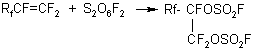
One may acquaint with these studies in reviews by A.V.Fokin and Yu.N.Studnev ( for example, Chem. Rev. 5, 47, 1984).
This report reviews briefly other specific reactions of fluoroolefins (tetrafluoroethylene,TFE, and hexafluoropropylene,HFP) with participation of PSF, they are syntheses of bifunctional fluoropolymers, tetrafluoroethylene oxide (TFEO) and hexafluoropropylene oxide (HFPO) as well as bifunctional perfluorooligoethers. These processes take place within a narrow range of PSF concentrations: from hundreth percents to several percents. In the range of higher PSF concentrations the reaction of addition to the double bond described above takes place.
In processes of TFE polymerization PSF acts as a highly efficient initiator of the process and as a regulator of the chain length. The reaction was carried out in a medium of inert solvents ( refrigerant-113, perfluorotrimethylamine, perfluorocyclobutane) at a temperature from -40oC to +20oC, at a PSF concentration in the solvent of 0.01-5% and TFE dilution with dry nitrogen at a ratio from 1:1 to 1:7. A PSF solution was charged into a reactor equipped with a stirrer, bubbler, cooling jacket, thermocouple and backflow condenser, the stirrer was then switched on, the reactor was cooled to the desired temperature and TFE diluted with dry nitrogen was charging slowly by the bubbler. Before charging the TFE was purified from the stabilizer.
he chain length control of carboxyl bifunctional perfluoropolymer was exercised by changing the ratio of the reagents, PSF concentration and temperature. The TFE conversion is determined by the contact time and stirring conditions. Formation of solid polymeric reaction products took place at all conditions but the careful choice of the process conditions resulted in the conversion over 90% at high level of the reaction selectivity.
So, at a temperature of –10oC - -20oC and the PSF concentration in R-113 of less 1% it is possible to synthesize  ,
, - bis (fluorosulfato) perfluoroalkanes with molecular weight up to 3800 preferably.
At a temperature of 5oC-20oC and the PSF concentration of 1-5% in R-113 or in R-318c the conversion reached 93% with formation of a products mixture of the following formula:
FSO2OCF2(CF2CF2)nCF2OSO2F
of the following content:
Polymer 5-6%
n=1 3-10%
n=2 76-85%
n=3,4 6-8% .
It is possible to organize the process with prevailing producing derivatives with n>3. Low-molecular products with n=1,2 were found convenient and effective solvents.
Earlier we studied and published in this journal the reaction of TFE polymerization with  ,
, –dibromoperfluoroalkanes ( dibromodifluoromethane, R12B2) and 1,2-dibromotetrafluoroethane (R-114B2) to produce long-chain ,- dibromoperfluoroalkanes with even and odd chain length. It has been found by the further investigations that the said reaction in the presence of PSF runs more smoothly, efficiently and allows producing the desired,-bis(fluorosulfato) perfluoroalkanes with high selectivity. The advantage of this process is the fact that it is possible to obtain the mentioned products both with even and with odd length of the carbon chain.
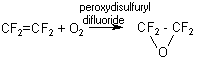
PSF was found a convenient reagent in catalytic methods of synthesis of TFEO and HFPO also. The oxidation process is carried out in the medium of R-113 and a temperature of 0oC-50oC as well. The use of PSF provides prevailing formation of the desired oxides ( up to 85%) with a negligible admixture of carbonylfluoride (~15%). The ratio of fluoroolefin/oxygen was from 1:1 to 1:9.
The reaction of TFE oxidation with oxygen in gas phase in the presence of PSF is very exothermic and various packings ( copper, nickel, bronze, iron) have not given the desired effect and only fluoroanhydride of trifluoroacetic acid and  ,
, -bis(fluorosulfato)perfluoroalkanes were isolated. A successful reaction was only in a medium of inert fluorocarbons with using packing of desintegrated PTFE. An increase in the temperature above 40oC results in an increase in the yield of carbonyl fluoride (above 40%) and at a temperature below 0oC there is an increase of the polymer amount ( above 30%) and peroxide chains are formed in it that makes the process explosive. The content of an “active” peroxide oxygen attains 0.7% that makes ~1 chain of the peroxide per 7-10 ether chains. The average molecular weight of the polymer is ~ 2100 units. TFE oxidation was carried out with molecular oxygen in a continuous reactor at atmospheric pressure in R-113. TFE was preliminarily purified from the stabilizer, oxygen was dried. PSF was charged in an argon flow.
Hexafluoropropylene oxide synthesis was carried out in the same reactor under similar conditions.
As it was noted above, a mixture of fluoropolymers is always formed in the reaction of oxidation of fluoroolefins with oxygen, therefore development of the method to synthesize co-polymers of TFE (or HFP) with oxygen as the desired products is of particular interest. The use of PSF as the initiator of this reaction allows obtaining unique products, i.e. perfluoropolygoethers with two end groups which are easily converted into appropriate fluoroanhydrides of perfluorooxaalkylendicarbonic acids.
Interaction of fluoroolefins with oxygen in the presence of PSF has been studied within a wide range of conditions: a temperature from -40oC to +50oC, the PSF concentration in inert solvents( R-113, R-318c, perfluoromethylamine) up to 2%, the ratio of TFE/O2 from 1:5 to 1:9 at various contact schemes and various contact times of the reagents. The reaction is very sensitive to changes in process parameters. As a result of the study there were found the conditions of synthesis of bifunctional perfluorooligoethers of the following formula:
FSO2CF2CF2O(CF2CF2O)n(O)k(CF2O)mCF2CF2OSO2F
To suppress the reaction of homopolymerization it is necessary to keep the ratio of TFE:O2 equal to or more than 1:8, this ratio influences much the ratio of coefficients m/n.
It is possible to control the process rate and the average molecular weight of perfluorooligoethers which attained 20000 units by changing the PSF concentration and temperature. A reduction in temperature from 20oC down to -10oC increases the molecular weight almost 1.5 times as much ( from 160 units to 2100 units) and a reduction in temperature from 15oC to -20oC resulted in an increase of m/n ratio from 3.5 to 18 , at the same time the content of peroxide chains reduces considerably ( from ~5% at 50oC to 0.5-0.7% at –20oC).
Another interesting direction is synthesis of fluoroanhydrides of perfluorooxaalkylendicarbonic acids from TFEO and oxalyl fluoride produced from TFE and PSF also according to the scheme:
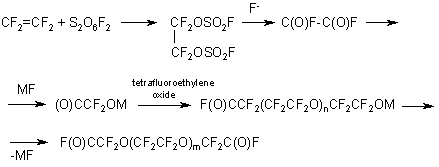
It is more technically convenient to use chlorofluoroacetyl fluoride instead of oxalyl fluoride according to the same scheme:
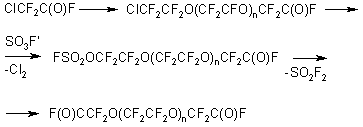
Producing chlorofluoroacetyl fluoride is similar to the synthesis of oxalyl fluoride:

The process was carried out in the following way: a suspension of calcined metal fluoride in a dehydrated aprotic solvent was charged into a reactor equipped with a stirrer and a back-flow condenser, an appropriate fluoroanhydride was then slowly bubbled at room temperature. After complete dissolution of MF the reactor was cooled to -20oC and TFEO of technical grade, preliminarily purified from carbonyl fluoride by passing it through solid alkali, was fed. After charging the calculated amount of TFEO the reaction mixture was heated at 150oC till pyrolysis stoppage and the mixture of fluoroanhydrides obtained was fractionated.
Such a process scheme allows to execute more directional synthesis of desired compounds with a desired chain length and in this case the synthesis is less sensitive to changes of the process parameters.
Bifunctional fluoropolymers were in particular used for producing appropriate salts of some metals which found application for modifying elastomers and lubricants.
TFEO and HFPO were used in different reactions including synthesis of perfluorooligoethers.
We think that fluoroanhydrides of perfluorooxaalkylendicarbonic acids are of the most interest among compounds obtained. They can be used as raw material for producing low-temperature chemically resistant elastomers, glues, sealants etc. as well as in the form of additives to oils and lubricants to improve parameters of their chemical resistance, physical and chemical properties and maintenance characteristics.
Fluorine Notes, 2002, 23, 3-4