The publication of the journal is supported by
SIA "P&M-Invest" Ltd and INEOS RAS
Volume # 4(11), July - August 2000 — "Trimethyl(trifluoromethyl)silane, Ruppert's reagent (TMTFMS) "

Fluorine Notes, 2000, 11, 3-4

Trimethyl(trifluoromethyl)silane, Ruppert’s reagent (TMTFMS)

T.E. Fiodorova

TMTFMS is a colorless volatile liquid with b.p.52-54oC at 10 torr (1), according to other sources of information b.p.= 54-55oC(2), 53oC (3), 45oC (4), it is stable for some weeks (5).

Introduction of fluorine into organic molecules as a measure to modify their chemical and biological properties is a known method used especially wide in pharmachemistry, agrochemistry and polymer chemistry. A possibility to introduce a fluorine-containing group as a single whole to a desired position is a particularly attractive way. TMTFMS is one of reagents providing introduction of the trifluoromethyl group.

TMTFMS became known in 1984 by Ruppert’s report (4) and caused interest as a reagent for nucleophilic trifluoromethylation under mild conditions of a number of compounds having an electrophilic functional group, a carbonyl one in particular.

A preparative method described by Ruppert to produce TMTFMS with use of expensive toxic compounds confined investigations with the use of that reagent. But already from the late 80-s prospecting work on development of process engineering began (6,1,3,7,8,9,10,11) and already in the middle 90-s a number of publications devoted to the synthesis of TMTFMS and investigations of reactions with its use dramatically increased. Approximately at that time the reagent was put up for sale, anyway the authors of publications (12,13,14) used in their work commercial TMTFMS including that supplied by Apollo Scientific Ltd.(14). Methods to produce TMTFMS, its reactions with compounds of different classes examined in detail and analyzed in review (2). However in connection with a great number of publications it is of interest to trace the development of investigations in this area even for a small period of time (since 1997 till the first half of 1999).

Nucleophilic trifluoromethylation with the use of TMTFMS is carried out in a solvent and is induced by fluoride ions. The choice of the compound, a donor of the fluoride ion and a reaction environment, has a determinant significance in every particular synthesis.

Thus, search for a system for carrying out nucleophilic aromatic substitution has shown that nitro and cyano groups may be replaced with the CF3- groups though in low yields when a system of TMTFMS/KF/dimethylacetamide is used (14). A melt CsF-CsOH-CsCl (1:1:1), CsF-CsCl-(1:1), CsF-CsOH-(10:1 –1.3:1 and 1:1) was suggested as a source of fluoride ion. The interaction of TMTFMS with paramethoxyphenylketone in the presence of CsF-CsOH (1:1) at 0oC gave a trifluoromethylated derivative in 86% yield (15).

A number of publications contain information about pharmaceutical chemicals including compounds synthesized with the use of TMTFMS as follows:

  • Polycyclic compounds of the net structure in antineoplastic remedies and makeup prepartions (16)
  • Derivatives of oxazolidine-2-one in medications for removal of depressions and phobias, for medical treatment of Parkinson’s and Alzheimer’s diseases (17).
  • Derivatives of piridine-2(1H)-one as an inhibitor of acetylcholinesterase for medical treatment of Alzheimer’s disease (18)
  • CF3-containing artemisin of high antimalarial activity (19)
  • Polymethylvinylketene with the CF3- groups as an adsorbent undestroying human albumin (20)
  • Heterocyclic substituted acylanilides in preparations with mixed androgenous and gestagenous activity (21)
  • Derivatives of benzoxizine-2-ones as inhibitors of transcriptase (22).

At that time a research on bioactivity of trifluoromehylated compounds was carried and syntheses leading to the goal products by direct trifluoromethylation were developed:

  • there was studied influence of arrangements of the CF3 group at C-3, C-4, C-5 positions on anticonvulsive/convulsive activity of γ-butyrolactones and γ-thiobutyrolactones (23)
  • α-hydroxy-α-trifluoromethylamides possessing structural analogy with some antiandrogens having anticancerogenic activity were produced by direct trifluoromethylation of α-ketoamides in the presence of tetrabutylammonium fluoride in tetrahydrofurane environment at room temperature. The process proceeds without formation of by-products in 91-96% yield (24).
  • Trifluoromethylsilane ethers , the raw materials for making trifluoromethylamides, were produced from the starting ketones and TMTFMS (25)

For the period under review, new methods to produce a number of compounds including unknown earlier have been developed.

1. With the purpose to produce difluoroenoxysilanes used in synthesis of hem-difluorocompounds, a method including condensation of TMTFMS with unfluorinated acylsilane in a medium of methylene chloride at activation with fluoride-ion ( tetrabutylammonium difluorotriphenylstannate as the donor of fluoride-ion) was developed. Subsequent interaction with enole in the same reactor results in the formation of difluoro-1,5-diketones. Series of 2,2-difluoro-1,5-diketones were produced , for example 2,2-difluoro-1,5-phenylhexane-1,5-dione. So, in that reaction TMTFMS is the source of difluoromethylene groups (26).

2. Ketoesters interact with TMTFMS in tetrahydrofurane in the presence of (C4H9)4NF*3H2O with formation of α-alkoxy-α-trifluoromethylarylacetic acid and its esters. Methyl-α-methoxy-α-trifluoromethylphenylacetate was produced in 90% yield (27).

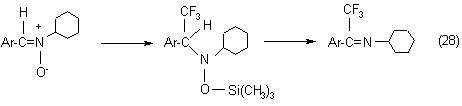
3. To obtain trifluoromethylamines and their derivatives being blocks for making new structures, a method of TMTFMS addition to the C=N bond of nitrons is under development:


4. Different trifluoromethylketones (TFMK) were synthesized:

  • by conversion of methyl ethers including those in enole form (29)
  • peptide and nonpeptide TFMK were obtained by conversion of α -N-substituted aminoacids to oxazolidine-5-ones with their subsequent treatment with TMTFMS (5,30) The process was carried out in tetrahydrofurane in argon atmosphere with initiation with CsF (5). Peptide trifluoromethylketones being inhibitors of proteolytic enzymes-proteases (pepsin, trypsin, carboxypeptidase etc) were used in detergent compositions (31,32,33).

5. Active investigations of synthesis of important bioactive compounds with high-lipophilic CF3S-substituent led to the development of a method of direct addition of the CF3 group to sulfur (selenium) in sulfur-containing (selenium-containing) compounds of the general formula RYCN, where Y=S, Se; R=C6H5, N=n-C8H17, etc. The reaction was carried out in tetrahydrofurane in the presence of 0.2 equiv of tetrabutylammonium fluoride at 0oC, then at room temperature. The yield was 70-87% depending on Y and R (13).

6. By interaction of Bi(CF3)3, TMTFMS and tetramethylammonium fluoride, a new effective reagent of trifluoromethylation, tetrakis(trifluoromethyl)bismuthate was produced which was a solid substance, stable in dry nitrogen at room temperature for some days (34).

7. TMTFMS is used in reactions of asymmetric trifluoromethylation conducting in the presence of chiral Lewis base (35,36), a high enantiomer excess was provided with a large quantity of TMTFMS. High stereoselectivity was observed in trifluoromethylation of aminoketones with a side chain, in this case there was no need in promoters (37).Acylfluorides of N-tritylaminoacids reacting with TMTFMS and NaBH4 form an intermediate product which allows to obtain enantiomer-pure tritylamino alcohols, alkenes, trifluoromethylketones (38). The synthesis of trifluoroalkylcarbohydrates was carried out in anhydrous dichloromethane in the presence of tetrabutylammoniumdifluorotriphenylstannate. Complete stereoselectivity was observed for derivatives of 3-oxo-glucose (39).

A reaction of tetramethylammonium fluoride with TMTFMS was investigated (40). TMTFMS is used in technique both as an independent compound and for production of compounds incoming into different compositions:

  • TMTFMS is used as a process gas for plasma-enriched deposition to produce moisture-proof dielectric fluorocarbon-containing film based on silicon (41,42,43)
  • Optically derivatives of alkylcyclohexane (44,45,46) produced with TMTFMS are used in compositions of liquid crystals for displays.

As regards publications about methods to produce TMTFMS, two publications (10,11) relate to electrochemical reduction of fluorohalocarbons in the presence of trimethylsilane reviewed in detail in (2).

Conclusions

Investigations of different level of development are now under way including production of new compounds (13,26,27,28,34), optimization of synthesis conditions of known compounds (14,15,24,25), creation of compositions including compounds produced with TMTFMS for technical (31,32,33,41,45,46) and medicine (16,17,18,19,20,21,22) purposes, for the latter trifluoro-containing ketones are of a particular interest because they are able to inhibit proteases. The mentioned investigations are carried out in many countries including the USA, Germany, Russia, Japan and other countries.

References

  1. G.P. Stahnly, D.R. Bell, J. Org. Chem., 1989, v.54, N 12, p. 2873
  2. G.K.S. Prakash, A.K. Yudin, Chemical Reviews, 1997, v.97, N 3, p. 757-786
  3. G.K.S. Prakash, D. Deffieux, A.K. Yudin, G.A. Olah, Synlett, 1994, N 12, p. 1057-8
  4. I. Ruppert, K. Schlich, W. Volbach, Tetrahedron Lett., 1984, v.25, N 21, p. 2195-8
  5. R.M. Adlington, J. E. Baldwin, C. J. Shofield, J. Org. Chem., 1998, v. 63, N. 15, p. 5179-92
  6. G.K.S. Prakash, R. Krishnamurti, G.A. Olah, JACS, 1989, v. 111, N 1, p. 393-5
  7. I. Grobe, I. Heyge, Synlett, 1995, N 6, p. 641-2
  8. F. Aymard, J-Y. Nedelec, J. Perichon, Tetrahedron Lett., 1994, v.35, N 46, p. 8623-4
  9. K. Kawada, K. Kato, K. Murakami, JP Appl. 94 340675, CO7 F7/12, 1991/94, Efutetsuku K.K.
  10. B.I. Martynov, A.A. Stepanov, J. Fluor.Chem.,1997, v.85, N 2, p. 127-28, CA, 1997, V.127, 331526
  11. B.I. Martynov, A.A. Stepanov, Novel Trends Electroorg. Synth., [Pap Int. Symp.] 3rd , 1997, 299-300, CA, 1998, v.129, 245194
  12. T. Billard, B.R. Langlois, Tetrahedron Lett., 1996, v.37, N 38, p. 6865
  13. T. Billard, S. Large, B.R. Langlois, Tetrahedron Lett., 1997, v. 38, N 1, p. 65-68
  14. D.J. Adams, J. H. Clark, L.B.Hansen and others, J. Chem. Soc., Perkin Trans I, 1998, v.18, p. 3081
  15. J. Busch-Peterson, Y. Bo and others, Tetrahedron Lett., 1999, v.40, N 11, p. 2065
  16. B. Leblond, F. Darro and others, WO Appl. 9726237, CO7C 63/66, 1996/97, Centre Europeen de Bioprospective- Ceb., CA, 1997, v.127, 176578
  17. S. Jedham, F. Puech, P. Burnier, WO Appl. 9717347, CO7D 413/04, 1995/97, Synthelabo S.A., CA, 1997, v.127, 34207
  18. A. Terajima, S. Kaneko, N. Nakajima and others, JP Appl 9795483, CO7D 221/22, 1995/97, CA, 1997, v.127, 17597
  19. A. Abouabdellah, D. Bonnet-Delpon and others, Bioorg.-Med. Chem. Lett., 1996, v.6, N 22, 2717-20, CA, 1997, v.126, 75081
  20. F.Lohr, M. Brell, H. Motschmann, EP Appl. 881266, 1997/98, Hals AG, CA, 1999, v.130, 39863
  21. M. Lehmann, K. Scholkopf, P. Strehlke and others WO Appl 9854159, 1997/98, Schering AG, CA, 1999, v.130, 52321
  22. D.D Christ, A.J. Cocuzza, S.S. Ko and others, US Patent 5874430, 1997/99, CA, v.130, 196659
  23. D.J. Canney, H.-F. Lu and others, Bioorg. Med. Chem., 1998, v.6, N 1, 43-55, CA, 1998, v.128, 225695
  24. R.P. Singh, R.L. Kirchmeier, J.M. Shreeve, J.Org. Chem., 1999, v. 64, N 7, p. 2579
  25. E.C. Tongco, G.K.S. Prakash, G.A. Olah, Synlett, 1997, N. 10, p. 1193-95, CA, 1998, v.128, 22517
  26. T. Brigand, C. Portella, Tetrahedron, 1998, v. 54, N 22, p. 5939-5948
  27. N. Lui, A. Morhold, DE Appl. 19643592, CO7C 69/734, 1996/98, CA, 1998, v.128, 308307
  28. D.W. Nelson, R.A. Easley, B.N.V. Pintea, Tetrahedron Lett., 1999, v.40, N 1, 25-28
  29. J. Wiedemann, T. Heiner, G. K.S. Prakash and others Angewandte Chemie Ind. Ed., 1998, v.37, N 6, s. 870-21, CA, 1998, v.129, 4265
  30. C.J. Schofield, M.W. Magnus, R.M. Adlington, J. E. Baldwin and others, WO Appl 9719681, 1995/97, Isis Innovation Ltd., CA, 1997, v. 127, 95610
  31. J. M. McIver, A.C. Huber, K.L. Mc Kellop, WO Appl. 9813458, 1996/98, Procter & Gamble Co., CA, 1998, v.128, 245500
  32. Mc Kellop, A.C. Huber, J. M. McIver , WO Appl. 9813460, 1996/98, Procter & Gamble Co., CA, 1998, v.128, 245501
  33. J. M. McIver, A.C. Huber, C.W. Saunders, L.A. Smith, WO Appl. 9813461, 1996/98, Procter & Gamble Co., CA, 1998, v.128, 258732
  34. W. Tyrra, D. Naumann, N.V. Kirij, A.A. Kolomeitsev, Y.L. Yagupolskii, J. Chem. Soc., Dalton Trans., 1999, N 5, p. 657-58
  35. T. Hagivara, T. Kobayashi, T. Fuchikami, Nippon Kagaky Kaishi, 1997, N 12, 869-75, CA, 1998, v.128, 22672
  36. T. Hagivara, T. Kobayashi, T. Fuchikami, Main Group Chem., 1997, v. 2, N 1, p. 13-15, CA, 1997, v. 127, 205308
  37. T. Hagivara, H. Mochizuki, T. Fuchikami, Synlett., 1997, N 5, 587-88, CA, 1999, v.130, 81191
  38. G. Korygiannis, C. Athanassopoulos, P. Matos and others, Acta Chem. Scand., 1998, v.52, N 9, 1144-1150, CA, 1998, v. 129, 290399
  39. S. Lavaire, R. Plantier-Royon, C. Portella, Tetrahedron' Asymmetry, 1998, v.9, N 2, p.213
  40. D.J. Adams, J.H. Clark, L.B.Hansen and others, J. Fluor. Chem., 1998, v.92, N 2, p.123, CA, 1999, v.130, 153709
  41. S. Fukuyama, J. Yamaguchi and others, JP Appl. 96321499, 1995/96, Fujitsu Ltd., CA, 1997, v.126, 125732
  42. S. Yamaguchi, S. Fukuyama, Y. Nakada, S. Katayama, JP Appl. 98284479, 1997/98, CA, 1998, v.129, 349874
  43. J. Yamaguchi, S. Fukuyama, S. Katayama, Y. Nakada, JP Appl. 99111712, 1997/99, Fujitsu Ltd., CA, 1999, v.130, 290197
  44. T. Ishizuka, M. Takeda and others, JP Appl. 97221438, 1996/97, Petroleum Energy Center, Kashima Oil Co Ltd., CA, 1997, v.127, 247861
  45. K. Miyazawa, H. Yano, JP Appl. 98236989, 1997/98, Chisso Corp
  46. T. Ishizuka, M.Takeda, S. Nayuki, JP Appl. 98120609, 1996/98 , Petroleum Energy Center, Kashima Oil Co Ltd., CA, 1998, v.129, 10764

Fluorine Notes, 2000, 11, 3-4

© 1998-2026 Fluorine Notes. All Rights Reserved.