Fluorine Notes, 2000, 11, 7-8
Use of perfluoroacylfluorides for the synthesis of perfluoroalkylvinyl ethers. Part III.Dependence of frost-resistance of fluoropolymers on the structure of vinyl ethers of general formula CF3O(CF2CF2O)mCF=CF2 and CF3O(CF2O)nCF2CF2OCF=CF2A.E.Ershov, L.M.PopovaAt present an increase in frost-resistance have been remained one of primary tasks of fluoropolymer chemistry [1,2]. Introduction of oxygen atoms into fluoropolymers allow to reduce significantly the glass transition temperature of these thermally stable and chemically inert compounds [3-5]. The oxygen introduction into the main chain of fluoropolymers is known to obtain perfluoropolyether oils able to work under cryogenic conditions. Good low-temperature properties of such polymers are explained by weak intermolecular interaction and an increase in mobility of individual chain links of macromolecules due to a low energy barrier of rotation around the CF2-O- bonds [3]. The glass-transition temperature of a polymer is also influenced by the size, polarity and mobility of side groups [2,6]. In this connection, perfluorinated vinyl ethers take on special significance because their copolymerization with other fluoroolefins may result in high-molecular , able to be vulcanized copolymers with oxygen-containing side groups of different length. As a result of investigations, samples of copolymers with vinylidene fluoride with a glass-transition temperature to 105oC were produced on the basis of synthesized vinyl ethers (VE) of general formula CF3O(CF2CF2O)mCF=CF2 (I) [7] and CF3O(CF2O)nCF2CF2OCF=CF2 (II) [8] . Copolymers of vinylidene fluoride with VE I and II differ in the length of side chains and in the ratio of oxygen and carbon atoms in these chains. In copolymers C-II of the general formula
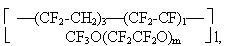
obtained on the basis of VE II, abundance of the oxygen atoms in the side chains at the equal length of these chains is always greater than in copolymers C-I of the general formula
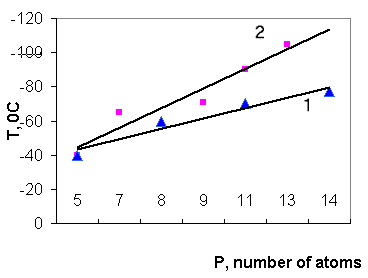
obtained on the basis of VE I. Moreover, the growth of the length of the side chains of copolymer C-II is followed by an increase in the ratio of oxygen/carbon while the growth of the length of the side chains of copolymer C-! is followed by a decrease ( though not very significant) of this ratio ( table and Fig.1) Table. Dependence of the glass transition temperatures of copolymers C-I and C-II on the length of the side chains and on the ratio of oxygen/carbon
P** is the total number of oxygen and carbon atoms in the side chains. The table and Figure show total influence of the two factors: the length of the side chains and the ratio of oxygen/carbon atoms on the glass-transition temperature of the copolymers.
Fig.1 Dependence of the glass-transition temperature of copolymers C-I and C-II on the length of the side chains. P is the total number of oxygen and carbon atoms in the side chains of the copolymers: 1-copolymer C-I; 2-copolymer C-II. The results presented in the table and figure show that the growth of the length of the side chains leads to the decrease in the glass-transition temperature of the copolymers produced, and a more drastic decrease in the glass-transition temperature is typical of the polymers containing difluoromethyleneoxide chain links according to the great value of the ratio of oxygen/carbon atoms in them. When the P value is about 14, the glass transition temperature of the copolymer containing tetrafluoroethyleneoxide groups is close to the minimal possible one while a further increase in the length of the side chains containing difluoromethylene oxide links may result in a decrease in the glass-transition temperature of the copolymers. Nevertheless, copolymers C-I should find application at temperatures above 80oC obviously the same as copolymers C-II because tetrafluoroethylene, which is a raw material for the synthesis of VE I, is the most available and cheapest fluoroolefin. Thus, the synthesis of two series I and II of perfluoroalkylvinyl ethers has allowed to evaluate combined influence of the length of the side chains and abundance of the oxygen atoms in these chains on the glass-transition temperature of the copolymers with vinylidene fluoride. References 2. Sokolov S.V.‚ Kagaya E.G.‚ Ivanova T.L. ZhVKhO im.D.I..Mendeleeva. 1974. T. 19, N 6. S. 650-660. 3. Yarosh A.A., Askadskij A.A., Krukovskij S.P.‚ Dashevskij V.G.‚ Slonimskij G.L.‚ Ponomarenko B.A., Vysokomolekul. coedin. 1974. T. 16, N 3. C. 527. 4. DonatoА., Lensi M., Wele A., J. Macromol. Sci.-Chem. 1967. V. 1, N 3. P. 429-438. 5. Eleuterio H.S., J. Macromol. Sci.-Chem. 1972.V. 6, N 6. P. 1027-1052. 6. Batgerd T.‚ Greger D.U., Svojstva privityh i blokpolimerov.M:Khimiya. 1970. 178 c. 7. A.E. Ershov, L.M. Popova. Fluorine notes, 2000, N 2. 8. A.E. Ershov. L.M. Popova. Fluorine notes. 2000, N 3. |
||||||||||||||||||||||||||||||||||||

Fluorine Notes, 2000, 11, 7-8